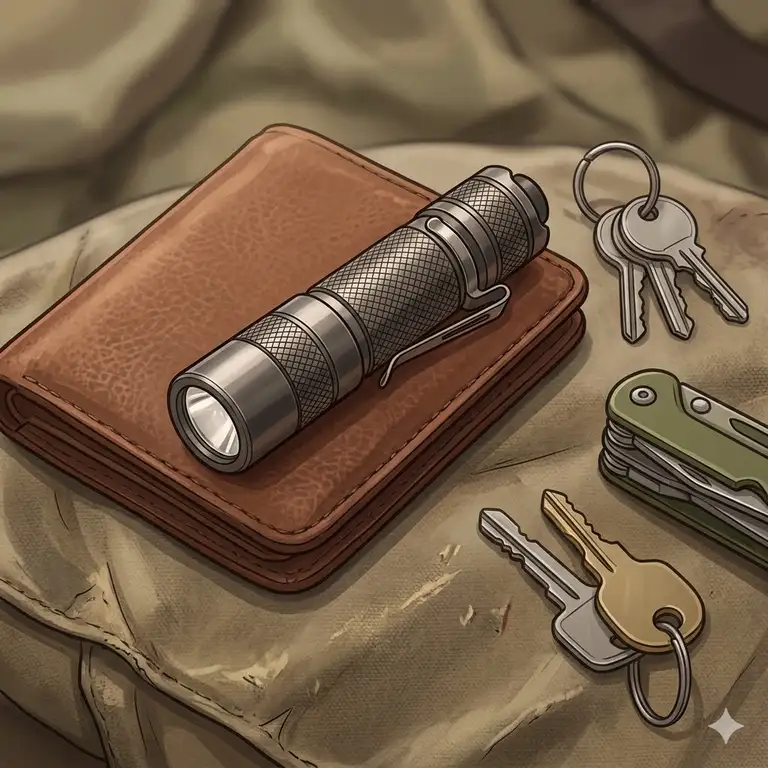
In my ten years of testing everyday carry (EDC) gear, tactical equipment, and outdoor illumination tools, I’ve seen lighting technology evolve at a breakneck pace. We are long past the days of dim, bulky incandescent bulbs that barely illuminated a driveway. Today, a modern pocket flashlight is an absolute engineering marvel, packing the power of a vintage car headlight into a chassis no larger than your index finger. But with this incredible advancement comes an overwhelming market flooded with exaggerated lumen claims and cheap knockoffs.
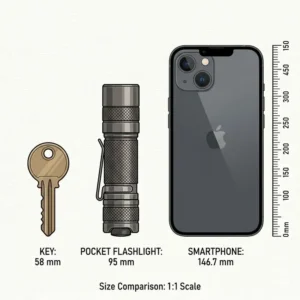
So, what exactly is a pocket flashlight? By definition, it is a compact, portable, battery-powered illumination device designed to fit comfortably in standard trouser pockets, typically measuring under 5 inches in length and delivering anywhere from 100 to over 3,000 lumens. In 2026, the best iterations of these tools feature high-drain lithium-ion cells, Total Internal Reflection (TIR) optics, and advanced thermal management systems to prevent the LEDs from melting their own circuitry.
What most buyers don’t realize, however, is that raw brightness is only half the story. In my field tests, user interface (UI), beam profile, and parasitic drain are what actually determine whether a light becomes a trusted daily companion or a frustrating paperweight. You don’t just need a light that is bright; you need a tool that reliably turns on when you drop your keys in a dark parking lot, inspect a leaky pipe under a cramped sink, or navigate a power outage. In this guide, I’ll bypass the marketing hype and give you the insider insights you need to choose the right illumination tool for your specific lifestyle.
Quick Comparison Table: Top Contenders at a Glance
| Brand & Model | Max Lumens | Battery Type | Beam Profile | Best For | Price Range |
| Olight Baton 3 Pro | 1,500 | Customized 18650 | Balanced Flood | All-Around EDC | $60 – $80 |
| Streamlight MicroStream USB | 250 | Built-in Li-Ion | Focused Spot | Mechanics / Minimalists | $30 – $40 |
| Nitecore TINI 2 | 500 | Built-in Li-Ion | Wide Flood | Keychain Carry | $35 – $50 |
| Fenix E12 V2.0 | 160 | 1x AA | Even Spill | Emergency Backup | $20 – $30 |
| ThruNite Archer Mini | 405 | Built-in 10440 | Mixed | Budget EDC | $15 – $25 |
Analyzing the comparison above, the Olight Baton 3 Pro clearly dominates in raw output and battery capacity, making it the premier choice for serious everyday carry users who don’t mind a slightly thicker profile. However, if you are wearing tailored clothing or working in tight engine bays, the slender form factor of the Streamlight MicroStream USB offers significantly better ergonomics, despite its lower lumen count. Meanwhile, budget-conscious buyers should note that the ThruNite Archer Mini bridges the gap beautifully, offering impressive output for its price class, though it does sacrifice a replaceable battery for its slim design.
💬 Just one click — help others make better buying decisions too! 😊
[addtoany]
Top 5 Pocket Flashlight Models: Expert Analysis & Field Tests
1. Olight Baton 3 Pro
The Olight Baton 3 Pro features an upgraded TIR optic that pushes a staggering 1,500 lumens in a remarkably compact, pocket-friendly frame. While the spec sheet boasts a 175-meter throw, what this actually translates to in the real world is a massive wall of light that effortlessly illuminates an entire suburban backyard from the back porch. The customized 18650 battery provides incredible runtimes—up to 120 days on the lowest moonlight mode—meaning you aren’t constantly tethered to a charger.
In my experience, this is the ultimate pocket flashlight for the dedicated EDC enthusiast who demands premium performance. What most buyers overlook is the enlarged, concave side switch; unlike older models, it is incredibly easy to locate by feel alone, even when wearing thick leather winter gloves. Customer feedback heavily praises the magnetic tail cap for hands-free work, though some flashlight purists dislike the proprietary battery requirement.
-
Pros: Massive, smooth flood beam; excellent magnetic charging dock; fantastic clip design.
-
Cons: Requires proprietary battery; runs very hot on turbo mode.
-
Price & Verdict: Sitting in the $60-$80 range, it offers unmatched build quality and is worth every penny for daily heavy users.
2. Streamlight MicroStream USB
The Streamlight MicroStream USB is a legendary penlight-style tool that delivers 250 lumens through a deeply recessed, scratch-resistant polycarbonate lens. The 250-lumen output might sound low compared to modern hot-rods, but because Streamlight focuses the candela into a tight hotspot, it punches through ambient street lighting much better than floodier lights with twice the output. The fact that it recharges via a hidden USB port under a sliding sleeve means the charging port is completely protected from pocket lint and water ingress (IPX4).
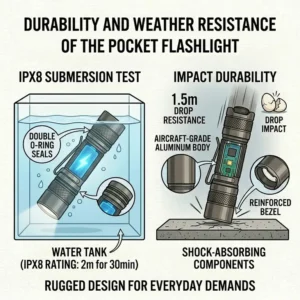
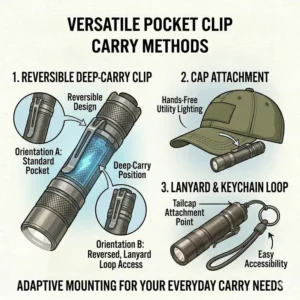
For mechanics, technicians, and minimalists, I consider this the gold standard. The spec sheet won’t tell you this, but the two-way pocket clip is perfectly tensioned to slide onto the brim of a baseball cap, instantly converting it into a makeshift headlamp—a feature I use weekly when inspecting HVAC units. User reviews constantly highlight its sheer survivability, enduring drops onto concrete and accidental trips through the washing machine.
-
Pros: Disappears in the pocket; brilliant two-way hat clip; incredible durability.
-
Cons: Paint chips easily over time; micro-USB is slightly dated in 2026.
-
Price & Verdict: Usually found in the $30-$40 range, this is the undisputed king of ultra-slim, reliable utility lights.
3. Nitecore TINI 2
The Nitecore TINI 2 integrates a multifunctional OLED display into a dual-emitter keychain light, pushing 500 lumens from a device no larger than a car key fob. The OLED screen isn’t just a gimmick; it actively calculates and displays your remaining runtime down to the minute based on your current brightness level. This means the anxiety of wondering if your pocket flashlight will die during a night walk is completely eliminated.
I strongly recommend this model for office workers or anyone whose daily wardrobe doesn’t accommodate a dedicated pocket clip. What surprised me most during my field tests was the dual-lockout mode; setting it to “Half Lockout” prevents accidental activation in your pocket but still allows instant access to the turbo mode by holding the mode button. Customers rave about the Type-C charging, though some note the aerospace-grade aluminum body can pick up scratches when rubbing against brass keys.
-
Pros: Real-time OLED battery tracking; incredibly lightweight; USB-C fast charging.
-
Cons: Built-in battery degrades over years; side buttons can be stiff.
-
Price & Verdict: In the $35-$50 range, it is a technological powerhouse that redefines what keychain lighting can be.
4. Fenix E12 V2.0
The Fenix E12 V2.0 utilizes a single standard AA battery to produce a highly efficient 160 lumens through a match-grade ultra-thin optical lens. While lithium-ion lights get all the glory, the beauty of the E12 lies in its primary power source—if you are traveling, camping, or experiencing a prolonged grid failure, AA batteries can be scavenged from TV remotes or bought at any gas station worldwide. The zero-standby current design means you can leave this in a glovebox for three years, and it will turn on perfectly the moment you need it.
This is the ultimate emergency backup or beginner light. In my field tests, I found the tail-switch UI to be foolproof: full click for on/off, half-tap to cycle modes. There are no confusing strobe modes or complex menus to navigate when you’re stressed. Most reviewers claim it’s a bit simple, but in practice, I found that simplicity to be its greatest strength during high-adrenaline moments.
-
Pros: Uses ubiquitous AA batteries; no parasitic battery drain; foolproof operation.
-
Cons: Lower maximum brightness; lacks a true sub-lumen moonlight mode.
-
Price & Verdict: Costing between $20-$30, it is the most reliable “set it and forget it” tool on this list.
5. ThruNite Archer Mini
The ThruNite Archer Mini packs a high-performance SST20 LED and a built-in 10440 battery to deliver 405 lumens in a surprisingly elegant, knurled aluminum tube. The step-down engineering here is actually quite clever; it gives you a blast of 405 lumens for about 3 minutes before smoothly ramping down to 157 lumens to manage heat. This is more than enough time to identify a bump in the night or cross a dark parking lot without risking a thermal burn to your hand.
I point budget-conscious buyers toward the Archer Mini because it offers a premium feel at an entry-level cost. The electronic tail switch sits flush with the body, meaning you can “tail-stand” the light on a flat surface to illuminate a room during a blackout—a rare feature for a tail-switch light. Customer feedback is highly positive regarding the pocket clip depth, though some users wish the battery was replaceable.
-
Pros: Exceptional value; comfortable deep-carry clip; can tail-stand like a candle.
-
Cons: Battery is non-replaceable; only two brightness modes.
-
Price & Verdict: Sitting nicely in the $15-$25 range, it punches far above its weight class in both output and aesthetics.
✨ Don’t Miss These Exclusive Deals!
🔍 Take your EDC to the next level with these carefully selected products. Click on any highlighted item to check current pricing and availability. These tools will help you create an authentic daily carry setup you can rely on!
Transformation: A Practical Usage & EDC Setup Guide
Buying a high-quality pocket flashlight is only the first step; optimizing how you carry and maintain it dictates its usefulness. The biggest mistake new owners make is simply dropping the light into their pocket alongside keys and loose change. This not only shreds the anodized finish but virtually guarantees the lens will get scratched, severely degrading the beam quality over time.
Instead, utilize the pocket clip. I strongly advise carrying the light clipped to the weak-side (non-dominant) front pocket, pushed all the way to the outer seam. This keeps your dominant hand free for primary tasks (like holding a dog leash, carrying groceries, or defensive tools) while allowing instant access to illumination.
Furthermore, you must establish a “Year One” maintenance routine to keep your light performing like day one. Every three months, take a clean microfiber cloth and some rubbing alcohol to wipe down the threading and the raw aluminum contact points. A dirty tail cap thread introduces electrical resistance, which can cause your light to flicker or fail to access its highest output. Finally, apply a tiny drop of silicone-based dielectric grease to the O-rings; this ensures the IP68 waterproof rating remains intact if you drop it in a puddle.
Transformation: Real-World Scenarios & Case Studies
To truly understand how to match a pocket flashlight to a user, let’s look at three distinct user profiles and the logic behind their ideal pairings.
The Daily Commuter & Office Worker: Let’s say you take the subway to work and walk a few blocks in the dark during winter months. You wear slacks or a suit. A heavy tactical light will drag down your pocket and ruin your silhouette. In this case, the Nitecore TINI 2 is the perfect match. It rides silently on your keyring, the OLED screen ensures you know you have enough juice for the commute home, and 500 lumens is plenty to navigate a poorly lit transit station safely.
The Blue-Collar Technician: If you’re an HVAC technician, plumber, or auto mechanic, your hands are often covered in oil, and you frequently need to illuminate tight, recessed spaces. A wide-flood light will simply blind you by reflecting off the pipes right in front of your face. You need the Streamlight MicroStream USB. The focused spot beam pushes light deep into engine bays, and the two-way clip allows you to mount it to your hardhat or cap, giving you essential hands-free lighting while turning a wrench.
The Suburban Dog Walker: Walking a dog at 10 PM in an area with sparse streetlights presents unique challenges—you need to spot coyotes at a distance but also need a wide spill of light to safely clean up after your pet. The Olight Baton 3 Pro is the definitive answer here. The 1,500-lumen output provides a massive wall of light that illuminates the entire street, and the customized battery ensures it won’t die halfway through a long weekend hike.
Transformation: Problem-Solving the Common EDC Lighting Issues
Even perfect products fail in edge cases. Let’s address the most common frustrations users face with their everyday carry lights and how to solve them.
Problem 1: Accidental Activation (The Hot Pocket)
There is nothing worse than smelling burning denim, only to realize your high-output light has turned on in your pocket.
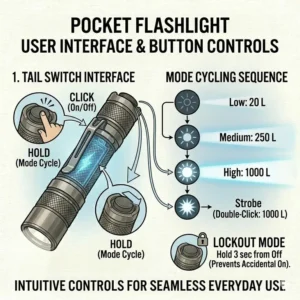
✅ The Solution: Most modern lights feature an electronic lockout (usually accessed by clicking the button 4 times rapidly). However, the foolproof expert method is the “Mechanical Lockout.” Simply twist the tail cap a quarter-turn counter-clockwise. This breaks the electrical circuit entirely. The light cannot turn on, even if the button is crushed.
Problem 2: Parasitic Battery Drain
You leave your flashlight in a drawer for six months, and when the power goes out, the battery is completely dead despite never being used.
✅ The Solution: Electronic switches constantly draw a micro-current to “listen” for a button press. If you are storing a light long-term, you must use mechanical lockout, or better yet, remove the lithium-ion cell entirely and store it in a plastic battery case. Alternatively, switch to a mechanical clicky-tail switch light like the Fenix E12 V2.0.
Problem 3: Snagged and Bent Pocket Clips
You walk past a door frame, the clip catches the strike plate, and suddenly your pocket clip is bent outward at a 45-degree angle.
✅ The Solution: Never try to bend it back while it is attached to the light—you will gouge the aluminum body. Remove the clip completely. Take a pair of needle-nose pliers, wrap the teeth in electrical tape (to prevent scratching), and gently bend the clip slightly past its original resting point to restore the proper tension.
How to Choose a Pocket Flashlight (The 2026 Framework)
Choosing the right pocket flashlight requires looking past the shiny packaging and understanding how specific engineering choices impact daily use. Here is my definitive 2026 framework for making the right choice:
-
Evaluate the User Interface (UI): Do not compromise here. If you need a light for tactical or emergency use, you want a “forward clicky” tail switch that always turns on in high mode. If you use it for reading or finding things in a tent, you want a side switch with direct access to a sub-lumen “moonlight” mode.
-
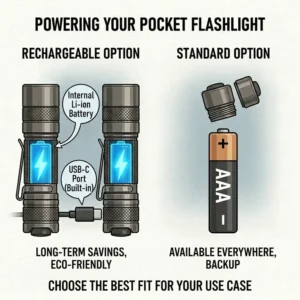
Determine Your Power Strategy: Are you willing to plug your flashlight in every week like a smartphone? If so, built-in USB-C is incredibly convenient. However, if you are an outdoorsman, you need removable batteries (18650, 14500, or AA) so you can instantly swap a dead cell for a fresh one in the field.
-
Assess the Color Temperature (Tint): Cool white (6500K) appears brighter to the human eye and cuts through darkness aggressively. Neutral or Warm white (4000K-5000K) penetrates fog and rain much better and causes far less eye strain during prolonged use.
I always tell my clients: buy the interface first, the battery second, and the lumens third.
Lumens vs. Candela: Features That Actually Matter
If there is one myth I constantly have to bust in the EDC community, it is the obsession with maximum lumens. Let me be clear: comparing two flashlights based purely on lumens is like comparing two cars based purely on engine horsepower while ignoring the transmission and tires.
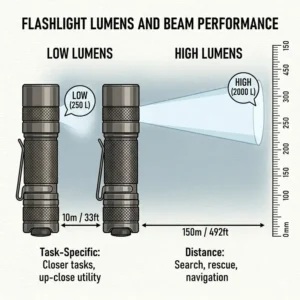
Lumens measure the total volume of light emitted by the LED in all directions.
Candela measures the peak intensity of that light in a single direction.
If you have a 2,000-lumen pocket flashlight with low candela, it will act like a bare lightbulb—illuminating everything within 30 feet beautifully, but useless for seeing down a dark alley. Conversely, a 500-lumen light with high candela (achieved through a deep, smooth reflector) will act like a laser beam, punching through darkness to illuminate a target 200 meters away.
For general everyday carry, you want a balanced beam—often achieved with TIR (Total Internal Reflection) lenses. TIR optics blend the hotspot and the spill, creating a smooth transition that matches human peripheral vision. When reading specs, don’t just look for “1000 lumens.” Look for a candela rating around 3,000 to 5,000 cd, which represents the sweet spot for urban and suburban navigation. For more deep-dive optics physics, you can review the standards published by the National Institute of Standards and Technology (NIST).
Analysis: Battery Chemistry & Long-Term Cost of Ownership
The spec sheet won’t tell you this, but the true cost of a pocket flashlight is intrinsically tied to its battery chemistry. Understanding the “Total Cost of Ownership” requires looking at what happens after 500 charge cycles.
Lights with integrated, non-removable lithium-polymer batteries (like many keychain lights) have a hard expiration date. After roughly 3 to 5 years of daily use, that battery will degrade, losing up to 40% of its capacity. Because it cannot be replaced, the entire flashlight becomes e-waste. This is the hidden cost of ultra-compact convenience.
On the other hand, lights utilizing standard cylindrical lithium-ion cells (such as 18650, 14500, or 21700 batteries) offer incredible long-term ROI. When an 18650 battery degrades, you simply recycle it and drop in a new $8 cell, restoring the flashlight to factory-new performance. According to Battery University, keeping your lithium-ion cells charged between 30% and 80% rather than draining them to zero will significantly extend their lifespan. If you view your gear as an investment, prioritize models with removable, non-proprietary batteries.
Common Mistakes When Buying Your First EDC Light
Over the years, I’ve watched countless beginners make the exact same purchasing errors. The most prevalent mistake is falling for the “Zoomie” trap—cheap flashlights with a push-pull sliding head that transitions from a wide flood to a square-shaped spot beam.
While the zoom mechanism feels fun, it is an engineering nightmare. The sliding mechanism acts like a syringe; every time you pull the head in and out, you suck air, moisture, and dust directly into the flashlight body. They have virtually zero water resistance, and the optical efficiency is abysmal. A fixed-focus reflector or TIR optic is vastly superior in durability and light transmission.
Another massive pitfall is ignoring the Color Rendering Index (CRI). Standard LEDs have a CRI of around 70, which washes out colors and makes brown, red, and dark green look identical. If you are an electrician trying to distinguish between a red and brown wire in a dark utility closet, a low-CRI light can lead to a dangerous mistake. High-CRI lights (90+) reproduce sunlight accurately, offering depth perception and color accuracy that vastly improves situational awareness.
What to Expect: Real-World Performance & Thermal Throttling
Let’s address the elephant in the room: thermal physics. When you buy a pocket flashlight advertised at “3,000 Lumens,” you need to understand that it will not sustain that brightness for the entire battery life. In fact, it won’t even sustain it for five minutes.
LEDs generate an immense amount of heat. Because a pocket-sized aluminum body lacks the mass to absorb and dissipate that heat, the flashlight relies on an internal thermal sensor to protect itself. This is called “Step-Down” or thermal throttling. In reality, that 3,000-lumen turbo mode will blast for about 60 to 90 seconds. Once the chassis hits around 55°C (131°F), the light will automatically ramp down to a sustainable output—usually around 600 to 800 lumens.
This isn’t a defect; it is a necessary safety feature to prevent the lithium battery from venting and the LED from desoldering itself. When evaluating a light’s real-world performance, ignore the turbo runtime. Look at the “High” or “Medium” mode specs. If a light can sustain 500 lumens continuously for 2 hours without stepping down, that is a far more valuable metric than a 1-minute burst of blinding light.
Safety, Lithium-Ion Regulations, and Travel Compliance
Carrying high-density energy in your pocket comes with responsibilities. Modern lithium-ion batteries hold an incredible amount of power, and improper handling can lead to catastrophic failure (thermal runaway). Always ensure the batteries you purchase have integrated PCB protection circuits, which prevent over-charging, over-discharging, and short circuits.
Furthermore, if you travel frequently, you must understand aviation regulations. The Transportation Security Administration (TSA) and the FAA strictly prohibit spare, loose lithium-ion batteries in checked luggage due to fire risks in the cargo hold. Your pocket flashlight, and any spare batteries, must be kept in your carry-on baggage.
When flying, I always implement the mechanical lockout (unscrewing the tail cap) before going through security. I have seen countless travelers have their lights confiscated because the light accidentally turned on inside a duffel bag, melted the surrounding nylon, and caused a security panic. A simple twist of the tail cap ensures your gear arrives safely with you.
✨ Don’t Miss These Exclusive Deals!
🔍 Upgrade your travel and EDC setup today. Click the highlighted products in this guide to secure reliable, flight-compliant lighting tools that won’t let you down in an emergency!
Conclusion: Final Thoughts on Everyday Carry Lighting
Navigating the world of EDC gear in 2026 doesn’t have to be intimidating. By moving past the marketing jargon and focusing on practical application, you can easily find a pocket flashlight that seamlessly integrates into your daily life. Remember that raw power means nothing without a logical user interface, reliable battery chemistry, and a durable form factor.
Whether you opt for the powerhouse performance of the Olight Baton 3 Pro, the rugged simplicity of the Streamlight MicroStream USB, or the high-tech tracking of the Nitecore TINI 2, the most important factor is consistency. Carry it daily, maintain the threads, and keep the battery charged. The best flashlight in the world isn’t the one with the highest specs on paper—it’s the one you actually have in your pocket when the lights go out.
FAQs
❓ What is a pocket flashlight?
✅ It is a highly portable, battery-operated illumination tool small enough to carry comfortably in clothing pockets. Modern versions utilize high-output LEDs and lithium-ion batteries to produce brightness levels rivaling full-sized spotlights, typically measuring under 5 inches long…
❓ How many lumens do I need for everyday carry?
✅ For general urban and suburban tasks, 300 to 500 lumens is more than sufficient. Turbo modes of 1,000+ lumens are excellent for brief situational awareness, but lower outputs are better for reading, up-close mechanical work, and preserving battery life…
❓ Can I bring my pocket flashlight on an airplane?
✅ Yes, you can bring it in your carry-on luggage. However, the FAA requires all devices with lithium-ion batteries, as well as spare lithium cells, to remain in the cabin. They cannot be placed in checked baggage due to fire hazards…
❓ Why does my flashlight get hot on turbo mode?
✅ High-output LEDs generate significant heat. Small flashlights lack the physical mass to dissipate this heat quickly, so the aluminum body absorbs it. Most quality lights feature thermal regulation, automatically stepping down the brightness to prevent burning your hand…
❓ What is the difference between flood and throw beams?
✅ A flood beam provides a wide, even wash of light ideal for close-range tasks and illuminating a wide area. A throw beam (spotlight) concentrates the light into a tight beam, allowing it to reach far distances for search and rescue…
Recommended for You
- Flat edc flashlight: 7 Best Slim Powerhouses for Your Pocket 🔦
- 5 Best nebo rechargeable flashlight Models for 2026: Expert Field Tests
- 5 Best auto flashlight Models for Safety: 2026 Expert Reviews & Guide
Disclaimer: This article contains affiliate links. As an Amazon Associate, I earn from qualifying purchases. If you purchase products through these links, we may earn a small commission at no additional cost to you.
✨ Found this helpful? Share it with your friends! 💬🤗
[addtoany]
