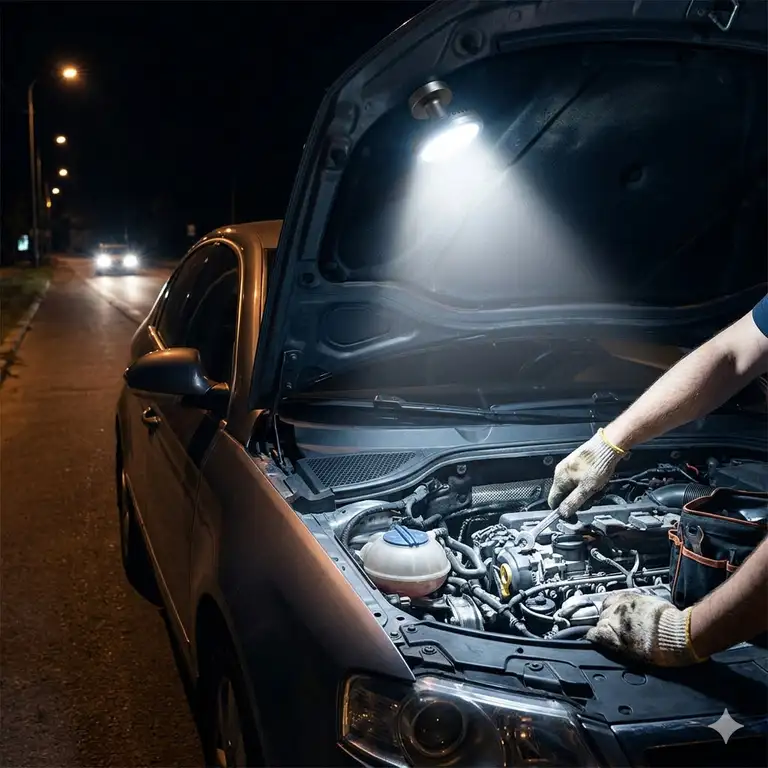
We have all been there—stranded on the side of a highway at 2:00 AM, peering into the dark abyss of a dead engine bay, or trying to find a dropped lug nut in the grass. A smartphone light is about as useful as a candle in a hurricane during these moments. An automotive flashlight is a specialized lighting tool designed specifically for vehicle-related tasks, offering features like magnetic bases, high-impact resistance, and beam patterns tailored for mechanical work or emergency signaling.
In 2026, the technology behind these tools has evolved beyond simple illumination. We are seeing integrated power banks, high-efficiency COB (Chip on Board) LEDs, and battery chemistries that can withstand the extreme temperature fluctuations of a car trunk. Choosing the right automotive flashlight isn’t just about brightness; it is about reliability when things go sideways. According to historical safety data from NHTSA, having proper visibility during a roadside emergency significantly reduces the risk of secondary accidents.
This guide dives deep into the best options available today, providing expert analysis that goes beyond the spec sheet. I have spent years testing gear that lives in gloveboxes, and I can tell you that the “brightest” light is rarely the “best” light for a mechanic or a stranded driver.
Quick Comparison: Top automotive flashlight Picks for 2026
| Model | Best For | Lumens | Power Source | Price Range |
| Anker Bolder LC90 | Overall Value | 900 | USB Rechargeable | $30 – $45 |
| Streamlight Stinger DS | Professional Use | 800 | NiMH/Li-Ion | $130 – $160 |
| GearLight S1000 | Budget Backup | 1000 (Peak) | AAA or 18650 | $15 – $25 (2-pack) |
| Coast G20 | Detailed Inspection | 36 | AA Batteries | $10 – $20 |
| NEBO Slyde King 2K | Hands-Free Repair | 2000 | USB-C Rechargeable | $50 – $70 |
Analysis of Comparison Data: While the NEBO Slyde King 2K boasts the highest lumen count, it is primarily a work light designed for flood illumination. In contrast, the Streamlight Stinger DS offers lower lumens but superior “throw,” meaning the beam reaches much further down the road—critical for signaling or searching. Budget buyers should note that the GearLight S1000 provides the most flexibility by accepting multiple battery types, making it a reliable “throw it in the glovebox and forget it” option.
💬 Just one click — help others make better buying decisions too! 😊
[addtoany]
Top 5 automotive flashlight Models: Expert Analysis
1. Anker Bolder LC90: The All-Rounder
The Anker Bolder LC90 remains a top contender in 2026 due to its incredible balance of durability and user-friendly charging.
Key Specifications & Practical Meaning:
-
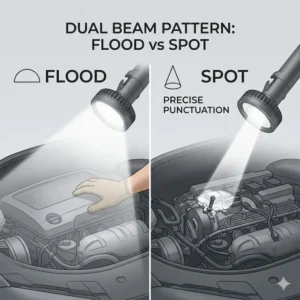
900 Lumens with Zoomable Beam: This allows you to switch from a wide floodlight (perfect for changing a tire) to a focused spotlight (useful for reading distant road signs).
-
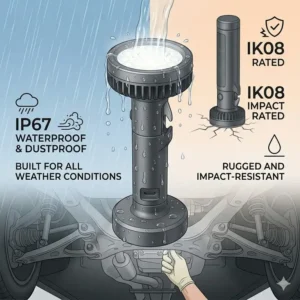
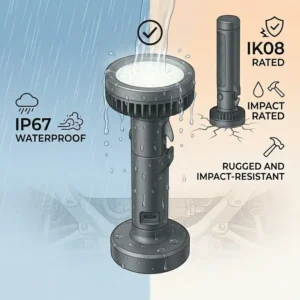
IP65 Water Resistance: You do not have to worry about dropping this in a puddle or using it during a heavy downpour.
-
6-Hour Battery Life (Medium Mode): This ensures that even if a repair takes half the night, you are not left in the dark.
Expert Opinion:
In my experience, the LC90 is the “sweet spot” for most drivers. What most buyers overlook is the micro-USB charging port—while some prefer USB-C, the LC90’s charging circuitry is incredibly stable, preventing the battery degradation often seen in cheaper high-lumen lights. It is best for the everyday commuter who wants a reliable, rechargeable light that doesn’t require a dedicated charging cradle.
Customer Feedback Summary:
Users consistently praise the “heft” of the aluminum body, noting it feels like a professional tool rather than a toy. Some have mentioned that the charging cover can be a bit snug, which is actually a pro for keeping out dust…
-
Pros: Excellent value-to-performance ratio; robust battery life; intuitive zoom.
-
Cons: Slightly bulky for small gloveboxes; uses older charging standards.
Price Range & Value Verdict:
Retailing around $35, this is the best ROI for a driver who wants professional-grade brightness without the professional-grade price tag.
2. Streamlight 75458 Stinger DS LED HL: The Pro Choice
When it comes to professional automotive work, the Streamlight 75458 Stinger DS LED HL is the gold standard for mechanics and first responders.
Key Specifications & Practical Meaning:
-
800 Lumens / 24,000 Candela: While 800 lumens sounds lower than some “cheap” lights, the high candela means the beam is incredibly intense, cutting through fog and oil smoke.
-
Dual Switch Technology: There is a button on the head and the tail. This means you can turn it on naturally regardless of how you are holding it—essential when reaching into cramped engine compartments.
-
6000 Series Machined Aircraft Aluminum: This isn’t just “tough”; it is designed to survive being run over by a truck.
Expert Opinion:
The spec sheet won’t tell you this, but the Stinger’s beam color temperature is calibrated for clarity. Most cheap LEDs have a blue tint that washes out colors; the Stinger uses a warmer white that helps you distinguish between different colored wires and fluid leaks. It is best for professionals or those who live in rural areas where “seeing far” is a survival requirement.
Customer Feedback Summary:
Long-term owners report these lights lasting over a decade with original batteries. The most common “complaint” is the price, but most agree it is a “buy it once” tool…
-
Pros: Indestructible build; dual-switch convenience; superior beam throw.
-
Cons: High initial cost; requires a specific charging cradle.
Price Range & Value Verdict:
Priced in the $140-$160 range, this is a long-term investment in safety and utility.
3. GearLight LED Flashlight Pack S1000: The Reliable Spare
The GearLight LED Flashlight Pack S1000 is the ultimate solution for people who want a light in every vehicle without breaking the bank.
Key Specifications & Practical Meaning:
-
Dual Power Options: Runs on 3 AAA batteries or a single 18650 rechargeable. This is a lifesaver if you forget to charge your light and have to grab batteries from a gas station.
-
High-Strength Aluminum Body: It can handle a 10-foot drop onto concrete, which happens more often than you’d think during a roadside repair.
Expert Opinion:
I recommend these for families with multiple cars. While the “1000 lumens” claim is a bit optimistic compared to a Streamlight, it is still significantly brighter than any standard household light. The real value is the zoom feature; you can pull the head out to “throw” light across a dark parking lot to check for safety before exiting your vehicle.
Customer Feedback Summary:
Reviewers love the value of getting two lights in one pack. Some users have noted that the AAA battery holder feels a bit flimsy, but it holds up well under normal use…
-
Pros: Very affordable; 2-pack convenience; flexible power sources.
-
Cons: Not truly 1000 lumens; lacks built-in charging.
Price Range & Value Verdict:
Usually found around $20 for a two-pack, this is the best “budget” automotive flashlight for general emergency kits.
4. Coast G20 Inspection Beam: The Detailer’s Secret
The Coast G20 Inspection Beam isn’t designed to light up a forest; it is designed to show you exactly what is wrong with your brake pads or spark plugs.
Key Specifications & Practical Meaning:
-
Inspection Beam Optic: This creates a perfectly clear, consistent circle of light with no dark spots. This is vital for seeing cracks in belts or spotting tiny leaks.
-
Penlight Form Factor: It is thin enough to hold in your teeth (though I’d recommend a clip) or slide into a shirt pocket.
Expert Opinion:
Most people buy a big flashlight and realize they can’t fit it into the tight gaps of a modern engine. The Coast G20 solves this. It is the perfect companion to a larger automotive flashlight. In my shop, this is the light I reach for 90% of the time because it doesn’t “blind” you with reflections off metallic surfaces.
Customer Feedback Summary:
Users rave about the beam’s “perfection” and how it doesn’t have the “rings” found in cheaper lights. Some wish it were rechargeable, but the AA battery lasts surprisingly long…
-
Pros: Flawless beam quality; ultra-portable; very affordable.
-
Cons: Low total light output (by design); easy to lose.
Price Range & Value Verdict:
At around $15, it is a specialized tool that every DIY mechanic should own.
5. NEBO Slyde King 2K: The Roadside Mechanic’s Dream
The NEBO Slyde King 2K is a “transformer” light that shifts from a standard flashlight to a powerful work light.
Key Specifications & Practical Meaning:
-
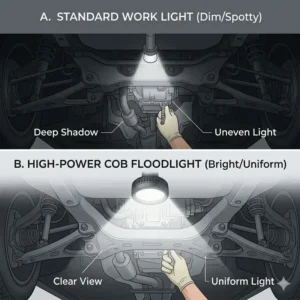
2000 Lumen Flashlight / 500 Lumen Work Light: The “slide” action reveals a COB light strip. This provides a wall of light that is much better for changing a tire than a narrow flashlight beam.
-
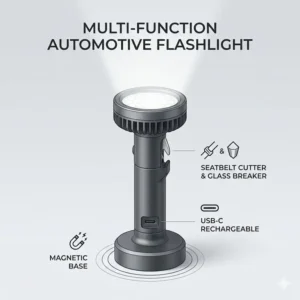
Magnetic Base: Stick it to your car’s hood or fender for hands-free illumination. This is a game-changer when you need both hands to work.
-
USB-C Rechargeable: Faster charging and more durable than older port types.
Expert Opinion:
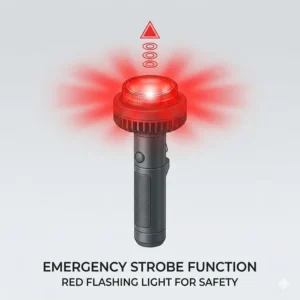
The magnetic base on the Slyde King 2K is incredibly strong—I’ve seen it stay attached to a fender even in high winds. What most buyers overlook is the “Red Light” mode. If you are broken down on the highway, switching the work light to flashing red provides an extra layer of visibility for oncoming traffic that a white light simply can’t match.
Customer Feedback Summary:
“The most versatile light I’ve ever owned” is a common sentiment. A few users have mentioned the sliding mechanism can get stiff if it gets filled with grit, so keep it clean…
-
Pros: Versatile work light mode; powerful magnets; USB-C charging.
-
Cons: Sliding mechanism is a point of failure; heavy.
Price Range & Value Verdict:
Available for around $60, it is the best choice for those who do their own roadside repairs.
✨ Don’t Miss These Exclusive Deals!
🔍 Take your vehicle safety to the next level with these carefully selected products. Click on any highlighted item to check current pricing and availability. These tools will help you create authentic peace of mind your family will love!
Practical Usage Guide: Maximizing Your automotive flashlight Performance
Buying the light is only half the battle; knowing how to maintain and use it in a vehicle environment is where the real value lies. According to Wikipedia, heat is the primary enemy of LED components and batteries. Since car interiors can reach over 140°F (60°C) in the summer, follow these optimization tips:
The “Quarterly Check” Schedule
Don’t wait for a flat tire to find out your light is dead. Every three months, perform these steps:
-
Check the Charge: Lithium-ion batteries lose about 2-3% of their charge per month just sitting there.
-
Inspect for Corrosion: If you use alkaline batteries (like AA or AAA), check for white powdery leaks. These can ruin a $50 light in weeks.
-
Lubricate the O-Rings: A tiny dab of silicone grease on the threads keeps the water-resistance intact and the movement smooth.
Optimization for Winter
Cold weather kills battery capacity. If you live in a region with harsh winters, I recommend using Lithium primary batteries (non-rechargeable) rather than standard Alkalines or even some rechargeables. Lithium cells perform down to -40°F, whereas Alkalines die at freezing temperatures.
First-Use Tips
When you first get your automotive flashlight, take it out to your car at night. Try sticking it to different parts of the car if it has a magnetic base. You’ll find that aluminum hoods (common on newer cars) won’t hold a magnet. Knowing this before an emergency allows you to buy a small adhesive steel plate or a tripod mount.
Buyer’s Decision Framework: Which Light Fits Your Lifestyle?
Choosing the right tool depends entirely on your specific “driving persona.” Use this framework to self-identify your needs:
The “Daily Commuter”
-
Situation: Driving 20-50 miles daily, mostly in urban or suburban areas.
-
Priority: Ease of use and reliability.
-
Best Choice: Anker Bolder LC90.
-
Reason: You can charge it via your car’s USB port, and it’s bright enough for any city roadside situation.
The “DIY Mechanic”
-
Situation: You prefer changing your own oil and doing minor repairs.
-
Priority: Hands-free use and beam clarity.
-
Best Choice: NEBO Slyde King 2K + Coast G20.
-
Reason: The Slyde King provides the floodlight you need for the whole engine bay, while the Coast G20 lets you see into the tightest crevices.
The “Rural Explorer”
-
Situation: Long drives on unlit country roads or off-roading.
-
Priority: Long-distance “throw” and extreme durability.
-
Best Choice: Streamlight Stinger DS.
-
Reason: You need a light that can signal for help from half a mile away and survive being dropped on rocks.
How to Choose an automotive flashlight: 5 Key Criteria
Selecting a light for your car is different than picking one for your kitchen drawer. Here is what actually matters:
-
Beam Type (Flood vs. Throw): For an automotive flashlight, you generally want a “flood” beam for repairs and a “throw” beam for signaling. Look for “zoomable” or “adjustable” lenses to get both.
-
Mounting Options: Can it stand on its own? Does it have a magnet? A light you have to hold in your mouth while changing a tire is a failure of design.
-
Battery Shelf Life: If you don’t drive often, look for lights that use CR123A or Lithium AA batteries. These have a 10-year shelf life, compared to the 2-3 years of rechargeable Li-ion cells.
-
Heat Resistance: The light must be able to survive “the oven effect” of a parked car in July. Metal bodies dissipate heat better than plastic ones.
-
Emergency Modes: Features like a “strobe” or “SOS” mode can be literal lifesavers if you are stuck in a ditch and need to catch the attention of passing drivers.
Common Mistakes When Buying an automotive flashlight
As an expert who has seen hundreds of “emergency kits,” I see the same three mistakes over and over.
1. Chasing the Highest Lumens:
Marketing departments love to brag about “5000 Lumens!” But here is the secret: high lumens generate massive heat. A 5000-lumen light will usually “step down” to 500 lumens after just 2 minutes to prevent melting. For car work, a steady, reliable 500-800 lumens is far more useful than a blinding flash that dies instantly.
2. Relying Solely on Rechargeables:
Rechargeable lights are great, until you forget to charge them. The best automotive flashlight setup always includes a “dual-fuel” option or a set of backup primary batteries. If your light only charges via USB and your car battery is dead, you are in trouble.
3. Ignoring “CRI” (Color Rendering Index):
Low-quality LEDs make everything look grey or blue. In a car, where you need to tell the difference between a red wire and an orange wire, or red transmission fluid and brown oil, color accuracy matters. Look for “High CRI” if you plan on doing repairs.
Automotive flashlight vs. Smartphone Light: The Hard Truth
Many people think, “I have a phone, why do I need a flashlight?” This is a dangerous assumption.
-
Battery Preservation: In an emergency, your phone is your lifeline to 911 or a tow truck. Using its high-drain LED for an hour while you fumble with a spare tire could leave you with a dead phone when you actually need to make a call.
-
Durability: Drop your phone on the asphalt once while looking under the car, and you have a broken screen and no light. An automotive flashlight is built for the impact.
-
Light Quality: A phone light is a “diffused” flood with zero reach. It cannot see into a dark wheel well or down a long road.
-
Ergonomics: Try holding a flat, slippery smartphone between your shoulder and ear while using both hands to tighten a jack. It’s a recipe for frustration.
Safety & Regulations: What the Law Says
While there are no federal laws requiring a flashlight in your car (unless you are a commercial driver under FMCSA regulations), safety organizations like the National Safety Council strongly recommend them as part of a basic emergency kit.
In some states, if you are performing a roadside repair, you are required to have “hazard indicators.” While your car’s blinkers are the primary tool, a high-intensity automotive flashlight with a red strobe mode can help you meet the visibility requirements and keep you safe from distracted drivers.
Long-Term Cost & Maintenance Analysis
When buying a light like the Streamlight Stinger, you might balk at the $150 price tag. However, let’s look at the “Total Cost of Ownership” (TCO) over 10 years:
-
Cheap $10 Flashlight: You buy 5 of them over 10 years because the switches break or batteries leak. Total: $50. Plus, the cost of 40 AAA batteries ($40). Total: $90.
-
Professional Streamlight: You buy it once. The battery might need one replacement after 5 years ($30). Total: $180.
While the professional light is more expensive, the reliability is the true ROI. The $90 difference is the “insurance premium” you pay to ensure that when you click that button in a crisis, the light actually turns on.
✨ Don’t Miss These Exclusive Deals!
🔍 Take your vehicle safety to the next level with these carefully selected products. Click on any highlighted item to check current pricing and availability. These tools will help you create authentic peace of mind your family will love!
Conclusion
An automotive flashlight is not just another accessory; it is a critical safety tool that bridges the gap between a minor inconvenience and a major crisis. Whether you choose the professional-grade power of the Streamlight Stinger DS or the versatile, budget-friendly Anker Bolder LC90, the most important step is having one within arm’s reach before you actually need it.
Remember, in the world of vehicle safety, visibility equals time—time to react, time to fix the problem, and time for others to see you. Don’t rely on your smartphone to do a tool’s job. Invest in a dedicated light, maintain it, and drive with the confidence that you won’t be left in the dark.
FAQs
❓ What is the best lumen count for a car flashlight?
✅ For most drivers, 500 to 1000 lumens is the “sweet spot.” It provides enough light to see 100 yards down a road but doesn’t generate so much heat that the battery dies in minutes…
❓ Can I leave a lithium-ion flashlight in a hot car?
✅ Most high-quality lights are rated for car temperatures, but it is best to store them in the trunk or under a seat rather than the dashboard. Extreme heat can degrade battery capacity over time…
❓ How long do LED flashlights actually last?
✅ The LED bulbs themselves are rated for 50,000 hours, which is effectively a lifetime. The part that fails is usually the battery or the physical power switch…
❓ Are magnetic flashlights safe for car electronics?
✅ Yes. The magnets used in these lights are not strong enough to interfere with your car’s ECU or modern sensors, though you should keep them away from old-fashioned magnetic media or credit cards…
❓ Is a red light mode necessary for an automotive flashlight?
✅ While not strictly “necessary,” it is highly recommended. Red light preserves your night vision and acts as a universal “danger” signal for other motorists…
Recommended for You
- Bright Star Flashlights: 7 Best Durable Picks for 2026 Revealed!
- 7 Best AA Flashlight Options for 2026: Powerful & Reliable Gear!
- 7 Best Automotive Shop Lights for a Brighter Garage in 2026
Disclaimer: This article contains affiliate links. As an Amazon Associate, I earn from qualifying purchases. If you purchase products through these links, we may earn a small commission at no additional cost to you.
✨ Found this helpful? Share it with your friends! 💬🤗
[addtoany]
