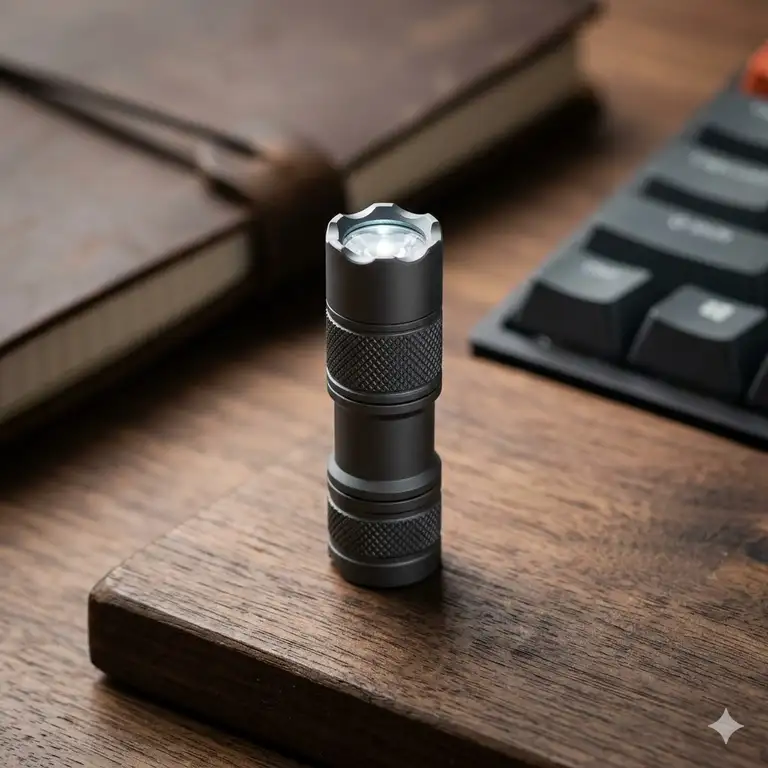
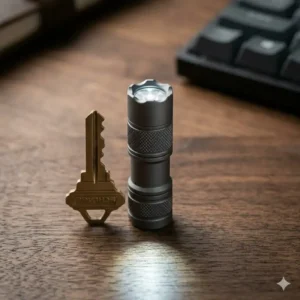
What is a smallest most powerful flashlight? In 2026, this term refers to an Ultra-Compact Everyday Carry (EDC) illumination tool that produces a minimum of 1,000 lumens while maintaining a form factor no larger than a standard thumb or a car key fob. These devices utilize high-density lithium-polymer batteries and multi-core LED emitters to provide searchlight-level brightness in a pocket-sized frame.
The landscape of portable lighting has shifted dramatically over the last few years. We’ve moved past the era where “small” meant a dim incandescent bulb and “powerful” meant carrying a heavy four-cell baton. Today, the smallest most powerful flashlight isn’t just a novelty; it’s a vital piece of safety equipment for hikers, mechanics, and urban commuters. As an enthusiast who has watched the lumen wars escalate, I can tell you that the 2026 models have finally solved the “thermal wall” problem. Thanks to advanced graphene heat sinks and AI-driven thermal throttling, these tiny torches can maintain high outputs for much longer than their predecessors.
Whether you are looking for a keychain companion or a backup light for your bug-out bag, the current market offers incredible density. We are seeing outputs that exceed 4,000 lumens from devices shorter than three inches. However, “power” isn’t just about the peak number on the box. It’s about how that light is thrown, the quality of the beam, and whether the interface allows you to access that power when your adrenaline is spiking in the dark.
Quick Comparison: Top Smallest Most Powerful Flashlight Picks
| Model | Peak Lumens | Battery Type | Best For | Price Range |
| Nitecore T4K | 4,000 | Built-in Li-ion | Ultimate Pocket Rocket | $90–$110 |
| Olight IMINI 2 | 50 | Magnetic Internal | Quick Keychain Access | $15–$25 |
| Imalent MS03 | 13,000 | 21700 (High-Drain) | Extreme Area Lighting | $120–$150 |
| RovyVon Aurora A8 | 650 | Li-Po (USB-C) | Versatile EDC | $45–$60 |
| Acebeam Defender P16 | 1,800 | 18650 | Tactical Reliability | $75–$95 |
The data above highlights a massive spread in what “powerful” means across different sizes. For instance, the Nitecore T4K offers a massive burst of 4,000 lumens, which is essentially like holding a car’s high beams in your palm, but it is best used for short durations. Conversely, the Acebeam Defender P16 provides a more balanced approach, offering a tactical throw that reaches further into the distance despite a lower total lumen count. If you need pure, raw floodlight capabilities, the Imalent MS03 remains the undisputed heavyweight champion of the “compact” category, though it requires a larger pocket than a keychain light.
💬 Just one click — help others make better buying decisions too!😊
[addtoany]
Top 5 Smallest Most Powerful Flashlight Models: Expert Analysis
1. Nitecore T4K: The Keychain Supernova
The Nitecore T4K is arguably the most ambitious keychain light ever designed, packing four CREE XP-L2 V6 LEDs into a frame that fits comfortably on a ring. It features a built-in OLED display that gives real-time data on battery voltage and remaining runtime.
With a 4,000-lumen “Turbo” mode, this light is designed for “momentary” dominance. What this means for you in the real world is that you can illuminate an entire backyard or a dark alleyway instantly. However, the expert takeaway here is management; 4,000 lumens generates immense heat. In my experience, you’ll get about 10–15 seconds of that peak brightness before the internal sensors downshift the power to protect the circuitry. It’s a specialized tool for quick identification rather than a long-distance hiking light.
Most users are shocked by how lightweight it is despite the metal casing. Customer feedback frequently mentions the “Lockout Mode,” which is crucial because a 4,000-lumen light turning on accidentally in your pocket can literally melt synthetic fabric.
-
Pros: Incredible lumen-to-size ratio, informative OLED screen, dual-switch interface.
-
Cons: Short turbo duration, non-replaceable battery.
-
Price Range: Around $100.
2. Imalent MS03: The EDC Sun
The Imalent MS03 is often cited as the smallest most powerful flashlight in the “palm-sized” category, pushing a staggering 13,000 lumens. It utilizes three American-made LEDs and a high-discharge 21700 battery.
The “power” here is transformative. While the T4K is a keychain light, the MS03 is a searchlight that happens to fit in a jacket pocket. When you activate the 13,000-lumen mode, the light doesn’t just illuminate what you’re looking at; it lights up everything in a 180-degree field of vision. This is the ideal tool for Search and Rescue (SAR) or property inspection where you need to see “everything at once.” What most buyers overlook is the battery requirement; to hit these numbers, you must use the included proprietary high-drain cell.
Feedback from professionals suggests that the heat dissipation is better than expected for its size, but it still gets “toast-burning” hot within a minute of high-mode use. It’s a beast of a light for those who prioritize raw output over all else.
-
Pros: Highest lumen count for its size, USB-C rechargeable battery, tactical strobe.
-
Cons: Gets very hot quickly, proprietary battery is expensive to replace.
-
Price Range: $120–$150.
3. Olight IMINI 2: The Instant Access Micro
The Olight IMINI 2 is the definition of “minimalist power.” It doesn’t compete in the thousands of lumens; instead, it provides 50 lumens of instant light by simply pulling the body away from its magnetic cap.
While 50 lumens sounds low compared to the others, its “power” lies in its utility. It is designed for those moments when you are fumbling with a lock, looking for a dropped screw, or navigating a dark hallway. The expert opinion on this model is that it’s the best “non-flashlight person’s” light. You don’t have to learn a complex UI or click a button five times to reach a lockout mode. You pull it, it shines. The integrated USB plug in the base is a stroke of genius, allowing you to charge it in any port without a cable.
Reviewers love the magnetic base, which allows you to stick it to the underside of a car hood for hands-free work. It’s the smallest most powerful flashlight for people who hate carrying gear.
-
Pros: Extremely tiny, magnetic quick-release, cable-free charging.
-
Cons: Low total output, magnetic cap can theoretically be lost.
-
Price Range: Around $20.
4. RovyVon Aurora A8: The Feature-Packed Polycarbonate
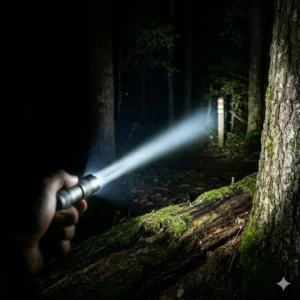
The RovyVon Aurora A8 is a transparent, USB-C rechargeable EDC light that offers 650 lumens from the main emitter and several “sidelights,” including UV and high-CRI reading lights.
The real-world value of the Aurora A8 is its versatility. Most smallest most powerful flashlight options focus on a single beam; the A8 gives you a Swiss Army knife of lighting. The 650-lumen main beam is more than enough for a midnight walk, while the UV light is perfect for checking currency or finding leaks. In my professional view, the “Momentary On” feature is the standout—press and hold for instant high power, let go to turn it off. It’s intuitive and prevents battery drain.
Customers praise the glow-in-the-dark body, which makes the light easy to find on a nightstand or if dropped in the grass. It’s the “intelligent” choice for hikers and campers who need multiple lighting types in one ounce of weight.
-
Pros: Multiple light sources (UV/Red/White), very lightweight, glow-in-the-dark.
-
Cons: Plastic body feels less “premium” than aluminum, interface takes time to learn.
-
Price Range: $45–$60.
5. Acebeam Defender P16: The Tactical Compact
The Acebeam Defender P16 is a “small” tactical light that uses a specialized SFT-40 LED to produce 1,800 lumens with an incredible 484-meter throw distance.
This is the light for people who need to see “way over there.” While the MS03 floods the area, the P16 acts like a sniper’s beam. This throw is achieved through a TIR (Total Internal Reflection) lens which focuses the light into a tight, intense hotspot. From an expert standpoint, this is the best smallest most powerful flashlight for self-defense or security work. The dual-tail switch allows you to go straight to strobe or turbo with one thumb press, which is critical in high-stress situations.
Users consistently report that the P16 feels “indestructible.” It has a stainless steel strike bezel with ceramic beads, making it a viable glass-breaker in emergencies. It’s a professional tool shrunken down for everyday carry.
-
Pros: Incredible beam distance (throw), mechanical tactical switches, rugged build.
-
Cons: Narrower beam isn’t great for close-up tasks, slightly larger than “keychain” size.
-
Price Range: $75–$95 range.
✨ Don’t Miss These Exclusive Deals!
🔍 Take your smallest most powerful flashlight search to the next level with these carefully selected products. Click on any highlighted item to check current pricing and availability. These tools will help you create authentic safety and visibility your family will love!
Practical Usage Guide: Optimizing Your Micro Lighting System
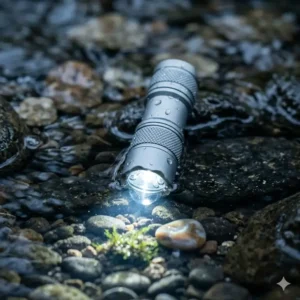
When you first receive your smallest most powerful flashlight, the temptation is to immediately crank it to “Turbo” and leave it there. Avoid this. In 2026, the power density of these devices is so high that they function more like “flashes” than “lamps” at their peak settings. To get the most out of your purchase, you should treat the Turbo mode as an emergency-only feature.
First-Time Setup and Maintenance
Most high-end lights like the Nitecore T4K or Acebeam Defender P16 ship with a plastic insulator over the battery or the light in a “Demo Mode.” Ensure you fully charge the device before your first use. For maintenance, every 3 months you should clean the threads with a microfiber cloth and apply a tiny amount of silicone grease. This keeps the water resistance (IPX8) intact. One common mistake beginners make is using “fast chargers” meant for laptops on tiny keychain lights; if the light doesn’t support PD (Power Delivery), stick to a standard 5V/1A phone brick to preserve battery health.
Maximizing Battery Longevity
The lithium-polymer batteries in micro lights are sensitive to extreme heat and cold. If you leave your smallest most powerful flashlight in a hot car during a Florida summer, you could reduce its capacity by 20% in a single season. I recommend carrying your light in your pocket—the human body acts as a natural thermostat, keeping the battery at a stable temperature. Also, try to keep the charge between 20% and 80%. Deeply discharging these tiny cells regularly will shorten their lifespan significantly.
Real-World Scenario: Which Small Powerhouse Fits Your Life?
Choosing the smallest most powerful flashlight depends heavily on your daily environment. Let’s look at three typical users in 2026 and see which tool solves their specific problems.
The Urban Commuter (The “Keyring” Specialist)
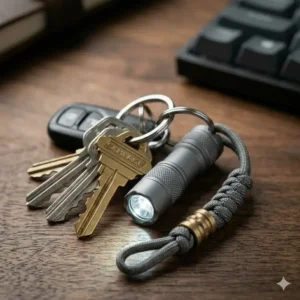
If you spend your time between an office and a subway, your main “threat” is a power outage in a stairwell or dropping your phone under a car seat. You don’t need a 400-meter throw; you need accessibility. The Olight IMINI 2 or the RovyVon Aurora A8 are the winners here. They weigh less than an ounce and disappear on a keychain. The Aurora A8’s red-light mode is also a “socially polite” way to find something in a dark movie theater without blinding everyone around you.
The Rural Homeowner (The “Flood” Specialist)
For someone living on an acre or more, “power” means being able to see if that noise by the fence was a raccoon or a coyote. You need the Imalent MS03. Its 13,000 lumens will turn “night into day” across your entire property. A smaller keychain light would leave too many shadows for comfort. The MS03 allows you to clear your backyard with a single click, providing a psychological sense of security that smaller beams can’t match.
The Outdoor Adventurer (The “Reliability” Specialist)
If you’re hiking the Appalachian Trail or camping, you need a light that survives a drop into a creek or a fall onto granite. You also need a beam that can signal for help. The Acebeam Defender P16 is the choice here. Its long-distance throw (484 meters) acts as a signaling device, and its rugged construction ensures it won’t fail when you’re miles from the nearest USB port.
How to Choose the Smallest Most Powerful Flashlight
Selecting the right light requires looking past the “Lumens” number. In the world of high-end illumination, there are five specific criteria you should evaluate:
-
Lumens vs. Candela: Lumens measure total light output (flood), while Candela measures beam intensity (throw). If you want to light up a room, look for high lumens. If you want to see a distant sign, look for high candela.
-
Battery Chemistry: In 2026, most micro lights use built-in Li-Po cells for size. However, if you want long-term sustainability, look for a light that uses a replaceable 18350 or 16340 battery.
-
User Interface (UI): Avoid “cycle” UIs where you have to click through every mode to turn it off. Look for “Direct Access” to Turbo and Moonlight modes.
-
Thermal Management: Check if the light uses active thermal regulation. Cheaper lights use “timed step-downs,” which dim the light regardless of how cold it is outside. Expert lights use sensors to give you more power in cold weather.
-
Charging Standard: Ensure it is USB-C. In 2026, Micro-USB is obsolete and finding a cable in an emergency will be difficult.
Common Mistakes When Buying Ultra-Compact Lights
The most frequent error I see is “Lumen Chasing.” A manufacturer might claim 10,000 lumens for $20 on a generic marketplace. This is almost always a lie. High-quality LEDs and high-discharge batteries are expensive. If a deal looks too good to be true, it likely uses “fake” lumens or lacks basic safety circuits, which can lead to battery fires.
Another mistake is ignoring “CRI” (Color Rendering Index). If you use your smallest most powerful flashlight for electrical work or medical emergencies, you need a High-CRI light. Standard cheap LEDs wash out colors, making a red wire look brown. High-CRI emitters, like those found in some RovyVon models, show colors accurately, which can be a literal lifesaver in technical situations. Lastly, don’t overlook “Parasitic Drain.” Some electronic-switch lights slowly drain the battery even when off. Always check if the light has a mechanical lockout or a very low standby current.
The “Lumen Wall”: Why Size Constraints Matter
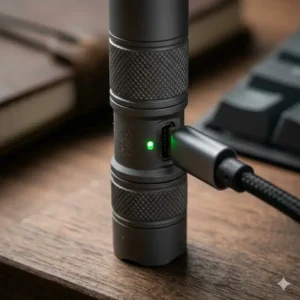
In physics, there is a direct relationship between power and heat. When you activate a smallest most powerful flashlight on its highest setting, you are essentially running a miniature heater. The reason why a 13,000-lumen light like the Imalent MS03 isn’t the size of a pea is because it needs surface area to shed heat.
In 2026, we have reached the limit of what aluminum can do. That’s why you’ll notice many top-tier lights now feature copper “slugs” or specialized cooling fins. When you’re shopping, look at the weight of the light. A light that is “too light” for its lumen rating will step down in seconds. A bit of weight (heatsink mass) is actually a good thing—it means the light can stay brighter for longer. What most buyers overlook is that a 1,000-lumen light that stays at 1,000 lumens is often more useful than a 4,000-lumen light that drops to 200 lumens after ten seconds.
Understanding 2026 Battery Technology
The heart of every smallest most powerful flashlight is the cell. While we are still waiting for solid-state batteries to become mainstream in flashlights, the 2026 “High-Discharge” lithium ions have improved significantly. We now have 21700 cells with 6000mAh capacity that can dump 40 amps of current.
What does this mean for the user? It means that even a “small” light can now handle the massive power draw required for multi-thousand lumen bursts without the battery sagging or being damaged. However, these high-performance cells have a shorter cycle life (total number of charges) than standard batteries. If you are a heavy user, expect to replace your high-performance battery every 2-3 years to maintain that “peak” power. This is why I personally prefer lights with removable batteries; when the cell dies, the expensive flashlight doesn’t become a paperweight.
Features That Actually Matter (And Those That Don’t)
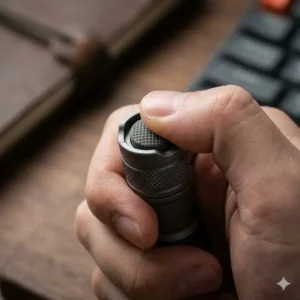
Marketing teams love to highlight “Digital Zoom” or “20 Different Modes.” In my experience, these are often distractions from poor build quality. A “Zoomable” head usually breaks the waterproof seal and creates a “hole” in the beam where there is no light. A fixed-lens smallest most powerful flashlight with a well-designed reflector is almost always superior in terms of durability and light quality.
What does matter is “Mode Memory.” This feature ensures that when you turn your light on, it returns to the last setting you used. There is nothing worse than being in a dark tent and turning on your light, only for it to blast 4,000 lumens because it didn’t remember you were on “Low” mode. Also, look for “IPX8” ratings. This means the light can be submerged in 2 meters of water. Even if you aren’t a diver, this ensures the light survives a heavy rainstorm or a drop into a puddle.
Long-Term Cost and Maintenance Analysis
When you buy a smallest most powerful flashlight in the $100 range, you aren’t just buying a light; you’re making an investment. The “Total Cost of Ownership” (TCO) is actually quite low compared to cheap disposables. A $100 Nitecore or Olight can last 10 years with basic care.
Compare this to buying a $10 “drugstore” light every year that leaks battery acid and dies. Over a decade, the “expensive” light is actually cheaper. The only recurring cost is the battery. For lights with built-in batteries, the cost is the “replacement” of the whole unit, which is why I suggest checking the warranty. Leading brands now offer 5-year warranties in 2026, which covers the electronics and the LED. If you treat the light well—avoiding deep discharges and keeping the O-rings lubed—your cost-per-use becomes fractions of a penny.
Why You Need a Dedicated Light vs. Your Smartphone
The most common question I get is: “Why do I need the smallest most powerful flashlight when my iPhone has a flash?” The answer is two-fold: Ergonomics and Output. A smartphone flash is a “mule” light—it has no lens and no throw. It is designed to light up a face 3 feet away. It cannot see 50 feet down a trail, and it certainly won’t help you signal a car from a distance.
Furthermore, using your phone as a light is a dangerous gamble. If you are lost or in an emergency, your phone is your lifeline for communication. Draining the battery by using the LED is a tactical error. A dedicated smallest most powerful flashlight like the RovyVon Aurora A8 is smaller than a lighter, packs 20 times the power of a phone flash, and leaves your phone battery at 100% for when you need to make a call. In my view, a dedicated EDC light is the most important “backup” tool you can carry.
✨ Don’t Miss These Exclusive Deals!
🔍 Take your smallest most powerful flashlight search to the next level with these carefully selected products. Click on any highlighted item to check current pricing and availability. These tools will help you create authentic safety and visibility your family will love!
Conclusion: Lighting Your Path in 2026
The search for the smallest most powerful flashlight leads to a fascinating intersection of material science and electronic engineering. Whether you choose the raw, overwhelming flood of the Imalent MS03 or the pocket-friendly versatility of the RovyVon Aurora A8, you are carrying technology that was unimaginable just a decade ago.
The key to a successful purchase is matching the light’s “personality” to your specific needs. Don’t just look for the biggest number; look for the beam pattern, the UI, and the durability that fits your lifestyle. A light is only “powerful” if it’s in your pocket when the lights go out. By prioritizing high-quality brands and understanding the balance between heat and output, you can ensure that you’re never left in the dark again.
FAQs
❓ What is the most powerful smallest flashlight?
✅ As of 2026, the Imalent MS03 holds the title for most power in a palm-sized frame at 13,000 lumens. However, for a true keychain size, the Nitecore T4K is the leader with 4,000 lumens…
❓ How many lumens is a “powerful” small flashlight?
✅ In today’s market, anything over 1,000 lumens is considered powerful for a compact light. For context, a 1,000-lumen beam is roughly five times brighter than a standard tactical flashlight from a decade ago…
❓ Can a small flashlight really throw 500 meters?
✅ Yes, models like the Acebeam Defender P16 use specialized “Throw” LEDs (like the SFT-40) and TIR optics to focus light into a tight beam that can reach over 480 meters despite the small size…
❓ Do these lights get dangerously hot?
✅ Yes. Any smallest most powerful flashlight producing over 2,000 lumens will generate significant heat. Most have “thermal regulation” to dim the light automatically, but the lens area can still cause burns if touched…
❓ Are built-in batteries better than replaceable ones?
✅ Built-in batteries allow for smaller, more waterproof designs. However, replaceable batteries (like 18350 or 14500 cells) offer better long-term value because you can swap them when they eventually wear out…
Recommended for You
- 7 Best good keychain flashlight Options for EDC in 2026: Expert Guide
- 7 Brightest AAA Flashlight Models for 2026: Power You’ll Love!
- 7 Best Keychain Torch Models of 2026: Brightest & Most Reliable Picks
Disclaimer: This article contains affiliate links. As an Amazon Associate, I earn from qualifying purchases. If you purchase products through these links, we may earn a small commission at no additional cost to you.
✨ Found this helpful? Share it with your friends! 💬🤗
[addtoany]
