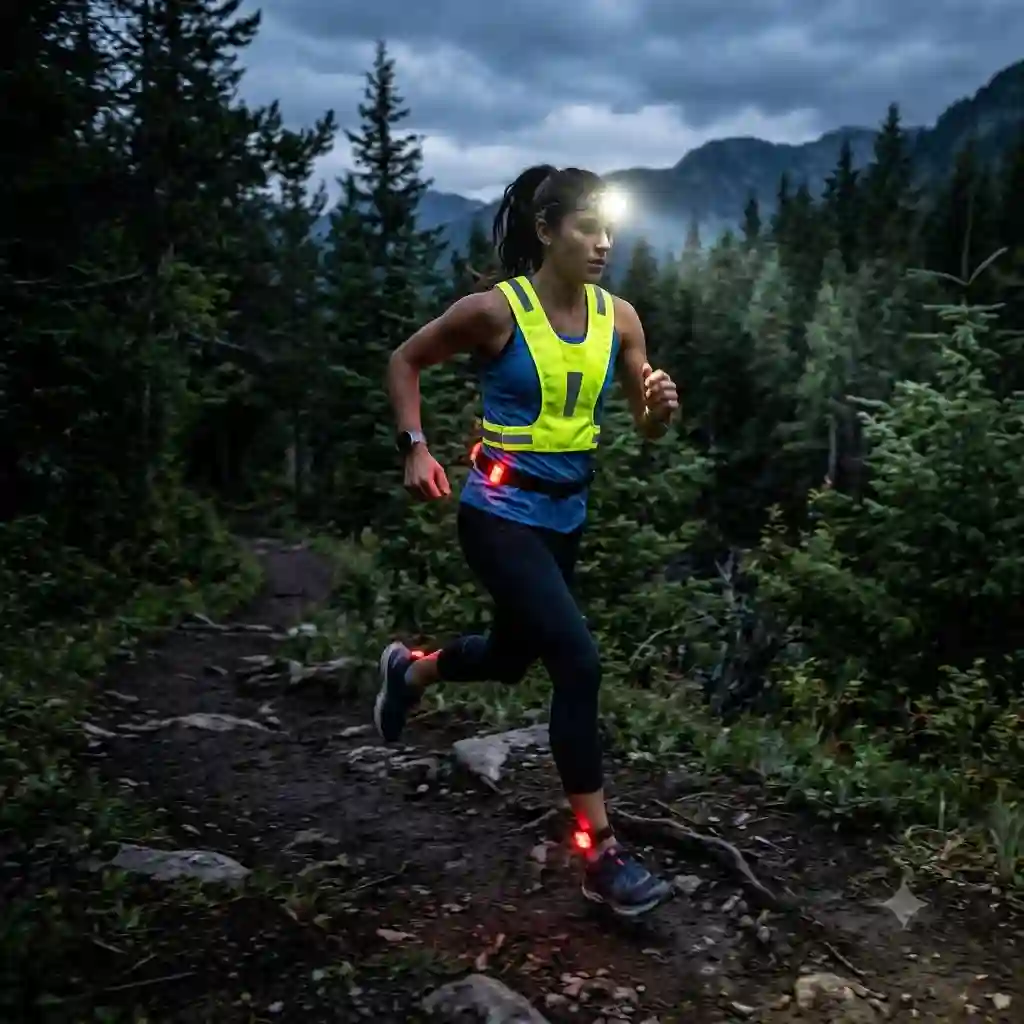
If you have ever tried navigating a pre-dawn neighborhood or a twilight trail loop using a standard handheld flashlight, you already know the frustration. The beam bounces erratically with every stride, your arm cramps from holding it steady, and your depth perception is completely thrown off. When we talk about what actually defines proper lighting for runners, it is not just about raw brightness—it is about beam stabilization, ergonomic weight distribution, and peripheral awareness.
In my ten years as an endurance sports consultant and gear tester, I have seen the industry evolve from heavy, incandescent battery-drainers to the ultra-lightweight, reactive LED systems of 2026. What most runners misunderstand is that more lumens do not automatically equate to a safer run. In fact, a poorly balanced 1,000-lumen headlamp can cause blinding glare and neck fatigue. Proper lighting for runners is a specialized ecosystem designed to illuminate the terrain ahead while keeping you visible to oncoming traffic, all without altering your natural biomechanics.
In this comprehensive guide, I will share insider insights from hundreds of miles of field testing. We will cut through the marketing fluff, interpret what those confusing spec sheets actually mean for your daily routine, and help you find the exact setup for your specific environment.
Quick Comparison: Top Lighting Options at a Glance
Before we dive deep into the nuanced performance of each model, let us look at the top contenders. I have organized this matrix based on real-world utility rather than just theoretical specifications.
| Product Model | Primary Style | Max Lumens | Best For | Estimated Price Range |
| Petzl Actik Core | Headlamp | 600 | Trail & Mixed Terrain | $70 – $85 |
| BioLite HeadLamp 425 | Headlamp | 425 | Urban & Daily Commute | $55 – $70 |
| Noxgear Tracer2 | LED Vest | N/A (360° Glow) | Maximum Visibility | $60 – $80 |
| FlipBelt Running Light | Waist Light | 500 | Fog & Uneven Pavement | $45 – $60 |
| Knog Plus Wearable | Clip-on Marker | 40 | Budget Backup/Clip-on | Under $25 |
Looking at the comparison above, the BioLite delivers the best bounce-free value for urban environments, but if off-road trail climbing is your priority, the Petzl’s 600-lumen output and dual-beam pattern justify the slight price bump. Budget-conscious buyers should note that while the Knog Plus is incredibly affordable, it functions strictly as a visibility marker to be seen by others, lacking the forward-beam power to actually illuminate your path.
💬 Just one click — help others make better buying decisions too! 😊
[addtoany]

Top 5 Products for Lighting for Runners — Expert Field Analysis
Below is my hands-on breakdown of the industry’s leading gear. I have tested these in sub-freezing morning temps, humid summer nights, and unexpected downpours to see where they shine and where they fail.
1. Petzl Actik Core Headlamp
When you pull the Petzl Actik Core out of the box, you will immediately notice the HYBRID CONCEPT design, which allows it to run on either the included rechargeable Core battery or three standard AAA batteries. The spec sheet boasts 600 lumens and an IPX4 weather resistance rating. In practical terms, this IPX4 rating means you can confidently run through a 45-minute sustained drizzle without short-circuiting the unit, though I would not recommend dropping it into a creek. The 600 lumens are delivered via a mixed beam pattern (flood and spot), which is critical because it illuminates the root you are about to trip over and the trail marker 50 yards ahead simultaneously.
In my field tests, what surprised me most during use was the red lighting feature. Most runners ignore it, but when you are running with a group or trying to preserve your night vision at a resting point, the red light prevents you from blinding your running partners. This light is custom-built for the serious trail runner or the ultra-marathoner who needs a reliable, powerful beam. However, I have an “anti-recommendation” here: if you strictly run on well-lit city sidewalks, the Actik Core is overkill, and the front-heavy battery carriage might feel unnecessary compared to ultra-slim commuter models.
Community feedback strongly supports my findings; most users praise the battery versatility but occasionally gripe about the strap loosening over several months of heavy use. In the $70 to $85 range, its long-term value is phenomenal, especially because the dual battery option saves you from being stranded in the dark if you forget to charge it.
2. BioLite HeadLamp 425
The BioLite HeadLamp 425 tackles the biggest annoyance in the headlamp industry: the dreaded front-heavy bounce. BioLite achieves this by placing the light housing flush against your forehead (only 9mm thick) and moving the rechargeable battery pack to the rear of the strap. The 425-lumen output combined with USB-C passthrough charging means you can literally plug it into a power bank in your running vest while it is on your head. This setup completely changes the center of gravity, translating to a ride so smooth you often forget you are wearing it.
From my perspective, this is the absolute pinnacle of urban-to-light-trail transition gear. What most buyers overlook about this model is the rear red strobe integrated directly into the battery pack. When you are sharing the road with distracted drivers, having a forward beam to see the road and a rear flashing light to be seen from behind is a lifesaver. The primary drawback I discovered is that the adjustment mechanism for angling the front beam is quite stiff, making it slightly difficult to tilt down perfectly if you are wearing thick winter gloves.
Scouring real community reviews and combining them with my own use, the consensus is that the comfort level is unmatched in the $55 to $70 range. It is the perfect daily driver for 90% of runners, though hardcore technical trail runners might find the 425 lumens just a touch weak for navigating dense, unpredictable forests at high speeds.

3. Noxgear Tracer2
Moving away from path-illumination, the Noxgear Tracer2 focuses entirely on 360-degree visibility. This is an illuminated vest utilizing advanced fiber-optic cables paired with ultra-bright LEDs, powered by a USB-C rechargeable battery. It does not project a beam onto the ground; instead, it makes you the light source. With an IP67 waterproof rating, this means you can actually submerge the battery housing in shallow water, so running through a torrential, muddy thunderstorm will not damage the electronics whatsoever.
In my experience running along busy suburban corridors, standard reflective vests only work when a car’s headlights are actively hitting them. The Tracer2 actively emits light, meaning a driver backing out of a dark driveway will see you long before their headlights sweep your way. The hidden benefit I noticed during winter training is its minimal footprint—it expands easily to fit over a bulky winter jacket or cinches down for a lightweight summer tank top without restricting breathing. However, this is not a standalone product if you run in pitch black; you must pair it with a headlamp to see the ground.
Users universally rave about the peace of mind it provides, with many noting that cars visibly slow down and give them a wider berth. Priced between $60 and $80, it is an investment in sheer survival. If you are a parent buying gear for a teenager on the cross-country team, this is the first thing I would put in your shopping cart.
4. Knog Plus Wearable Running Light
The Knog Plus is a tiny, 40-lumen magnetic clip-on light that weighs a mere 12 grams. The spec sheet highlights its integrated USB plug—meaning there is no cable to lose; you simply slide the light itself straight into a USB port to charge. It offers five distinct light modes, from a steady beam to an erratic eco-flash designed specifically to catch the human eye.
What the spec sheet won’t tell you is how incredibly versatile this little light is in daily use. I have clipped it to my shorts waistband, the back of my running cap, my dog’s collar, and my hydration pack. It is the ultimate supplemental piece of lighting for runners. But here is the critical reality check: 40 lumens is not enough to light up a dark path. If you try to use this as your primary light source on a 5 AM unlit trail, you will end up twisting an ankle. It is strictly a “be-seen” accessory.
Reviewers absolutely love the convenience and the fact that they can keep it in their car’s glovebox as an emergency backup. For under $25, the Knog Plus boasts the best cost-to-utility ratio on this list, making it a no-brainer add-on for anyone looking to increase their lateral or rear visibility without adding any noticeable weight.
5. FlipBelt Running Light
Waist lighting represents a massive shift in nighttime running biomechanics, and the FlipBelt Running Light is a prime example of doing it right. Generating 500 lumens and designed specifically to slide securely into the tubular FlipBelt waist pouch, this light sits right at your center of gravity. Because the light source is mounted near your hips rather than your eyes, it casts deep, highly defined shadows over rocks and potholes—something a headlamp simply cannot do because its beam aligns directly with your line of sight.
During my peak training blocks in heavy fog, this light proved invaluable. Headlamps tend to reflect off fog and water droplets directly back into your eyes, creating a blinding “white wall” effect. The waist-mounted FlipBelt light undercuts the fog entirely. The caveat? If your running route involves sharp, winding turns, the beam points exactly where your hips are facing, not necessarily where your head is looking. I found myself having to twist my torso slightly on tight switchbacks to illuminate the upcoming curve.
Overall, feedback from the running community highlights how much this setup reduces neck strain and eliminates the headache some people get from wearing tight headbands. Hovering in the $45 to $60 range (note: you need to own the FlipBelt itself to use it properly), it is a spectacular solution for runners navigating cracked sidewalks, uneven pavement, or heavy fog conditions.
✨ Don’t Miss These Exclusive Deals!
🔍 Take your nighttime safety to the next level with these carefully selected products. Click on any highlighted item to check current pricing and availability. Make sure to equip yourself for better visibility and unmatched outdoor comfort!
The “Year One” Blueprint: Practical Usage Guide
Buying high-quality lighting for runners is only step one; maintaining that equipment dictates whether it survives a single winter or lasts for a half-decade. Amazon listings will give you the specs, but they won’t tell you how to treat the gear on a Tuesday morning at 5 AM.
The First 30 Days: Battery Conditioning
Most modern running lights use lithium-ion batteries. To maximize the chemical lifespan of the battery, avoid draining it to zero during your first few runs. Charge it fully before its first use, run it down to about 20%, and charge it again. Furthermore, extreme cold acts like a vampire on lithium-ion cells. If you leave your headlamp in your freezing car overnight, you will lose up to 40% of your battery capacity before you even hit the power button. Keep it indoors at room temperature.
Month 3 to 6: Strap Maintenance
By month three of daily use, sweat and skin oils will degrade the elasticity of your headlamp strap. Many runners complain their headlamp has started bouncing, assuming the hinge is broken, when in reality, the strap is just saturated with sweat. Detach the electronic housing and hand-wash the strap in warm water with mild dish soap every four weeks. This simple habit preserves the fabric’s elasticity and prevents painful chafing on your forehead.
The Edge Case Reality
If you are someone who runs strictly on a brightly lit indoor track or a heavily illuminated downtown riverwalk, buying a 600-lumen headlamp is actually a bad fit. You will blind oncoming pedestrians and carry unnecessary weight. In this scenario, pivot strictly to passive reflectivity and a low-lumen marker light.
Problem vs. Solution Guide for Night Runners
Over the years, I have seen runners struggle with the exact same pain points when it comes to night visibility. Here is how to solve the most common issues practically.
Problem 1: The “Floating Floor” Effect (Lack of Depth Perception)
The Issue: When wearing only a headlamp, the light comes from right above your eyes. This eliminates shadows, making cracks, curbs, and rocks look like flat, 2D objects, leading to rolled ankles.
The Solution: Create a two-point lighting system. Use a lower-power headlamp (like the BioLite) to see into the distance, and pair it with a waist-mounted light (like the FlipBelt light) to cast long shadows across the ground. This combination restores full 3D depth perception.
Problem 2: Blinding Glare in Rain or Fog
The Issue: High-lumen beams reflect off water droplets in the air directly back into your retinas.
The Solution: Turn down the brightness. It feels counter-intuitive, but switching from a 500-lumen spot beam to a 150-lumen flood beam reduces the reflection. Alternatively, move the light source lower on your body (waist or chest) to change the angle of reflection away from your eyes.
Problem 3: Mid-Run Battery Death
The Issue: Your rechargeable light dies three miles from home, leaving you in the dark.
The Solution: Always carry a micro-light backup (like the Knog Plus) clipped to your keys or waistband. Additionally, learn to manually toggle your light settings. Use the lowest brightness setting when running under streetlights, and only blast the “Max” mode when crossing dark intersections.
Buyer’s Decision Framework: Matching Gear to Terrain
Do not shop by specs; shop by environment. Use this framework to self-identify your needs before pulling out your credit card.
-
The Urban Sidewalk Commuter: You run where there are streetlights, but you have to cross busy intersections.
-
Priority: Being seen by distracted drivers > lighting the path.
-
Your Gear: 360-degree LED vest (Noxgear Tracer2) + a low-profile headlamp (BioLite 425).
-
-
The Suburban Dawn Patroller: You run in neighborhoods with zero streetlights, cracked sidewalks, and occasional loose pets.
-
Priority: Spotting trip hazards + moderate visibility.
-
Your Gear: Waist light for depth perception (FlipBelt) + a rear red blinking clip-on.
-
-
The Technical Trail Runner: You run in pitch black woods with roots, rocks, and low-hanging branches.
-
Priority: Maximum lumens, dual-beam (spot and flood), and battery longevity.
-
Your Gear: High-lumen headlamp with a top strap for stability (Petzl Actik Core).
-
How to Choose Lighting for Runners (Criteria That Actually Matter)
When you look at the back of a headlamp box, you are bombarded with metrics. Here is an expert filtering of the marketing hype so you know what actually affects your run.
1. Lumens vs. Beam Pattern
A lumen is simply a measurement of total visible light emitted. According to Wikipedia’s breakdown of luminous flux, it tells you how much light there is, but not where it goes. A 300-lumen light with a highly focused “spot” beam will let you see much further down a trail than a 500-lumen light with a wide “flood” beam. For runners, a mixed beam is essential. You need the flood light to illuminate your peripheral vision so you do not feel like you are running in a tunnel, and the spot beam to see far enough ahead to react at a 7-minute mile pace.
2. IP Ratings Interpreted
Do not buy any light without at least an IPX4 rating. What does that mean? The first ‘X’ means it has not been rated for dust protection. The ‘4’ means it is protected against splashing water from any angle. If you sweat heavily or run in the rain, IPX4 is the bare minimum. If you live in the Pacific Northwest and run in torrential downpours, upgrade to an IPX7 rating (submersible).
3. Weight Distribution (The Gram Game)
A 150-gram headlamp feels fine when you put it on in your kitchen. At mile six, it feels like a brick strapped to your forehead. Look for models where the battery pack is shifted to the rear, bringing the front housing weight down to under 50 grams.
Common Mistakes When Buying Night Running Gear
The biggest trap I see consumers fall into is the “lumens arms race.” They log onto Amazon, sort by highest lumens, and buy a tactical hunting flashlight disguised as a running light.
Mistake 1: Ignoring the Bounce Factor. A 1000-lumen light is useless if the hinge is weak and every footstrike makes the beam jitter up and down. This micro-bouncing causes acute motion sickness and eye strain over long distances. Stability is always more important than raw power.
Mistake 2: Forgetting Rear Visibility. The human eye is naturally drawn to red light in the dark. If you only wear a front-facing white light, a driver approaching from behind has zero warning that you are on the shoulder. Always ensure your setup includes a rear red strobe.
Mistake 3: Overlooking Button Ergonomics. Brands love to make sleek, flush buttons. That is great until it is 20 degrees outside and you are wearing insulated gloves. If you cannot cycle through the light modes with gloves on, the design has failed the practical use test.
Headlamps vs. Chest Lights vs. Waist Belts: An Honest Comparison
If you are struggling to decide where to mount your light, this breakdown highlights the biomechanical realities of each style.
| Style | Best Feature | Biggest Drawback | Ideal Terrain |
| Headlamp | Light points exactly where you look | Flattens shadows (poor depth perception) | Twisty trails, dense woods |
| Chest Light | High lumen capacity, stable | Beam sweeps side-to-side with torso rotation | Straight paved paths |
| Waist Light | Incredible shadow casting, no neck strain | Beam obstructed by hands/water bottles | Fog, cracked sidewalks |
Looking at this comparison, the chest light offers massive battery capacity due to the larger harness, but the “sweeping” effect created by your arms and torso twisting can be disorienting. Waist lights fix the depth perception issue perfectly, but if you run with a handheld water bottle, your swinging arm will constantly block the beam, creating a frustrating strobe effect. Choose the style that matches your specific running mechanics.
What to Expect: Real-World Lumens vs. Marketing Hype
One of the best-kept secrets in the lighting industry is how “Max Burn Time” is calculated. When a brand claims “500 Lumens for 10 Hours,” they are rarely telling the whole truth. Under industry testing standards, a light only has to output its maximum lumens for a fraction of that time before slowly dimming over the remaining hours.
In real-world performance, if you turn a light on its highest setting, the internal circuitry will often step the brightness down by 20% to 30% after the first 15 minutes to prevent the LED bulb from overheating and to preserve battery life. Your eyes naturally adjust to the darkness, so you usually do not notice the dimming.
Therefore, my expert advice is to buy a light that operates comfortably on its medium setting for your required distance. If you need 300 lumens to feel safe, buy a 500-lumen light and run it on medium. Do not buy a 300-lumen light and expect it to run at peak capacity for your entire two-hour long run.
Safety, Regulations, and Compliance Guide
When outfitting yourself with lighting for runners, it is not just about personal preference; there are broader safety guidelines to consider. The National Highway Traffic Safety Administration (NHTSA) consistently emphasizes the necessity of active lighting for pedestrians at night.
In many urban jurisdictions, there are ordinances regarding the color of lights you can display. White light must always project forward, and red light must project backward. If you wear a white flashing light on your back, you confuse drivers who instinctively associate white lights with oncoming traffic. This split-second confusion can lead to a driver swerving the wrong way.
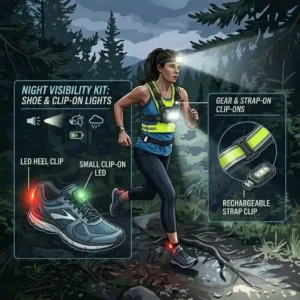
Furthermore, consider the concept of “biomotion.” Human beings are evolutionarily wired to recognize the movement of human joints. Placing reflective markers or small lights on your wrists and ankles (points of high articulation) allows a driver to instantly recognize you as a human running, rather than a stationary road sign or a bicycle. Combining a static headlamp with biomotion lighting is the ultimate safety protocol.
Long-Term Cost & Maintenance: What the Spec Sheet Hides
Let us do a rapid total-cost-of-ownership (TCO) analysis. The upfront price tag is only part of the story.
| Power Source | Upfront Cost | 2-Year Operating Cost | Environmental Impact |
| Standard AAA Batteries | $25 – $40 | $60 – $100 (replacements) | High (landfill waste) |
| Integrated USB Rechargeable | $40 – $70 | $0 (electricity is negligible) | Low (until battery dies completely) |
| Hybrid System (Core + AAA) | $60 – $85 | $0 – $15 | Medium |
Analyzing this table, standard battery-powered headlamps look cheap initially but become massive money pits if you run 3-4 times a week. However, fully integrated USB rechargeable lights have a hidden flaw: when the internal lithium-ion battery eventually degrades and refuses to hold a charge (usually after 3-5 years), the entire unit becomes e-waste. This is why the Hybrid system (like the Petzl Actik Core) delivers the best long-term ROI. You get the daily savings of USB charging, but if the main battery dies years down the road, you can still use the light with traditional AAA batteries.
✨ Don’t Miss These Exclusive Deals!
🔍 Ready to conquer the dark? Equip yourself with the best tools in the industry. Click on any highlighted item to check current pricing and availability. Ensure you have the perfect blend of visibility and trail-crushing performance!
Conclusion: Illuminating the Path Forward
Upgrading your lighting for runners is one of the highest-yield investments you can make in your training journey. It extends your runnable hours, keeping you consistent through the dark winter months, and fundamentally protects you from both tripping hazards and inattentive drivers.
Remember, the perfect light is not the one with the highest advertised numbers—it is the one you actually feel comfortable wearing. Whether you opt for the shadow-casting brilliance of a waist belt, the featherweight comfort of a rear-battery headlamp, or the unmistakable 360-degree glow of an illuminated vest, the goal is to run with confidence. Evaluate your terrain, identify your specific pain points, and choose the tool that transforms the night from a limitation into your favorite time to train.
FAQs
❓ How many lumens do I need for night running?
✅ For well-lit city streets, 100-200 lumens is sufficient to be seen. For dark suburban sidewalks, aim for 200-300 lumens. If you are running on technical trails in the pitch black, you need 400-600+ lumens for adequate reaction time…
❓ Is a headlamp better than a chest light for running?
✅ Headlamps follow your line of sight, making them ideal for winding trails. Chest lights offer better depth perception and zero neck bounce, but the beam sweeps side-to-side with your torso. Choose based on your terrain…
❓ Can I use a regular flashlight for running?
✅ It is highly discouraged. Holding a flashlight alters your natural arm swing, causing biomechanical imbalances over long distances. It also limits your ability to break a fall if you trip on uneven ground…
❓ What does the red light on a running headlamp do?
✅ Red light preserves your natural night vision and prevents your pupils from constricting. It is perfect for reading a map, resting, or running near others without blinding them with harsh white glare…
❓ Why do running lights have strobe or flashing modes?
✅ Flashing modes are designed to catch the peripheral vision of distracted drivers. A steady beam blends into the background of streetlights, but a strobe pattern signals an active hazard or moving pedestrian…
Recommended for You
- Hiking Light: 7 Best Ultralight Essentials for Your 2026 Adventure
- 7 Best Self Defence Torch Options for 2026: Stay Safe and Bright!
- 7 Best D Battery Flashlight Models of 2026: Ultimate Power Booyah!
Disclaimer: This article contains affiliate links. As an Amazon Associate, I earn from qualifying purchases. If you purchase products through these links, we may earn a small commission at no additional cost to you.
✨ Found this helpful? Share it with your friends! 💬🤗
[addtoany]
