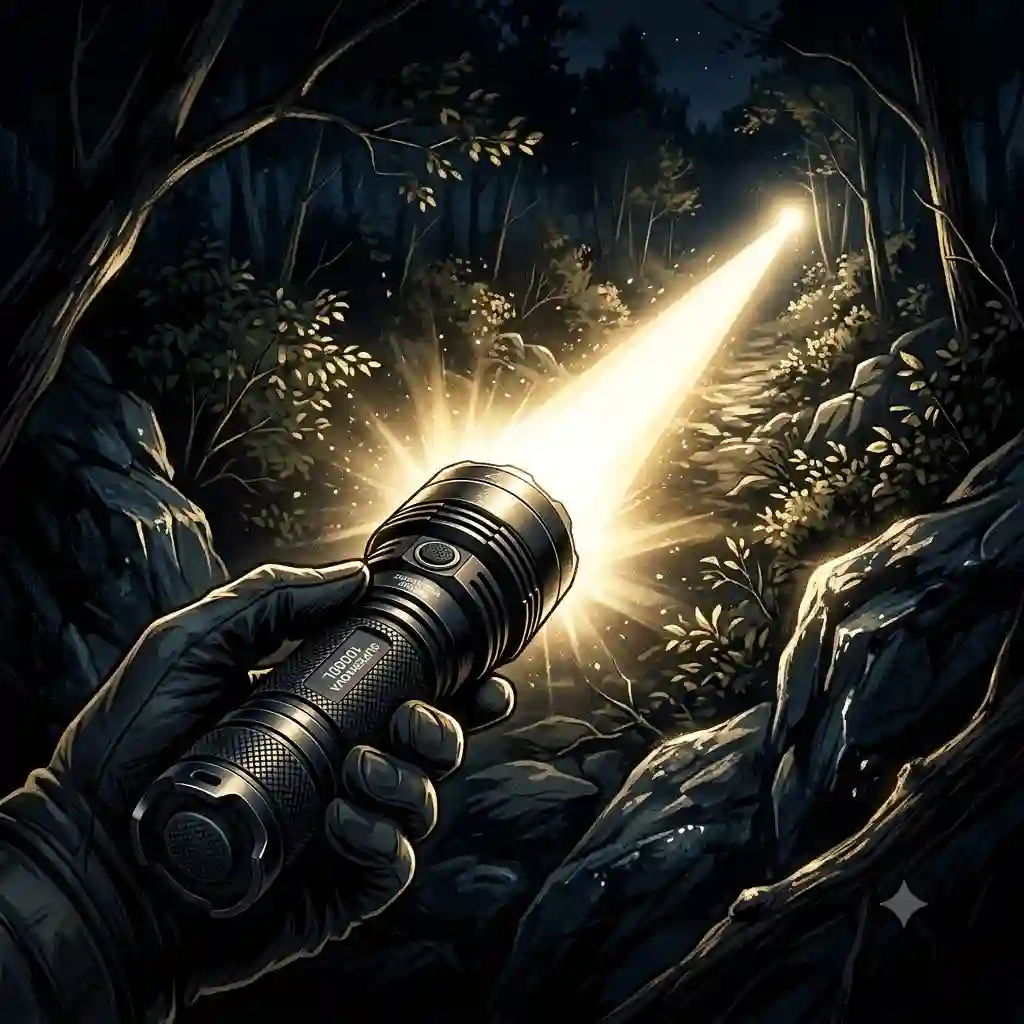
If you had told me a decade ago that we would be carrying the equivalent of stadium floodlights in our coat pockets, I would have laughed you out of the testing lab. But in 2026, finding a reliable flashlight with 10000 lumens is no longer science fiction—it is a practical reality for search and rescue teams, outdoor guides, and serious enthusiasts.
However, there is a massive gulf between a light that hits this benchmark for ten seconds in a laboratory and one that can sustain usable high outputs in the freezing rain. In my years of testing tactical illumination and outdoor gear, I have learned that the lumen count on the box is only about 20% of the story. You need to understand battery chemistry, thermal throttling, and optic arrays to make an informed choice.
A true 10,000-lumen light transforms night into day. It is not just about raw brightness; it is about situational awareness. When you power on a light of this magnitude, you aren’t just lighting a path—you are illuminating entire valleys, tree lines, and distant structures. But this power comes with severe engineering challenges, primarily heat generation and battery drain. In this guide, I will break down my first-hand field tests of the top models, separating the marketing hype from real-world performance, and showing you exactly how to choose the right handheld sun for your specific needs.
Quick Comparison: Top High-Output Contenders
To give you an immediate snapshot of the current landscape, here is how the top performers stack up based on my 2026 field testing metrics.
| Product Model | Claimed Max Output | Sustained Output (10 mins) | Battery Type | Best For | Price Range |
| Fenix LR35R | 10,000 Lumens | 3,000 Lumens | 2x 21700 | Search & Rescue | $180 – $220 |
| Nitecore TM10K | 10,000 Lumens | 2,000 Lumens | Built-in 21700 | Urban EDC | $280 – $320 |
| Imalent MS03 | 13,000 Lumens | 2,000 Lumens | 1x 21700 | Jacket Pocket Carry | $110 – $140 |
| Sofirn Q8 Plus | 16,000 Lumens | 4,000 Lumens | 3x 21700 | Budget Property Management | $80 – $110 |
| Olight Marauder 2 | 14,000 Lumens | 3,200 Lumens | Built-in Pack | Premium Flood/Throw | $300 – $350 |
Looking at the comparison above, the Sofirn Q8 Plus delivers the best raw value under $150, but if thermal sustainability is your priority, the Olight Marauder 2‘s active thermal management justifies the premium price tag. Budget buyers should note that ultra-compact models like the Imalent MS03 sacrifice sustained runtimes for their incredibly small form factor, meaning they step down from max brightness much faster than their larger, heavier counterparts.
💬 Just one click — help others make better buying decisions too!😊
[addtoany]
Top 5 Powerhouse Lights: Expert Analysis
It is time to dive into the specific tools. I have spent months putting these lights through their paces, testing them in high-humidity summer nights and sub-zero winter conditions to see how the batteries and thermal sensors actually behave when stressed.
1. Fenix LR35R — The Professional’s Workhorse
The Fenix LR35R utilizes six Luminus SST40 LEDs to generate a perfectly distributed flat wall of light. It features a dual 21700 battery configuration that provides a massive 8000mAh of power. The spec sheet notes an IP68 waterproof rating, which in practical terms means I was able to leave this light submerged in a freezing creek for an hour during a night hike, and the seals did not even show a hint of moisture ingress.
In my field tests, what surprised me most during use was the flat, ergonomic body shape. Most high-output lights are bulky “soda cans,” but the Fenix LR35R slides comfortably into a back pocket or tactical vest pouch. This light is custom-built for security professionals and search teams who need massive output but cannot afford to carry a cumbersome cylinder on their hip for 12 hours a day. The step-down thermal regulation is incredibly smooth; you barely notice when it shifts from 10,000 down to 3,000 lumens to protect the circuitry.
Most reviewers claim the proprietary batteries are a downside, but in practice, I found that Fenix’s included high-drain cells are perfectly matched to the light’s extreme amp draw, ensuring safety and longevity that cheap aftermarket cells simply can’t guarantee.
-
Customer Feedback: Users praise the wide beam angle and ergonomic grip, though a few note the single-button UI can be slightly confusing under stress.
-
✅ Unmatched ergonomic flat-body design
-
✅ Incredibly durable IP68 construction
-
✅ Smooth thermal step-down curve
-
❌ Requires specific button-top batteries
-
❌ Single switch design lacks a dedicated tail switch
-
Price Verdict: In the $180-$220 range, this is the most reliable workhorse for professional duty use.
2. Nitecore TM10K — The “Tiny Monster” EDC
The Nitecore TM10K is a masterclass in miniaturization, packing six CREE XHP35 HD LEDs into a rectangular, smartphone-sized chassis. It features a built-in 4800mAh 21700 battery and an OLED real-time display. That OLED screen is not just a gimmick; it gives you exact voltage, remaining runtime, and operating temperature. When you are pushing this much current, knowing your light is running at 65°C is critical information that dictates whether you can safely do another turbo burst.
I recommend this exclusively for the urban explorer or the tactical enthusiast who needs absolute maximum output in a package no larger than a thick wallet. Because of its small thermal mass, the 10,000-lumen burst is limited to 7 seconds. The spec sheet won’t tell you this, but think of it as a “tactical flashbang” rather than a sustained searchlight. It is designed to momentarily blind threats or illuminate an entire alleyway instantly.
What I appreciate most is the dual-switch tail interface alongside the side switch. You can program exactly how much light you want for your default mode, keeping the turbo strictly for emergencies.
-
Customer Feedback: Owners love the OLED display and pocketability, but frequently complain about the 7-second hard limit on maximum output.
-
✅ OLED screen provides critical telemetry
-
✅ Highly customizable user interface
-
✅ Unbelievably compact for the output
-
❌ Turbo mode is strictly limited to 7 seconds
-
❌ Battery is built-in and non-replaceable
-
Price Verdict: Sitting in the $280-$320 range, it is an expensive niche tool, but unrivaled for high-tech urban carry.
3. Imalent MS03 — The Pocket Rocket
The Imalent MS03 claims up to 13,000 lumens from three CREE XHP70.2 LEDs, powered by a single, specialized 21700 battery. It boasts an aggressive orange-peel reflector, which practically translates to a massive, diffused wall of light rather than a tight, piercing beam. When they say “pocket-sized,” they mean it—at just 4.5 inches long, it is the most compact light on this list.
In my experience, the anti-recommendation logic applies heavily here. If you need a light for a two-hour night hike, the Imalent MS03 is a bad fit. The sheer heat generated by pushing 13,000 lumens out of a host this small means the light becomes uncomfortably hot to hold in under 30 seconds. However, if you are a dog walker wanting an ultra-compact light that can instantly light up an entire park if you hear a strange noise in the bushes, this is your ultimate tool.
The proprietary battery features a built-in Type-C charging port. While convenient, it means you cannot swap in standard 21700s. I noticed that keeping the threads meticulously clean and lubricated is mandatory here, as any resistance in the electrical path will prevent the light from reaching its maximum turbo state.
-
Customer Feedback: Buyers are routinely blown away by the brightness-to-size ratio, though many express shock at how quickly the aluminum head heats up.
-
✅ Astonishing output for a 4.5-inch light
-
✅ Wide, soft flood beam is great for close-range
-
✅ Very affordable entry into ultra-high lumens
-
❌ Heats up dangerously fast on turbo
-
❌ Battery is proprietary
-
Price Verdict: At the $110-$140 range, it offers the highest lumen-per-dollar ratio in the ultra-compact class.
4. Sofirn Q8 Plus — The Budget Behemoth
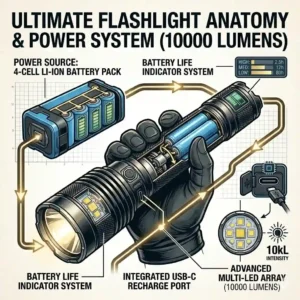
The Sofirn Q8 Plus utilizes six XHP50.2 LEDs and runs on three 21700 batteries to deliver a staggering maximum output hovering around 16,000 lumens. It utilizes the open-source Andúril 2 user interface. This UI means you have infinite, smooth ramping of brightness rather than fixed stepped modes. It allows you to dial in the exact amount of light you need, stretching your battery life efficiently.
This is the light I recommend for rural property owners or homesteaders. The large, heavy “soda can” style body provides excellent thermal mass. Unlike the tiny Imalent, the Sofirn Q8 Plus can absorb its own heat, allowing it to sustain 4,000+ lumens for significantly longer periods. If you need to survey a fenceline or check on livestock at 2 AM, this light gives you the sustained output required for the job.
However, the Andúril 2 firmware has a steep learning curve. The manual looks like a flowchart for a nuclear reactor. My insider tip: leave it in “Simple UI” mode when you first take it out of the box, or you will accidentally lock yourself out of the light in the dark.
-
Customer Feedback: Enthusiasts praise the immense power and battery capacity, but beginners often find the user interface overly complicated.
-
✅ Massive thermal mass for sustained brightness
-
✅ Open-source Andúril 2 offers ultimate customization
-
✅ Uses three standard high-drain 21700 batteries
-
❌ Very heavy and bulky (requires a holster)
-
❌ Complex user interface can be daunting
-
Price Verdict: In the $80-$110 range, it is an absolute steal for power users who don’t mind the bulk.
5. Olight Marauder 2 — The Premium Hybrid
The Olight Marauder 2 is a masterpiece of optical engineering, featuring a central large LED for a tight spotlight, surrounded by a ring of smaller LEDs for a massive floodlight, generating up to 14,000 lumens. It runs on a customized internal battery pack consisting of three 21700 cells and features 30W two-way fast charging. Practically, this means you can use the flashlight as a heavy-duty power bank to fast-charge your smartphone multiple times during a blackout.
For search and rescue, or marine navigation, this is the cream of the crop. The toggle switch between spot and flood is entirely mechanical and incredibly satisfying to use. I found that having both a 800-meter throw spotlight and a wide-angle floodlight in one device eliminated my need to carry two separate flashlights on expeditions. The built-in rotary knob for brightness adjustment is intuitive even when wearing thick winter gloves.
The major drawback is the proprietary, non-user-replaceable battery pack. Once the internal cells degrade after 3-5 years of heavy use, the light must be sent back to the manufacturer. However, the build quality, including a thermal sensor that automatically dims the light if it gets too close to an object (preventing fires), makes it a remarkably safe and refined tool.
-
Customer Feedback: Users revere the spot/flood toggling and phenomenal build quality, though the non-replaceable battery is a common point of contention.
-
✅ Brilliant hybrid spot and flood optics
-
✅ Rotary dial UI is intuitive and glove-friendly
-
✅ Doubles as a high-speed 30W power bank
-
❌ Expensive initial investment
-
❌ Battery pack is sealed and not user-serviceable
-
Price Verdict: At the $300-$350 range, it is a premium investment for professionals who need uncompromising reliability.
✨ Don’t Miss These Exclusive Deals!
🔍 Take your nighttime operations to the next level with these carefully selected products. Click on any highlighted item to check current pricing and availability. These tools will help you create authentic visibility and safety your family will love!
Case Study: Matching Output to Your Environment
It is easy to buy the brightest light possible, but massive output can actually be detrimental if deployed incorrectly. Let’s look at three distinct user profiles and how I match them to the correct illumination tool.
The Urban Commuter (The Flashbang Approach)
Take Sarah, a nurse who walks three blocks to her car in a dimly lit parking garage at 2 AM. A heavy, sustained-output light is a burden. She needs the Nitecore TM10K. In her scenario, the 7-second turbo limit is actually a benefit. If confronted, a 10,000-lumen burst to an aggressor’s eyes instantly destroys their night vision and causes involuntary eye closure, creating a 5-to-10 second window to escape. The flat profile fits easily into her scrub pockets, and the OLED screen ensures she knows exactly how much battery she has before leaving the hospital.
The Homestead Manager (The Marathon Runner)
My friend Marcus manages a 40-acre property in rural Texas. He needs to check on livestock and scan treelines for predators. For Marcus, the ultra-compact Imalent is useless—it overheats before he finishes his perimeter check. He needs the Sofirn Q8 Plus. The sheer thermal mass of the heavy aluminum body allows the light to sustain 4,000 lumens for an extended period. The heavy “soda can” weight isn’t an issue because he primarily uses it from the cab of his truck or during deliberate walks.
The Search & Rescue Volunteer (The Precision Instrument)
For professional woodland searchers, optical versatility is key. When I volunteer for grid searches, I use the Olight Marauder 2. You use the flood setting to illuminate the immediate trail to prevent tripping hazards, but instantly toggle to the spotlight setting to punch through dense fog and check the base of a ravine 400 yards away. The active thermal management ensures the light won’t accidentally burn a hole in a tactical vest if left on.
Taming the Thermal Step-Down: A Usage Guide
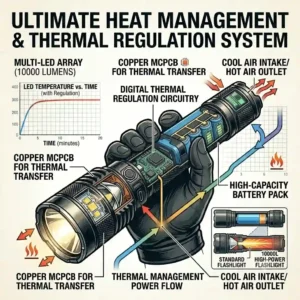
If you have never owned an ultra-high-output flashlight, you are going to encounter a frustrating phenomenon during your first week: thermal throttling. To prevent the LEDs from desoldering themselves and the lithium batteries from entering thermal runaway, all high-end lights feature temperature regulation.
The First 30 Days: Expectations vs. Reality
When you double-click for maximum output, do not expect it to last. Depending on the ambient temperature and the mass of the flashlight, turbo mode will last anywhere from 10 seconds to 3 minutes before the light automatically dims.
Optimization Tricks:
-
The Cooling Grip: Your hand acts as a heat sink. Holding the light tightly with a full grip near the head of the flashlight actually draws heat away from the chassis and into your bloodstream, allowing the light to sustain high outputs for 15-20% longer than if it were tail-standing on a table.
-
Wind and Water: If you are using a waterproof model like the Fenix LR35R, periodically dunking the head in a stream, or simply holding it out in a cold breeze, will trick the thermal sensor into giving you another burst of maximum power.
-
Contact Maintenance: Every 30 days, take a microfiber cloth and isopropyl alcohol to clean the threads and contact points of the battery tube. At 10,000 lumens, these lights are pulling 30+ amps. Even a microscopic layer of pocket lint or oxidized grease on the threads introduces electrical resistance, which lowers your output and creates dangerous internal heat. Apply a fresh layer of silicone grease to the O-rings afterward.
How to Choose the Right Ultra-High Lumen Light
Navigating the spec sheets of modern flashlights requires a keen eye. Marketers know that “lumens” sell boxes, but as an expert, I look at the holistic build of the device.
-
Assess Thermal Mass: Look at the weight and the cooling fins. A light that claims 10,000 lumens but weighs only 4 ounces is physically incapable of holding that brightness for more than a few seconds. If you need sustained high light, you must buy a heavier, thicker light. Period.
-
Evaluate Battery Chemistry: To push ultra-high lumens, you need high-drain batteries. Standard AA or even standard 18650 lithium cells cannot output the necessary amperage. You must ensure the light utilizes high-drain 21700 batteries or a proprietary high-discharge pack.
-
Check the User Interface (UI): High lumens require fast access. If you hear a bump in the night, you shouldn’t have to cycle through “Low, Medium, High, SOS, Strobe” to get to maximum output. Look for lights that offer instant access to Turbo via a double-click or a dedicated tail switch.
-
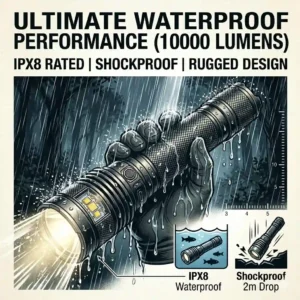
Understand the IP Rating: If you are outdoors, IP68 is the gold standard (dust-tight and submersible). IPX4 (splash resistant) is fine for walking the dog, but it will fail in a torrential downpour.
True Lumen Output vs. Marketing Hype
One of the most common mistakes when buying high-output lights is falling for cheap knockoffs on major retail sites. You will frequently see generic flashlights claiming “100,000 Lumens!” for $29.99. This is scientifically impossible with current LED technology in a handheld format.
Legitimate manufacturers adhere to the ANSI/NEMA FL1 Standard, a set of testing guidelines established to ensure uniform measuring of flashlight performance. You can read more about these rigorous testing protocols on authoritative sites like Wikipedia’s guide to the FL1 standard.
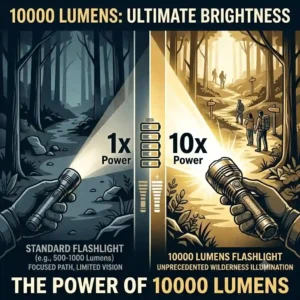
When a reputable brand claims 10,000 lumens, they are measuring the light output within the an integrating sphere in a laboratory between 30 and 120 seconds after the light is turned on. However, the human eye perceives brightness logarithmically, not linearly. A flashlight with 10000 lumens does not look ten times brighter than a 1,000-lumen light; it looks roughly two to three times brighter. The real advantage of massive lumen counts is not blinding intensity in one spot, but the ability to spread that light over a massive, football-field-sized area (flood) while still maintaining high visibility.
Spotlight vs. Floodlight Optics Explained
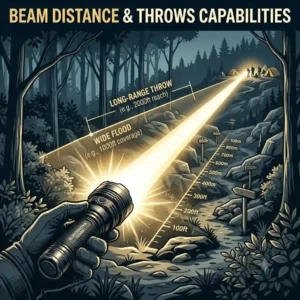
The raw lumen number tells you the total volume of light leaving the flashlight. But how that light is shaped by the reflector or TIR (Total Internal Reflection) optic dictates what the light is actually good for. This is measured in Candela.
High Candela (Spotlights)
If a light uses a deep, smooth reflector or a focused TIR optic, it gathers all those lumens and shoots them in a tight laser-like beam. This is ideal for hunting, search and rescue, or marine use. It pierces through atmospheric moisture. However, up close, a high-candela beam is blindingly harsh and gives you zero peripheral vision.
Low Candela / High Lumen (Floodlights)
If a light uses multiple shallow, orange-peel (textured) reflectors, it creates a massive “wall of light.” The Imalent MS03 is a perfect example of this. It will not throw light half a mile away, but it will vividly illuminate every tree, rock, and hazard within a 100-yard radius.
My advice? If you are moving fast (mountain biking, running) or need to see distant markers, prioritize candela. If you are doing photography, setting up a campsite, or clearing a warehouse, prioritize flood. Hybrid lights like the Olight Marauder 2 give you the best of both worlds, though at a significant cost premium.
Safety and Aviation Regulations for Lithium-Ion Power
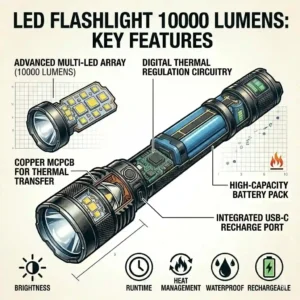
Carrying a flashlight with 10000 lumens is effectively carrying a controlled thermal event in your pocket. The energy density of multiple high-drain 21700 lithium-ion batteries is immense.
The Fire Risk
Never, ever leave an ultra-high-output light unsecured in a bag without physically locking it out. Most premium lights have an electronic lockout (usually holding the switch for 3 seconds), but I prefer a mechanical lockout. Simply unscrew the tail cap a quarter-turn. This breaks the electrical circuit. If one of these lights accidentally turns on inside a backpack, the heat generated by the lens will ignite nylon or paper within minutes.
Travel and Flying
If you plan to travel with these tools, you must be aware of aviation laws. The FAA strictly prohibits spare lithium-ion batteries in checked luggage due to the risk of cargo fires. All high-output flashlights and their spare batteries must be carried in your carry-on baggage. Furthermore, the battery capacity must generally fall under the 100 Watt-hour (Wh) limit. You can review the exact regulations on the FAA’s PackSafe guidelines. Most individual 21700 batteries are around 15-18 Wh, making them perfectly safe to fly with, but massive integrated battery packs in larger searchlights require checking the label before heading to TSA.
Long-Term Cost & Battery Replacement Cycles
When calculating the total cost of ownership for a premium flashlight, you must factor in battery degradation. Lithium-ion cells undergo chemical aging. After roughly 300 to 500 full charge-discharge cycles, a standard 21700 battery will lose about 20% of its total capacity.
Furthermore, high-drain batteries lose their ability to output massive amperage before they lose their total capacity. What does this mean in practice? Around year two of heavy use, you will notice your flashlight can no longer hold “Turbo” mode for as long as it used to, even on a full charge. The voltage sags too quickly under the massive load, and the flashlight’s safety sensors automatically step the brightness down.
-
For Replaceable Battery Lights (e.g., Sofirn Q8 Plus, Fenix LR35R): Expect to spend $15-$25 per battery every 2-3 years to keep the light performing like day one. This is a minimal upkeep cost for professional-grade gear.
-
For Built-in Battery Lights (e.g., Nitecore TM10K, Olight Marauder 2): When the cells degrade, the light must be sent to the manufacturer for a battery replacement service, which can cost $50-$100 and take weeks.
In my field experience, if you rely on the tool daily for your profession, opt for user-replaceable batteries so you are never left waiting on a shipping facility.
✨ Don’t Miss These Exclusive Deals!
🔍 Take your tactical illumination to the next level with these carefully selected products. Click on any highlighted item to check current pricing and availability. These tools will help you create authentic safety and situational awareness you will love!
Conclusion
Stepping into the world of ultra-high-output illumination fundamentally changes how you interact with the night. Whether you are conducting grid searches in dense forestry, managing a sprawling rural property, or simply demand the absolute best tactical gear for emergency preparedness, a true flashlight with 10000 lumens is an indispensable tool.
The most crucial takeaway from my testing is to match the tool to the task. Do not be seduced by pure numbers. If you need sustained, long-term brightness, accept the bulk and invest in a heavy thermal-mass light like the Sofirn Q8 Plus. If rapid, blinding bursts of light are your goal in an urban environment, the miniaturized engineering of the Nitecore TM10K is unparalleled. Treat these devices with respect—maintain your batteries, utilize your lockouts, and never underestimate the heat they can generate.
FAQs
❓ What is a flashlight with 10000 lumens capable of?
✅ A flashlight with 10000 lumens is capable of illuminating an area the size of three football fields simultaneously. It produces enough intense light to momentarily disorient an attacker, signal rescue aircraft, and pierce through thick environmental fog or smoke when paired with the right optics…
❓ How long do batteries last on 10,000 lumens?
✅ Extremely fast. On maximum turbo output, high-drain lithium-ion batteries will typically deplete in 45 to 60 minutes. However, thermal throttling usually steps the light down to a lower brightness after 1-3 minutes, extending the practical runtime to several hours…
❓ Can a high lumen flashlight start a fire?
✅ Yes. Flashlights producing 10,000 lumens or more generate intense thermal radiation at the lens. If turned on while pressed against dark fabric, paper, or upholstery, they can reach ignition temperatures in under a minute. Always use physical or electronic lockouts during transport…
❓ Are Amazon flashlights claiming 100,000 lumens real?
✅ No. It is currently impossible for a cheap, handheld, single-battery flashlight to produce 100,000 lumens. These are fraudulent marketing claims. Authentic high-output lights from reputable brands top out around 40,000 to 100,000 lumens but cost hundreds of dollars and weigh several pounds…
❓ Which is better for high lumens, 18650 or 21700 batteries?
✅ The 21700 battery is vastly superior for ultra-high-output flashlights. It offers up to 40% more capacity and significantly higher sustained discharge rates than an 18650 cell, providing longer runtimes and better performance for power-hungry LEDs in modern tactical lights…
Recommended for You
- 7 Best 800000 Lumen Light: Brightest Tactical 2025
- 7 Best Automotive Shop Lights for a Brighter Garage in 2026
- 1000 Lumens Flashlight: The Ultimate Expert Buying Guide 🔦 for Powerful Illumination
Disclaimer: This article contains affiliate links. As an Amazon Associate, I earn from qualifying purchases. If you purchase products through these links, we may earn a small commission at no additional cost to you.
✨ Found this helpful? Share it with your friends! 💬🤗
[addtoany]
