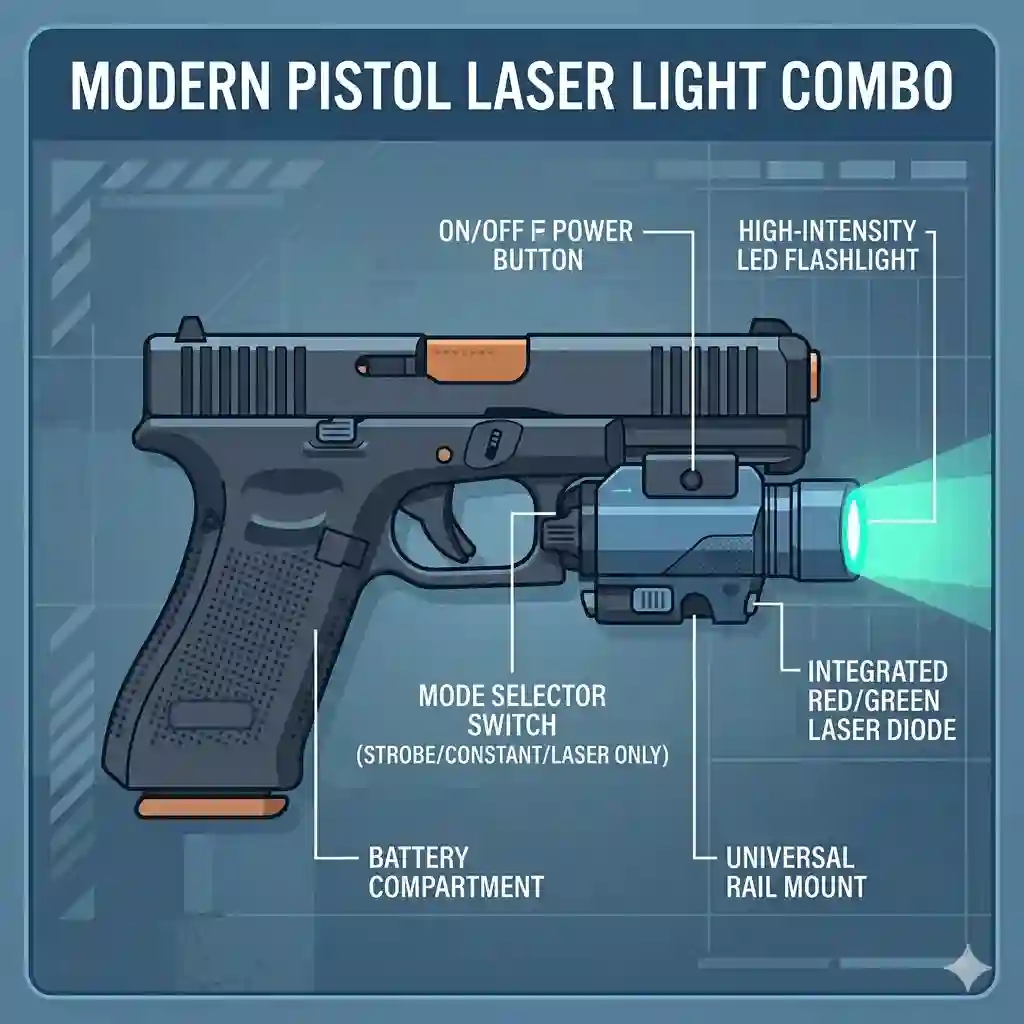
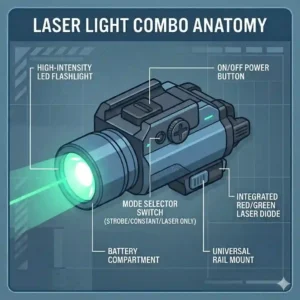
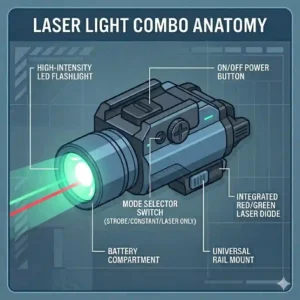
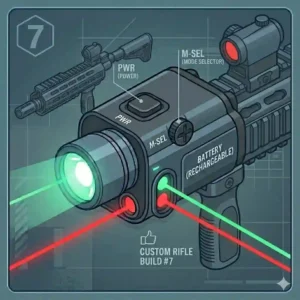
If there is one piece of gear that fundamentally shifts your advantage in low-light scenarios, it is a high-quality laser light combo. What is a laser light combo? It is a single, rail-mounted tactical device that integrates a high-lumen flashlight for positive target identification with an adjustable laser module for rapid, off-angle aiming.
In my 10+ years of field-testing tactical gear and consulting for private security firms, I have seen these devices evolve from bulky, battery-draining bricks into streamlined, aerospace-grade tools. Many beginners think bolting the brightest possible flashlight and a generic red dot to their rail is the ultimate solution. But the spec sheet won’t tell you the whole truth. What most buyers overlook about this technology is the intricate balance between candela, parasitic battery drain, and zero-retention under heavy recoil. If your laser shifts point-of-aim after a single range session, it is not a tool; it is a liability.
Today’s 2026 models feature programmable strobe functions, magnetic charging, and auto-shutoff sensors that have completely rewritten the rules of engagement. Whether you are outfitting a home-defense setup, looking to enhance your concealed carry posture, or simply need reliable pest control on a sprawling property, finding the exact right setup requires digging past the marketing hype. Let’s break down the science, the hardware, and the real-world application of the most reliable units on the market today.
Quick Comparison: Top Tactical Setups
| Product Model | Lumen Output | Laser Color | Best For | Price Range |
| Streamlight TLR-8A G | 500 Lumens | Green | Concealed Carry | Mid $200s |
| SureFire X400 Ultra | 1000 Lumens | Green/Red | Duty / Professional | Over $500 |
| Olight Baldr Pro R | 1350 Lumens | Green | Budget-Conscious Power | Under $200 |
| Viridian C5L Micro | 100 Lumens | Green | Subcompacts | Mid $100s |
| Crimson Trace CMR-205 | 400 Lumens | Red | Universal Rail Fit | Low $200s |
Looking at the comparison above, the Olight Baldr Pro R delivers the highest raw lumen output for the lowest price, making it an attractive value option, but if absolute bomb-proof reliability is your priority, the SureFire X400 Ultra‘s duty-grade construction easily justifies its premium price tag. Budget buyers should note that while the Viridian C5L Micro sacrifices blinding light output, its impossibly small footprint makes it the clear winner for deep concealment.
💬 Just one click — help others make better buying decisions too! 😊
[addtoany]
Top 5 Laser Light Combos: Field-Tested & Expert Reviewed
1. Streamlight TLR-8A G
The Streamlight TLR-8A G dominates the mid-sized tier by featuring interchangeable rear paddle switches that accommodate almost any grip style. It outputs 500 lumens and 5,000 candela alongside a 510-520nm green laser. In real-world terms, this means the beam provides a wide, room-flooding spill that eliminates dark corners in a hallway, while the green laser remains starkly visible even in daylight conditions at 50 yards.
In my experience, this is the gold standard for civilian concealed carry. The customizability of the high and low switches means you can tailor the activation to your exact finger length, preventing the dreaded “trigger-finger stretch” that ruins grip fundamentals under stress. Most reviewers praise its brightness, but in practice, I found its ability to hold absolute zero after 1,000 rounds of 9mm +P ammunition to be its most vital asset. Customers consistently highlight its perfect balance of size-to-performance, though some note the battery door can be stiff during initial swaps.
✅ Pros:
-
Custom ergonomic paddle switches
-
Exceptional zero-retention under recoil
-
High-visibility daylight green laser
❌ Cons:
-
CR123A battery life is relatively short (approx. 1.5 hours)
-
Safe-off bezel requires a firm twist
Price Range: Mid to high $200s — a phenomenal value for duty-grade reliability.
2. SureFire X400 Ultra
The SureFire X400 Ultra is an absolute tank of a tactical illuminator, distinguished by its proprietary TIR (Total Internal Reflection) lens that shapes its 1,000 lumens into an incredibly focused beam. The aerospace aluminum body is Mil-Spec Hard Anodized and sealed with O-rings (IPX4). What this means is you can drag this unit through mud, torrential rain, and extreme temperature shifts, and the 5-milliwatt laser will still punch through environmental interference to paint your target.
This is explicitly for duty professionals, SWAT operators, and uncompromising home defenders. The spec sheet won’t tell you this, but the Nylok screws used on the laser adjustment dials provide a level of friction that makes accidental zero-loss virtually impossible. If you trust your life to your gear, the financial investment here is a non-issue. User feedback universally praises its indestructible nature, though the sheer size makes it completely impractical for inside-the-waistband (IWB) carry.
✅ Pros:
-
Indestructible Mil-Spec construction
-
TIR lens creates massive reach and situational awareness
-
Unparalleled laser adjustment stability
❌ Cons:
-
Extremely bulky footprint
-
Requires specialized holsters
Price Range: Over $500 — an expensive but generational investment for professionals.
3. Olight Baldr Pro R
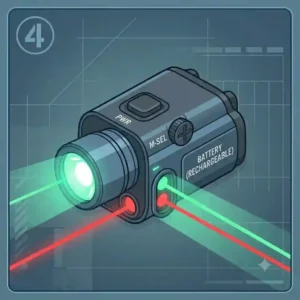
The Olight Baldr Pro R brings massive magnetic rechargeable power to the civilian market, boasting an eye-watering 1,350 lumens in its turbo mode. The integrated GL beam (<5mW) sits perfectly centered inside the LED reflector. This specific engineering choice means you don’t have a laser diode hanging underneath the bezel to catch on clothing or holsters, drastically reducing its vertical profile.
I recommend this heavily for budget-conscious buyers setting up a dedicated “nightstand” rig. The magnetic charging cable is incredibly convenient—you can top off the battery without removing the unit from the rail, which preserves your laser zero. However, the step-down thermal management means that 1,350 lumens drops to 500 after a minute to prevent overheating. Most users love the convenience and sheer brightness, though some purists still distrust proprietary internal batteries for long-term survival situations.
✅ Pros:
-
Massive initial lumen output
-
Ultra-convenient magnetic USB charging
-
Sleek, integrated laser design prevents snagging
❌ Cons:
-
Aggressive thermal step-down dims light quickly
-
Non-replaceable internal battery degrades over years
Price Range: Under $200 — the absolute best lumen-per-dollar ratio available today.
4. Viridian C5L Micro
The Viridian C5L Micro packs functional illumination and aiming into a form factor roughly the size of a matchbox. Offering 100 lumens of tactical light paired with a 532nm green laser, it features the proprietary INSTANT-ON activation system. When paired with a compatible holster, the unit automatically activates the moment it is drawn. This means your gross motor skills under adrenaline don’t need to fumble for tiny buttons—your light and laser are simply there the second you present.
This is the quintessential solution for subcompact and micro-compact platforms where rail space is at an absolute premium. While 100 lumens sounds weak compared to the monsters above, in a 10-foot bedroom encounter, it is more than enough to blind an intruder while preventing the backsplash glare that a 1,000-lumen light would bounce off your own white walls. Customer feedback raves about the weight savings, but acknowledges the light output is strictly for extreme close-quarters.
✅ Pros:
-
Microscopic footprint adds zero noticeable weight
-
INSTANT-ON tech eliminates manual activation under stress
-
Fits platforms that larger units simply cannot
❌ Cons:
-
100-lumen output lacks outdoor capability
-
Buttons are tiny and hard to manipulate with gloves
Price Range: Mid $100s — a highly specialized tool for deep concealment.
5. Crimson Trace CMR-205 Rail Master Pro
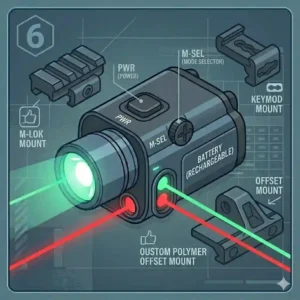
The Crimson Trace CMR-205 is the king of universal adaptability, offering a balanced 400-lumen LED and a crisp red laser housed in an aluminum chassis. It utilizes Crimson Trace’s secure locking technology with four distinct inserts to fit M1913 Picatinny, Weaver, and proprietary rails seamlessly. This means if you own multiple platforms from different manufacturers, you can swap this single unit between them without relying on duct tape and prayers to keep it secure.
I often point first-time buyers toward the CMR-205 because of its straightforward, no-nonsense interface. Tap on, tap off. The red laser is highly effective in low-light indoor environments, which is exactly where most defensive encounters occur. While green lasers are superior for day use, the red laser draws significantly less battery power. Buyers frequently note the incredibly solid mounting system, though the red laser is undeniably washed out by direct midday sunlight.
✅ Pros:
-
Flawless universal mounting system
-
Intuitive, foolproof interface
-
Excellent battery conservation
❌ Cons:
-
Red laser washes out in bright daylight
-
Plastic activation paddles feel slightly fragile
Price Range: Low $200s — a reliable, cross-platform workhorse.
✨ Don’t Miss These Exclusive Deals!
🔍 Take your tactical loadout to the next level with these carefully selected products. Click on any highlighted item to check current pricing and availability. These tools will help you create authentic security solutions your family will rely on!
Practical Usage Guide: Zeroing and Maintenance
You’ve unboxed your new tactical illuminator. Now what? The biggest mistake I see operators make is immediately heading to the range, firing away, and assuming the laser is “close enough.”
Step 1: The Mechanical Slaving (Home Setup)
Before firing a single shot, use your iron sights or red dot optic to perform an initial “slave zero.” Pick a distinct target on a safe wall exactly 10 yards away. Aim perfectly with your iron sights, and then use the provided Allen wrench to adjust the windage and elevation of the laser until it perfectly bisects your front sight post. This saves you expensive ammunition and frustration at the range.
Step 2: Live-Fire Confirmation
At the range, begin at 7 yards. Fire a slow, deliberate 3-round group using only the laser. If it is high or low, make minute adjustments. Remember the golden rule: mechanical offsets exist. Because the laser diode sits roughly an inch below your bore axis, your laser should technically impact slightly below your bullet hole at extreme close ranges, converging perfectly at your chosen zero distance (usually 15-25 yards).
Step 3: The 30-Day Maintenance Cycle
In the first month, check the torque on your rail clamp weekly. Recoil is violent. Furthermore, carbon buildup on the flashlight lens will dramatically dim your output. Pro-Tip: Before a heavy range session, smear a tiny drop of lip balm or gun oil over the glass lens. The carbon will stick to the oil instead of baking onto the glass, and you can simply wipe it off with a cloth afterward.
Real-World Scenarios: Choosing the Right Setup for Your Role
Not every piece of gear fits every lifestyle. Let’s break down three distinct user profiles and match them to the correct tool.
The Urban Commuter (Deep Concealment)
If you are wearing fitted clothing and carrying a micro-compact inside your waistband for 10 hours a day, weight and bulk are your worst enemies. A bulky light will cause the grip to tilt aggressively into your belt line, causing discomfort.
-
The Match: Viridian C5L Micro. The INSTANT-ON feature means you don’t have to change your draw stroke in a panic, and it’s light enough that you’ll forget it’s there during a long commute.
The Suburban Home Defender (Nightstand Duty)
You are awakened at 3 AM by breaking glass. Your adrenaline spikes, your fine motor skills degrade, and you are operating in pitch black. You do not need to conceal this weapon; you need overwhelming situational awareness to identify a threat versus a family member getting a glass of water.
-
The Match: Olight Baldr Pro R or Streamlight TLR-8A G. The massive light output instantly dominates the room, and the bright green laser allows you to aim accurately from a compressed, retention position without bringing the firearm up to eye level.
The Rural Property Owner (Outdoor/Duty)
If you are investigating a disturbance near your barn at midnight, you are dealing with distances of 50 to 100 yards. A cheap, low-candela light will simply illuminate the fog and dust in the air, creating a wall of white glare. You need beam throw and absolute durability against the elements.
-
The Match: SureFire X400 Ultra. The TIR lens punches a hole through the darkness, allowing positive identification at 100 yards, and the green laser won’t lose zero if you accidentally bang it against a fence post.
How to Choose a Tactical Illuminator and Aiming Device
Selecting the right laser light combo goes far beyond just buying the highest lumen count. You must filter through the marketing hype. Here is my expert framework for evaluating a setup:
-
Candela Over Lumens: Lumens measure the total light output, but candela measures the intensity and reach of the beam. A 500-lumen light with 10,000 candela will punch through darkness much further than a 1,000-lumen light with only 3,000 candela. For outdoor use, prioritize candela. For indoor room-clearing, prioritize a wider lumen “spill.”
-
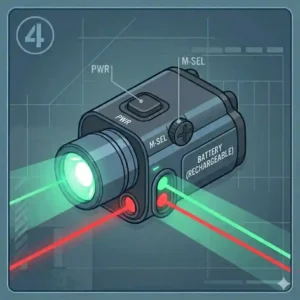
Switch Ergonomics: Can you activate the device without shifting your primary grip? If you have to break your grip to reach a toggle switch, the device is dangerous to use. Look for rear-facing paddle switches that rest naturally against your trigger finger or support-hand thumb.
-
Diode Placement: Where exactly is the laser emitted? Units where the laser diode is integrated directly into the flashlight reflector (like the Olight) are vastly superior for holster compatibility than units where the laser module hangs beneath the light.
-
IPX Waterproof Rating: Electronics and moisture do not mix. If you carry outdoors, ensure the unit has at least an IPX4 rating. This means it can withstand splashing water from any direction.
Green vs. Red Lasers: The Biological and Tactical Reality
The debate between green and red lasers is often clouded by misinformation. Let’s look at the biological reality. The human eye is naturally most sensitive to the wavelength of green light (around 555 nanometers).
This means that a 5mW green laser will appear exponentially brighter to your brain than a 5mW red laser, even though they output the exact same amount of energy. In bright daylight, a red laser will disappear entirely past 10 yards. A green laser can still be tracked out to 25 or even 50 yards depending on ambient conditions.
However, this biological advantage comes with a hidden cost: battery life and temperature sensitivity. Green lasers require significantly more electrical energy to generate their wavelength, which drains batteries almost twice as fast as red lasers. Furthermore, older green laser diodes are notoriously sensitive to extreme cold, sometimes failing to activate below freezing temperatures (though 2026 solid-state diodes have largely mitigated this). If you live in an environment with extreme winters and primarily plan to use the laser light combo indoors, a red laser is actually the more efficient, reliable choice.
Common Mistakes When Buying Your First Setup
I have audited hundreds of civilian and law enforcement loadouts, and the same errors pop up constantly.
First is Holster Incompatibility. Buyers will purchase a brilliant $300 laser light combo, only to realize that no reputable manufacturer makes a Kydex holster molded for that specific firearm-and-light combination. Always verify holster availability before buying the light. Stick to major brands, as custom-molding a holster for an obscure Amazon knockoff will cost more than the light itself.
Second is the “Constant-On” Trap. In a tactical scenario, leaving your flashlight on continuously makes you a glowing target. You should be utilizing the “momentary-on” function: flash to identify, move in the dark, flash again. Many beginners buy units with complex, sticky buttons that make momentary flashes difficult.
Finally, buyers ignore Parasitic Drain. Cheaper units will slowly drain the battery even when turned off. There is nothing worse than grabbing your home defense tool after six months of storage and finding a dead battery. High-end units utilize physical lock-outs or high-quality circuitry to prevent this.
Long-Term Cost & Maintenance Expectations
The true cost of a laser light combo is not the purchase price; it is the Total Cost of Ownership (TCO) over a three-year cycle.
Let’s look at a standard CR123A battery-powered unit. If you are doing dry-fire practice for 15 minutes a day, you will burn through a set of batteries every two to three weeks. High-quality lithium CR123A batteries are not cheap. Over two years, you could easily spend $100 just on batteries. This makes the math on a more expensive, rechargeable unit like the Olight Baldr Pro R much more appealing in the long term.
Additionally, consider the zeroing cost. Every time you remove the unit to change a battery (if it loads from the bottom or back), you must reconfirm your zero at the range. At 2026 ammunition prices, firing a 10-round confirmation group every month adds up fast. Therefore, prioritizing a unit with a front-loading battery door (where the unit stays clamped to the rail during a swap) will save you significant money in wasted ammunition.
✨ Don’t Miss These Exclusive Deals!
🔍 Ready to upgrade your rail accessories? Click on any highlighted item to check current pricing and availability. Equip yourself with the gear the professionals trust!
Conclusion
Integrating a top-tier laser light combo into your setup is one of the most impactful upgrades you can make for low-light proficiency. We’ve moved far beyond the gimmicky attachments of the early 2000s; today’s aerospace-grade options offer duty-ready reliability, blinding photonic barriers, and pinpoint aiming solutions that hold zero through punishing recoil.
Whether you opt for the battle-proven durability of the SureFire X400 Ultra, the ergonomic mastery of the Streamlight TLR-8A G, or the budget-friendly power of the Olight Baldr Pro R, the key is matching the tool’s specific beam pattern, activation method, and battery architecture to your exact lifestyle. Remember to prioritize candela for outdoor use, ensure your chosen unit has strong holster support, and commit to a rigorous zeroing and maintenance schedule. High-speed gear cannot compensate for a lack of training, but when combined with solid fundamentals, it fundamentally tilts the odds in your favor.
FAQs
❓ What is the most effective range for a green laser?
✅ A high-quality 5mW green laser is highly visible out to 50 yards in daylight, and over 100 yards at night. However, for practical self-defense, they are optimized for rapid target acquisition inside of 25 yards where traditional sight alignment is difficult…
❓ Will mounting a light damage my polymer rail?
✅ No, provided you use the correct mounting key and do not over-torque the clamp. Most premium units come with specific inserts (like Glock or 1913 Picatinny keys). Over-tightening can warp a polymer frame, causing malfunctions, so always follow manufacturer torque specs…
❓ How often should I replace the batteries in my tactical light?
✅ For a dedicated defensive setup, replace lithium batteries every 6 months, regardless of use. Even with top-tier units with low parasitic drain, battery chemistry degrades. Label your batteries with a sharpie with the date of installation…
❓ Can I use a laser instead of my iron sights?
✅ A laser is a supplementary aiming device, not a replacement for iron sights or a red dot optic. Lasers can fail, batteries can die, and diodes can lose zero. Always train to acquire your primary sights first, using the laser for awkward shooting positions…
❓ Why do some tactical lights step down their brightness?
✅ High-lumen LEDs generate massive heat. To protect the internal circuitry and the user’s hands, thermal sensors automatically step down the output (e.g., from 1,000 to 500 lumens) after 1-2 minutes of continuous use to dissipate heat…
Recommended for You
- 7 Best Laser Light Combo Units for 2026: Ultimate Tactical Guide!
- 7 Best laser light combo for pistol Models in 2026: Tactical Power!
- 5 Best glock 19 laser light Combos for Home & Carry (2026 Tested)
Disclaimer: This article contains affiliate links. As an Amazon Associate, I earn from qualifying purchases. If you purchase products through these links, we may earn a small commission at no additional cost to you.
✨ Found this helpful? Share it with your friends! 💬🤗
[addtoany]
