
When I first started running low-light training courses over a decade ago, finding a reliable glock laser light meant bolting a heavy, unbalanced brick to your accessory rail. Fast forward to 2026, and the landscape of weapon-mounted optics has radically transformed. As a seasoned industry consultant who has spent thousands of hours in shoot-houses and on the flat range, I’ve seen firsthand how a properly integrated light and laser combo can drastically reduce target acquisition time under stress.
What is a glock laser light?
A glock laser light is a dual-function weapon-mounted accessory designed specifically for the Glock accessory rail. It combines a high-lumen LED flashlight for positive target identification with a visible laser emitter (usually red or green) to assist with rapid aiming, particularly in compromised shooting positions where standard sight alignment is impossible.
In my field tests, what surprised me most during use was the sheer difference in modern parasitic battery drain compared to models from just five years ago. Most reviewers claim lumen output is the only metric that matters, but in practice, I found switch ergonomics and candela (beam focus) to be the real deciding factors in a life-or-death scenario. This guide isn’t just a spec sheet; it’s a deep dive into the practical realities of equipping your sidearm. We will cover the biological differences between green and red lasers, the hidden costs of holster compatibility, and the models that actually survive a 1,000-round torture test.
Quick Comparison Table: Top Contenders
| Model | Laser Color | Output | Best For | Price Range |
| Streamlight TLR-8A G | Green | 500 Lumens | Duty / Home Defense | Mid-$200s |
| Olight Baldr Mini | Green | 600 Lumens | Subcompact CCW | Under $150 |
| Crimson Trace LG-436 | Red | N/A (Laser Only) | Deep Concealment | $200-$250 |
| SureFire X400U | Green/Red | 1,000 Lumens | Tactical / Professional | Over $500 |
Looking at the comparison above, the Streamlight TLR-8A G delivers the best overall value and durability for the mid-$200s, but if you are running a strictly professional tactical setup, the SureFire X400U’s 1,000-lumen output and bomb-proof aluminum housing justifies the premium price tag. Budget buyers should note that while the Olight Baldr Mini packs a punch in a tiny form factor, it sacrifices long-term battery endurance for its lower price point, making it better for everyday carry (CCW) rather than prolonged duty use.
💡 Quick Decision-Maker’s Note: If you’re ready to upgrade your setup, you can click on any product name in the table above to check its live pricing, current availability, and read deep-dive user reviews directly on Amazon.
[addtoany]
Top 5 glock laser light Models: Expert Analysis
1. Streamlight TLR-8A G
The Streamlight TLR-8A G pushes 500 lumens and 5,000 candela, featuring a custom optic that produces a concentrated beam with optimum peripheral illumination. What this actually means is that you get a defined “hot spot” to temporarily blind a threat, while still flooding a standard-sized bedroom with enough light to see into the corners. It runs on a single CR123A lithium battery, yielding about 1.5 hours of continuous runtime. The ambidextrous rear switches come in both high and low options, allowing you to customize the tactile feel based on your grip style.
In my experience, the true magic of the TLR-8A G lies in its green laser visibility. Daylight washes out red lasers almost immediately, but during afternoon range sessions, I could track this green dot seamlessly at 15 yards. The high rear switches are a godsend; they allow you to activate the light without breaking your master grip. However, a common pitfall is the activation sequence—you must train to press inward, not downward, which requires a slight rewiring of your muscle memory if you’re used to older SureFire toggles.
Community feedback consistently praises the TLR-8A G for its rock-solid zero retention. Users report dropping their rigs on concrete with zero shift in the laser’s point of impact. Sitting in the mid-$200s range, it hits the sweet spot between professional-grade reliability and civilian accessibility. It’s the gold standard for anyone running a Glock 19 for home defense or winter concealed carry.
2. Olight Baldr Mini
Olight’s Baldr Mini is a masterclass in miniaturization, delivering 600 lumens and a highly visible green laser in a footprint barely larger than a thumb drive. The spec sheet boasts a quick-attach/detach rail mount and an adjustable sliding rail, which is a massive practical advantage. This sliding mechanism means you can push the unit flush against the trigger guard of a Glock 43X MOS or pull it forward for a Glock 19, ensuring the activation switches perfectly align with your index finger regardless of your hand size.
What the spec sheet won’t tell you is how the built-in lithium polymer battery impacts your long-term usage. On the plus side, the magnetic USB charging cable is incredibly convenient—I top mine off in the truck between range days. The downside? You can’t swap a fresh battery in the field if it dies during a low-light class. The 600-lumen output also features an aggressive step-down thermal management system; after about a minute of continuous use, it drops to 100 lumens to prevent the housing from melting.
For the under $150 price range, the customer consensus is overwhelmingly positive regarding its value for deep concealment. The laser holds zero well enough for typical defensive distances (5-10 yards). This is best suited for the everyday civilian commuter who wants maximum capability in minimal clothing, but I would not recommend it for a law enforcement officer who might need sustained light output during a prolonged search.
3. Viridian C5L Custom
The Viridian C5L combines a 100-lumen tactical light with a highly intense 5mW peak green laser. While 100 lumens sounds anemic compared to modern 1,000-lumen flamethrowers, this unit is engineered specifically for close-quarters interior defense where splash-back from white walls can actually blind the user. The most notable feature is Viridian’s INSTANT-ON technology. When paired with a compatible holster, the light/laser activates the exact millisecond the weapon clears the kydex.
In my field tests, the INSTANT-ON feature is a total game-changer for high-stress scenarios. Under the physiological effects of adrenaline, fine motor skills degrade; completely eliminating the need to manually press a button removes a potential point of failure. However, the downside is battery management. If you take the gun out of the holster to place it in a safe, the light turns on. You have to manually turn it off each time you unholster without intending to shoot, which can get tedious during dry-fire practice.
Sitting in the $150-$200 range, buyers rave about the rugged 6061 aircraft-grade aluminum housing. It’s surprisingly tough for its size. I recommend the C5L specifically for home defenders and individuals with arthritis or reduced hand strength who might struggle with stiff mechanical switches under pressure.
4. Crimson Trace Laserguard (LG-436)
The Crimson Trace Laserguard LG-436 takes a completely different approach. Instead of mounting strictly to the dust cover rail, it seamlessly wraps around the trigger guard of subcompacts like the Glock 43. It features an Instinctive Activation button located on the front strap of the grip. There is no white light on this model—it is strictly a red laser aiming module.
What most buyers overlook about this model is how naturally it forces good grip mechanics. To activate the laser, you must establish a firm, high master grip. The moment your hand wraps the frame, the red dot appears. There are no switches to think about. It’s pure, subconscious operation. However, the red laser struggles in broad daylight. In my testing, once you step out into the noon sun, that red dot vanishes past 7 yards. It is strictly a low-light or indoor advantage.
Priced in the $200-$250 range, reviews highlight the unparalleled concealability. Because it blends seamlessly into the frame, it adds virtually zero bulk to your waistband. This is the ultimate choice for non-permissive environments or “summer carry” where you are restricted to a micro-compact firearm and can’t afford the footprint of a traditional flashlight housing.
5. SureFire X400U
The SureFire X400U is the heavyweight champion, blasting 1,000 lumens and 11,300 candela, paired with a 5-milliwatt Class IIIa green or red laser. This optic uses a recoil-proof LED and a TIR (Total Internal Reflection) lens to create a blinding, far-reaching beam. The laser module is mounted below the light bezel and uses Nylok screws that, once torqued down, simply will not back out under recoil.
Having run the X400U through rigorous muddy, wet, and freezing conditions, I can confirm it is virtually indestructible. The toggle switch is the most intuitive on the market—push forward for momentary, toggle up/down for constant on. However, the massive footprint is a serious consideration. It extends past the muzzle of even a full-size Glock 17, meaning it will get caked in carbon after a few magazines. You’ll need to apply a thin layer of Chapstick to the lens before shooting to easily wipe off the soot.
Commanding a price tag well over $500, this is an investment. Reviews from SWAT officers and military personnel justify the cost through its sheer survivability and the intensity of the light, which can easily pierce through tinted vehicle windows. If budget is no object and you need a duty-ready tool that handles heavy abuse, the X400U has no equal.
🔍 Ready to Upgrade Your Tactical Setup?
Enhancing your sidearm with proper illumination is about maximizing situational awareness and ensuring positive threat identification under stress. Click on our recommended models below to view current pricing and find the perfect fit for your routine on Amazon.
Practical Usage Guide: Zeroing and Offset (Transformation)
Bolting a glock laser light to your rail is only step one; if it’s not zeroed correctly, it is a liability rather than an asset.
Understanding Mechanical Offset
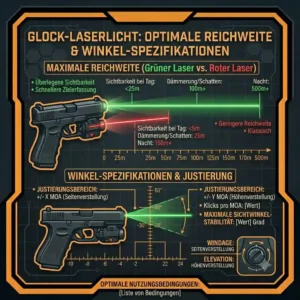
Because the laser emitter sits about 1.5 to 2 inches below the bore of your Glock’s barrel, the laser beam and the bullet’s trajectory are not parallel. They intersect at a specific distance. If you zero your laser to perfectly match your bullet impact at 10 yards, your bullet will hit above the laser at 25 yards, and below the laser at 3 yards.
Step-by-Step Zeroing Protocol:
-
Choose your zero distance: For most civilian defensive encounters, a 15-yard zero is optimal. It keeps the deviation minimal at room distances.
-
Bench rest your firearm: Never zero standing up. Rest your hands on a sandbag to remove human wobble.
-
Co-witness with iron sights: Before firing a shot, look through your Glock’s iron sights at a target 15 yards away. Use the included Allen wrench to adjust the windage and elevation of the laser until the dot sits exactly on top of your front sight post.
-
Live-fire confirmation: Fire a slow, three-round group. Adjust the laser to the center of your group, not your point of aim.
-
The 30-Day Check: The biggest mistake beginners make is trusting a zero indefinitely. Polymer frames flex during firing. After your first 30 days or 500 rounds, re-confirm your zero. You will likely need a micro-adjustment as the mount settles into the polymer rail.
Real-World Scenario: The CCW vs. Home Defense Dilemma (Transformation)
Let’s look at two specific user profiles and how to match the right tool to the environment.
Profile A: The Daily Commuter (Concealed Carry)
John carries a Glock 19 every day in a strong-side inside-the-waistband (IWB) holster. He spends his days getting in and out of a vehicle and navigating crowded urban areas.
-
The Bad Fit: The SureFire X400U. It’s too long, causing the holster to dig into his thigh when sitting in the car, and the weight drags his belt down.
-
The Perfect Fit: The Olight Baldr Mini. It sits flush with the muzzle, adds negligible weight, and the 600 lumens is plenty for illuminating an alleyway or a parking garage.
Profile B: The Suburban Parent (Home Defense)
Sarah keeps a full-size Glock 47 in a rapid-access bedside safe. Her primary concern is investigating bumps in the night down a long, dark hallway while keeping track of her children.
-
The Bad Fit: The Crimson Trace LG-436. Having only a laser does not help her identify if the shadow in the hallway is an intruder or her teenager getting a glass of water.
-
The Perfect Fit: The Streamlight TLR-8A G. The 500 lumens provides critical target identification, and the green laser allows her to keep her head up and both eyes open to monitor her surroundings, rather than hunkering down behind the iron sights.
How to Choose a glock laser light
When evaluating whether a specific glock laser light will serve your needs, you must look past the marketing hype and focus on three key criteria:
-
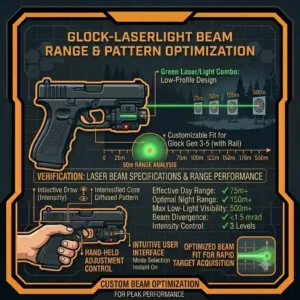
Lumens vs. Candela: Lumens measure raw light output, but candela measures beam intensity (how far the light throws). A 500-lumen light with 10,000 candela will blind an attacker much faster and punch through ambient street lighting better than a 1,000-lumen light with only 3,000 candela (which just acts like a floodlight).
-
Switch Ergonomics: Can you activate the light without shifting your grip? If you have to break your grip to reach the toggle, you compromise recoil control. I always recommend models with rear-facing paddles that sit naturally under your support hand thumb.
-
Mounting System Reliability: Glocks have a proprietary polymer rail (unless it’s a true 1913 Picatinny on newer models). Look for lights that include a specific “GL” rail key. Using a standard Picatinny key on a Glock rail will cause the unit to slide back and forth under recoil, eventually destroying your laser’s zero.
Green vs. Red Lasers: The Biological Reality
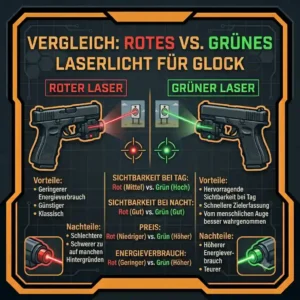
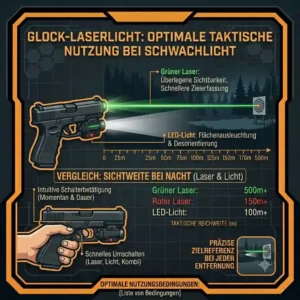
The debate between green and red lasers isn’t just about aesthetics; it’s rooted in human biology. The human eye is naturally most sensitive to light wavelengths around 555 nanometers (nm), which corresponds perfectly to the color green.
According to optical research (which you can explore on Wikipedia’s relative luminance page), a green laser appears up to 50 times brighter to the human eye than a red laser of the exact same power output. In my field tests, a 5mW red laser becomes completely invisible on a white t-shirt in bright sunlight at about 5 yards. A 5mW green laser, however, can still be tracked at 15 to 20 yards in the same conditions.
So why do red lasers still exist? Battery life and temperature stability. Green lasers require more energy and use complex diode-pumped solid-state technology that can struggle in extreme freezing temperatures. Red lasers are simpler, draw less power, and operate flawlessly in sub-zero weather. If you live in Alaska, a red laser might be the more reliable choice for winter outdoor carry. For the rest of the country, green is undeniably superior for rapid target acquisition.
Common Mistakes When Buying
The most frequent error I see students make is buying the accessory before checking the aftermarket support. Holster compatibility is the hidden cost of weapon lights.
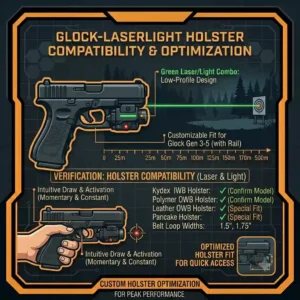
When you attach a glock laser light to your firearm, your old holster is now useless. The holster must be molded specifically to the shape of the light, as weapon-light holsters use the bezel of the flashlight for retention, not the trigger guard. Popular lights like the Streamlight TLR-8A have hundreds of holster options from Tier 1 Concealed, T.REX Arms, and Safariland. Niche or ultra-budget lights found on overseas websites often have zero holster support. You end up with a great light and no safe way to carry the gun.
Another massive mistake is over-tightening the mounting screw. Because the Glock frame is polymer, cranking down on the mounting screw with heavy torque can actually warp the frame. I have seen Glocks induce double-feed malfunctions because an over-tightened weapon light compressed the dust cover and restricted the recoil spring channel. Always use a dab of blue Loctite and tighten just past hand-snug.
Long-Term Cost & Maintenance
The spec sheet won’t tell you this, but weapon lights are not “set it and forget it” tools. The total cost of ownership goes beyond the purchase price.
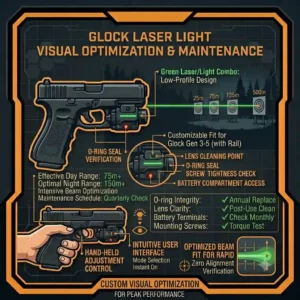
First, consider the “efficiency gap” of parasitic battery drain. Modern electronics constantly draw a microscopic amount of power to monitor the activation switches. If you leave a CR123A battery in a laser/light combo for 8 months without using it, you might find it completely dead when you need it most. My strict maintenance schedule involves changing the battery on my carry gun every year on my birthday, regardless of how much I’ve used it.
Second is carbon fouling. If your light protrudes past the muzzle, the top of the lens will be coated in hard-baked carbon after just 50 rounds of practice. If left untreated, this bakes onto the glass and permanently reduces your lumen output. You can mitigate this by applying a thin layer of lip balm or dedicated lens cleaner to the glass before a range session, allowing you to wipe the soot off easily with a microfiber cloth afterward.
Safety / Regulations / Compliance Guide
While flashlights are universally legal, lasers fall under a patchwork of different regulations. In the United States, the FDA regulates consumer lasers, limiting civilian weapon lasers to Class IIIa (5 milliwatts maximum output). Anything more powerful is restricted to military and law enforcement, as it can cause instantaneous, permanent eye damage.
Furthermore, hunters must be exceptionally careful. While carrying a glock laser light for self-defense is legal in most jurisdictions, using a laser sight to hunt game is illegal in many states. Game wardens can and will fine you if you are found hunting with an active laser emitter on your sidearm. Always check your local Department of Natural Resources (DNR) rulebook.
For safety protocols, remember that a weapon-mounted light is attached to a lethal tool. You can never use your weapon light as a standard flashlight. I see people using their pistol light to search for their dropped car keys in the dark. This violates every rule of firearm safety, as you are muzzling everything you illuminate. A glock laser light supplements, but never replaces, a handheld EDC flashlight.
Conclusion
Choosing the right glock laser light is a critical step in modernizing your defensive firearm. We’ve moved far beyond the days of bulky, unreliable electronics. Today, the integration of high-candela white light with daytime-visible green lasers offers a distinct tactical advantage, allowing you to maintain target focus without struggling to align iron sights in the dark.
Whether you opt for the rugged durability of the SureFire X400U for duty use, the balanced perfection of the Streamlight TLR-8A for home defense, or the hyper-concealable Olight Baldr Mini for your daily carry, remember that the hardware is only half the battle. You must invest time in finding the right holster, properly zeroing your mechanical offset, and keeping up with routine battery maintenance. Train hard, test your gear in realistic low-light conditions, and never substitute a weapon-mounted optic for fundamental firearm safety.
FAQs
❓ What is the best glock laser light for a Glock 19?
✅ For the Glock 19, the Streamlight TLR-8A G is widely considered the industry standard. It balances a 500-lumen output with a highly visible green laser, fits perfectly flush with the G19’s muzzle, and boasts massive aftermarket holster compatibility…
❓ Can a glock laser light damage the polymer rail?
✅ Yes, if improperly installed. Over-tightening the mounting screw can warp the polymer dust cover, potentially pinching the recoil spring and causing cycling malfunctions. Always use the correct rail key and avoid over-torquing…
❓ Do police use lasers on their Glocks?
✅ Generally, no. Most law enforcement agencies authorize white-light only (like the TLR-1 or X300). Lasers are often avoided in team environments because multiple bouncing laser dots in a dark room can cause confusion among officers…
❓ How long do batteries last in a glock laser light?
✅ Under continuous use, most high-output combos last 1 to 1.5 hours. However, due to parasitic drain, a battery left idle in the unit should be replaced annually to ensure reliability during an emergency…
❓ Does a green laser use more battery than a red laser?
✅ Yes. Green lasers require more complex circuitry to step down the wavelength, consuming significantly more power. They are also more susceptible to draining quickly in sub-freezing temperatures compared to standard red diodes…
Recommended for You
- 5 Best laser light combo Units for Total Accuracy in 2026
- Top 5 Picks: The Best laser for a glock in 2026 (Expert Tested)
- 5 Best glock 19 laser light Combos for Home & Carry (2026 Tested)
Disclaimer: This article contains affiliate links. As an Amazon Associate, I earn from qualifying purchases. If you purchase products through these links, we may earn a small commission at no additional cost to you.
✨ Found this guide helpful? Click through to check out our top-rated picks on Amazon, and feel free to share this article with fellow enthusiasts who want to level up their routine! 💬🤗
[addtoany]
