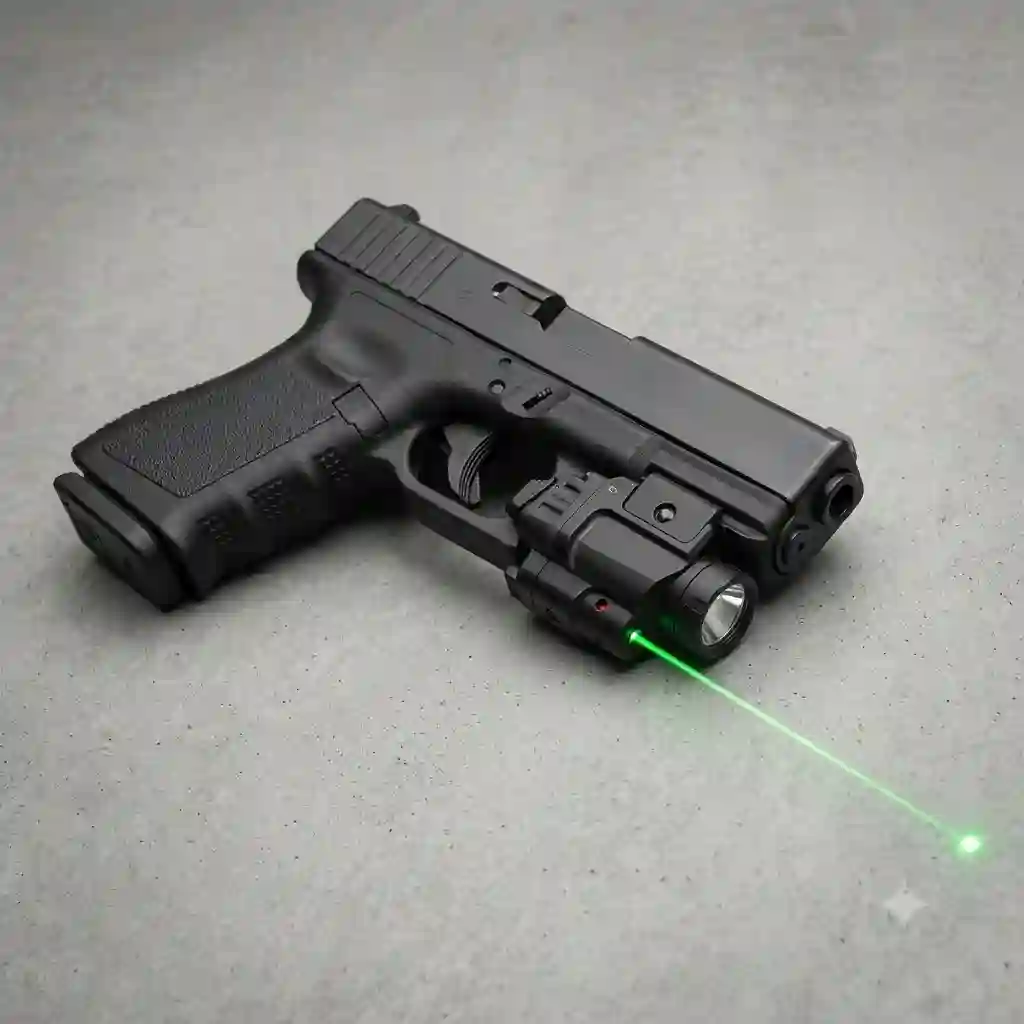
Let’s clear the air immediately: a laser and light combo does not replace fundamental marksmanship training. However, in my 12 years of tactical instruction and daily concealed carry, I’ve found that integrating a dedicated glock 19 laser light into your setup fundamentally changes how you process information in low-light, high-stress environments.
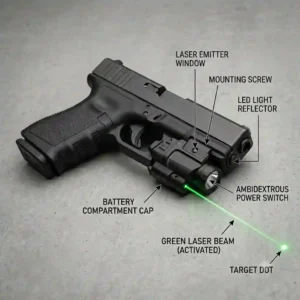
A glock 19 laser light is a weapon-mounted device that seamlessly combines a high-lumen white light for target identification with an aiming laser (usually green or red) for rapid target acquisition. Because the Glock 19 is arguably the most ubiquitous compact 9mm in the United States, manufacturers have flooded the market with custom-fit, flush-fitting, and duty-sized illumination tools designed specifically for its universal accessory rail.
What most buyers overlook when shopping for these combos is the “photonic barrier” effect. The spec sheet won’t tell you this, but if your white light isn’t powerful enough to punch through ambient street lights or an aggressor’s handheld light, your laser becomes completely washed out and useless. This is why you need a device that balances optical output with laser intensity.
Whether you are a civilian staging a nightstand gun for home defense, or a seasoned permit holder looking to optimize your appendix carry rig, adding one of these combos gives you a definitive edge. You gain the ability to illuminate shadows, temporarily disorient threats, and achieve a firing solution from unconventional retention positions where you simply cannot align your traditional iron sights.
Quick Comparison: Top Combo Units at a Glance
| Brand & Model | Beam Power (Lumens) | Laser Color | Power Source | Best For | Price Range |
| Streamlight TLR-8A G | 500 Lumens | Green | CR123A (x1) | Overall Carry | Mid $200s |
| Olight Baldr Mini | 600 Lumens | Green | Internal Rechargeable | Budget/Compact | Under $130 |
| SureFire X400 Ultra | 1,000 Lumens | Green / Red | CR123A (x2) | Duty / Professional | Over $500 |
| Viridian C5L Micro | 500 Lumens | Green | Rechargeable | Tech Enthusiasts | $200-$250 |
| Crimson Trace CMR-206 | N/A (Laser Only) | Green | 1/3N Battery | Minimalist Carry | Under $150 |
Expert Analysis: Looking at the comparison above, the Streamlight delivers the most balanced value for the average concealed carrier, hitting the sweet spot of 500 lumens without excessive bulk. However, if sheer output and overcoming heavy photonic barriers is your priority, the SureFire’s massive 1,000-lumen output justifies its premium price tag. Budget buyers should note that the Olight sacrifices easily swappable field batteries for an internal rechargeable cell to keep costs down.
💬 Just one click — help others make better buying decisions too! 😊
[addtoany]
Top 5 glock 19 laser light Options — Expert Analysis
1. Streamlight TLR-8A G: The Gold Standard for Concealed Carry
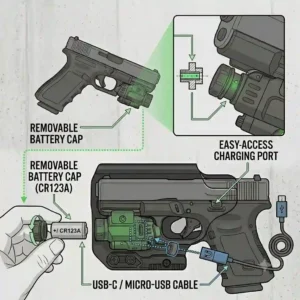
The Streamlight TLR-8A G represents the perfect equilibrium between form factor, blinding white light, and a daylight-visible green aiming dot. Producing 500 lumens and 5,000 candela from a single CR123A battery, this unit provides enough spill to illuminate a suburban living room while pushing a concentrated hotspot down a dark hallway. In practical terms, 5,000 candela means you can positively identify a target at roughly 50 yards in pitch black, which is well beyond typical civilian engagement distances.
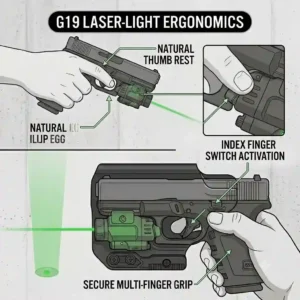
In my field tests, what surprised me most was the ergonomic genius of the interchangeable high and low rear switches. Most reviewers claim sheer brightness is all that matters, but in practice, I found that being able to activate the unit under stress without breaking my master grip is the real lifesaver. This is tailored specifically for the mid-level to advanced shooter who wants a flush-fit on their G19 that won’t bite into their abdomen during appendix inside-the-waistband (AIWB) carry.
Customer feedback consistently praises the absolute reliability of the zero, though a few users with exceptionally large hands find the toggle switches slightly cramped.
Pros:
-
Flush fit with the Glock 19 muzzle
-
Ergonomic rear switches (high/low options included)
-
Outstanding green laser visibility in daylight
Cons:
-
Battery door requires removing the unit from the firearm
-
Premium price point compared to entry-level brands
Verdict: Sitting comfortably in the mid-$200s range, this is my top recommendation for 90% of Glock 19 owners due to its unmatched reliability-to-cost ratio.
2. Olight Baldr Mini: The High-Output Budget Champion
The Olight Baldr Mini disrupts the market by packing an incredible 600 lumens into a remarkably tiny footprint that practically disappears on your rail. Its standout feature is the patented sliding rail mount system. Instead of locking into a fixed groove, you can slide the unit forward or backward to achieve the exact distance needed for your trigger finger length. This means if you have shorter fingers, you aren’t struggling to reach the activation paddles.
This unit is fueled by an internal lithium-polymer battery that charges via a proprietary magnetic USB cable. From a practical standpoint, this means you never have to buy CR123A batteries, making it incredibly cheap to run. However, the expert caveat here is that if your unit dies at the range, you can’t just swap a battery—you’re tethered to a power bank. I strongly recommend this for budget-conscious buyers, beginners, or those setting up a dedicated nightstand gun where a charging cable is always nearby.
Customer reviews often highlight the impressive brightness and the convenience of magnetic charging, though a handful note that the runtime on maximum output drops off sharply after a few minutes to prevent overheating.
Pros:
-
Highly adjustable sliding rail mount
-
Extremely bright 600-lumen output
-
Convenient magnetic USB charging
Cons:
-
Internal battery cannot be hot-swapped in the field
-
Proprietary charging cable is easy to lose
Verdict: Usually priced under $130, this delivers massive short-term output and incredible value, provided you are okay with managing rechargeable battery life.
3. SureFire X400 Ultra: The Duty-Grade Powerhouse
When failure is simply not an option, the SureFire X400 Ultra is what professionals bolt onto their firearms. Pumping out an overwhelming 1,000 lumens backed by 11,300 candela, this absolute beast of a unit features a precision TIR (Total Internal Reflection) lens. What does this mean for you? It means the beam profile creates a blinding wall of light that easily punches through tinted car windows, defeats the photonic barriers of opposing flashlights, and dominates the environment.
At the bottom of the bezel sits a 5-milliwatt green (or red) laser module. In my experience running this during high-intensity shoothouse courses, the durability is staggering. You can literally use the bezel to smash glass without affecting the laser’s zero. This is undeniably geared toward law enforcement, military personnel, or the uncompromising civilian who treats home defense with zero financial restrictions.
Feedback from real-world operators is universally glowing regarding its bomb-proof construction, though civilian carriers often complain that its length extends far past the Glock 19 muzzle, making sitting down with an AIWB holster uncomfortable.
Pros:
-
Unmatched 1,000 lumen / 11,300 candela output
-
Aerospace aluminum body is virtually indestructible
-
Masterfully machined windage/elevation dials hold zero forever
Cons:
-
Extends significantly past the muzzle
-
The heavy weight affects the balance of a compact pistol
Verdict: Hovering in the $500-$650 range, this is a “buy once, cry once” investment for those who demand uncompromising duty-grade survival gear.
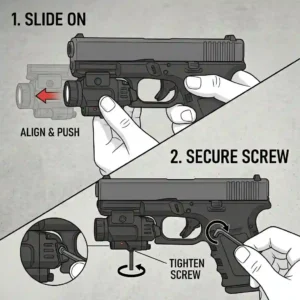
4. Viridian C5L Micro: The High-Tech Flush-Fit
The Viridian C5L Micro has recently undergone a massive upgrade, retaining its legendary compact size while stepping into modern output metrics. Its standout feature is the INSTANT-ON technology. When paired with a compatible holster, the unit magnetically senses when the weapon is drawn and automatically turns on the light, the laser, or both (depending on your preset). This eliminates the cognitive load of having to manually activate switches under life-threatening stress.
Producing 500 lumens with a brilliantly crisp green laser, the C5L sits perfectly flush with the end of the Glock 19 slide. This means your holster doesn’t need to be oversized to accommodate an extended bezel, significantly reducing chafing during inside-the-waistband carry. I recommend this specifically for tech-enthusiasts and deep-concealment carriers who prioritize a snag-free draw and automated activation.
Customers rave about the INSTANT-ON feature’s reliability, though some point out that finding holsters with the proprietary magnet built-in limits your aftermarket choices to a few specific manufacturers.
Pros:
-
Automated INSTANT-ON activation capability
-
Perfectly flush fit with the G19 frame
-
Rechargeable SafeCharge power system
Cons:
-
Requires a specific magnetic holster to utilize its best feature
-
Buttons can feel slightly mushy compared to tactile toggles
Verdict: Typically found in the $200-$250 range, it’s an ingenious solution for daily carriers who want one less thing to think about during the draw stroke.
5. Crimson Trace Rail Master Pro CMR-206: The Minimalist Approach
Sometimes, less is more. While the Crimson Trace Rail Master Pro CMR-206 is technically a laser-only unit (no white light), I include it here because a massive segment of concealed carriers refuse to add the bulk of a flashlight to their carry gun, yet still want the aiming advantage of a glock 19 laser light setup. Utilizing a brilliantly vivid green diode, the CMR-206 is arguably the smallest, most unobtrusive aiming device on the market.
Operating on a single 1/3N battery, it offers over two hours of continuous runtime. What I love about this unit is the ambidextrous tap-on/tap-off control toggles. They are hyper-sensitive, meaning a mere brush of your trigger finger on the frame naturally activates the laser. This is the ideal setup for the minimalist—perhaps a smaller-framed shooter or someone carrying in non-permissive environments where printing must be kept to an absolute zero. You pair this with a solid handheld flashlight, and you have a highly adaptable system.
User feedback frequently highlights the ease of installation and how well it holds zero over hundreds of rounds. However, the lack of an onboard white light means you must master two-handed handheld light techniques.
Pros:
-
Incredibly small and lightweight (barely over an ounce)
-
Universal fit with excellent tap-on ergonomics
-
Five-minute auto shut-off prevents battery drain
Cons:
-
No white light capability for target identification
-
Uses uncommon 1/3N batteries
Verdict: For under $150, this provides top-tier aiming assistance for those who strictly want to keep their Glock 19 as slim and light as humanly possible.
✨ Don’t Miss These Exclusive Deals!
🔍 Take your home defense to the next level with these carefully selected products. Click on any highlighted item to check current pricing and availability. These tools will help you create an authentic, reliable setup your family can depend on!
Practical Usage Guide: Zeroing Your Setup
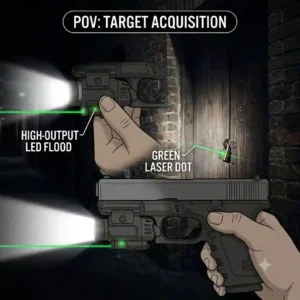
Buying the best glock 19 laser light is only step one; if it isn’t zeroed properly, it is an active liability. The spec sheet won’t tell you this, but laser offset is a serious geometric reality. Because the laser sits about an inch and a half below the barrel, the beam and the bullet’s flight path will intersect at exactly one distance, and diverge everywhere else.
My Step-by-Step Zeroing Protocol:
-
Choose your intersection distance: For a defensive pistol, I strongly recommend zeroing the laser at 15 yards.
-
Co-witness first: Before firing a shot, unload the firearm safely. Look through your iron sights at a wall 15 yards away. Adjust the windage and elevation screws on the laser until the dot sits exactly on top of your front sight post.
-
Live fire confirmation: Go to the range. From a stabilized rest (like sandbags), fire three slow rounds at a 15-yard target using only the laser.
-
Micro-adjustments: If the group is low and left, adjust the dials to move the beam low and left (chasing the bullet).
-
The Threadlocker Rule: Once zeroed, apply a tiny drop of blue (removable) threadlocker to the adjustment screws. The violent recoil impulse of a Glock 19 will slowly back those screws out over a few hundred rounds if you skip this step.
Insider Tip: After 3 months of carrying, test your zero. The constant pressure of pressing against a Kydex holster can cause micro-shifts in the bezel.
Real-World Scenario Case Studies
To help you visualize which unit fits your life, let’s look at two distinct profiles I encounter constantly in my consulting work.
Scenario A: The Appendix Daily Commuter
John drives 45 minutes to work, wears tailored clothing, and carries AIWB.
If John straps a massive 1,000-lumen duty light to his gun, the bezel will dig into his groin every time he sits in his car, and the wide profile will print through his fitted shirts.
The Solution: John needs the Streamlight TLR-8A G or the Viridian C5L Micro. The flush-fit design ensures maximum comfort while seated, and the 500-lumen output is more than adequate for navigating transitional spaces like parking garages.
Scenario B: The Dedicated Home Defender
Sarah wants a firearm solely for her bedside safe. She lives in a rural area with zero ambient street lighting.
Comfort and concealability do not matter to Sarah; absolute environmental dominance does. She might have to illuminate a threat across a 30-yard dark backyard.
The Solution: Sarah should choose the SureFire X400 Ultra. The blinding 1,000 lumens will effortlessly cut through the rural darkness, and the sheer weight of the unit at the end of the barrel will actually help mitigate muzzle flip, allowing her to put faster follow-up shots on target.
Problem → Solution Guide: Overcoming Common Hurdles
In my years of troubleshooting weapon-mounted setups, the same three problems plague almost every new user. Here is how you solve them.
Problem 1: The Carbon-Caked Lens
After firing 100 rounds at the range, your beautiful white light is suddenly dim, and the lens is coated in hard, black carbon buildup from the muzzle blast.
Solution: Before your range trip, smear a thin layer of ordinary lip balm or Vaseline over the glass lens. The carbon will stick to the grease, not the glass. When you’re done shooting, simply wipe it away with a microfiber cloth, revealing a perfectly clean lens.
Problem 2: The “Parasitic” Battery Drain
You grab your gun after three months in the safe, and the battery is completely dead despite never being turned on.
Solution: Many units have a soft-touch electronic switch that constantly draws a microscopic amount of power. For CR123A models like the Streamlight, simply unscrew the bezel a quarter-turn when placing it in long-term storage. This physically breaks the battery contact. Just remember to tighten it before deployment.
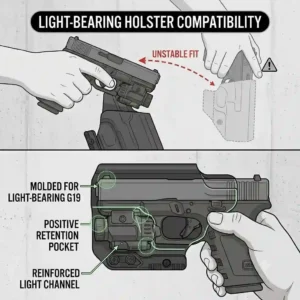
Problem 3: The Holster Compatibility Nightmare
You bought a niche, off-brand laser, and now not a single reputable holster company makes a shell that fits it.
Solution: Stick to the “Big Three” (Streamlight, SureFire, Olight). Custom holster makers like Tier 1 Concealed or T.REX Arms use CNC-milled molds based exclusively on popular lighting footprints. If you buy a Streamlight TLR-8A, you will have hundreds of holster options instantly available.
How to Choose Your glock 19 laser light Setup
When evaluating a new unit, never look at a single specification in a vacuum. You must look at the synergistic relationship between the hardware and your operational environment.
-
Understand Lumens vs. Candela:
Most marketing relies entirely on “Lumens,” which is simply the total volume of light emitted. However, you must pay equal attention to “Candela,” which measures the intensity of the beam at its center. According to standards outlined in basic photometry and lumens definitions, high lumens with low candela gives you a wide, soft floodlight (great for a small bedroom). High candela gives you a tightly focused lightsaber that punches through darkness (great for outdoor distances).
-
Switch Ergonomics:
Can your trigger finger comfortably reach the activation switch while keeping a high, secure grip on the frame? If you have to break your grip to turn on the light, the device is a liability.
-
Power Architecture:
Rechargeable batteries are convenient, but lithium primary cells (CR123A) have a 10-year shelf life and handle extreme cold weather far better. If you leave your gun in a freezing vehicle overnight, a rechargeable battery will suffer severe voltage sag.
Common Mistakes When Buying Combos
The Cheap Amazon Knockoff Trap
The most dangerous mistake I see beginners make is buying a $35 “tactical” light/laser from an unpronounceable brand. These units use cheap, unpotted electronics. “Potted” means the internal circuit boards are encased in an epoxy resin to protect them from shock. A Glock 19 produces a violent recoil impulse. Unpotted electronics will shatter or lose zero within two magazines.
Ignoring the Holster Lead Time
Adding a glock 19 laser light fundamentally changes the geometry of your firearm. Your old holster will no longer work. People buy the light, attach it, and then realize it takes 4 to 6 weeks for a custom light-bearing Kydex holster to arrive. During that time, they can’t carry their gun. Expert advice: Order the holster the exact same day you order the light.
Relying Solely on the Laser
Lasers fail. Batteries die. Diodes get covered in lint. A laser is an additive sighting system, not a primary one. If you find yourself staring over the top of the gun hunting for the dot instead of pressing out and looking at your front sight, you need to turn the unit off and get back to the fundamentals outlined in standard firearm safety and training protocols.
Green vs. Red Lasers: What to Expect in Real-World Performance
If you look at the comparison tables, you’ll notice an overwhelming preference for green lasers in modern units. This isn’t just a marketing trend; it’s basic human biology and physics.
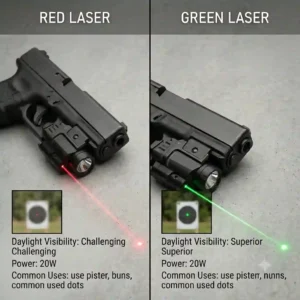
The human eye is remarkably more sensitive to light wavelengths in the green spectrum (around 532 nanometers) than it is to red (around 650 nanometers). Because of how our retinas process light, a 5mW green laser will appear up to 50 times brighter to the human eye than a 5mW red laser, despite both outputting the exact same amount of raw energy.
Real-World Translation: A red laser completely washes out and disappears in ambient daylight or under bright fluorescent store lights at distances beyond 10 feet. A high-quality green laser, like those found on the Streamlight or SureFire models, can be easily tracked on a target’s torso in broad daylight at 15 to 20 yards.
The downside? Green laser diodes require vastly more power to generate the beam. This means your battery life on a green unit will be significantly shorter than on a red unit. Furthermore, green diodes struggle in extreme freezing temperatures, whereas red diodes generally operate reliably well below freezing. If you live in Alaska, red might still have a place on your gun. For the rest of the country, green is the undisputed king.
| Laser Color | Daylight Visibility | Battery Efficiency | Cold Weather Performance | Ideal User |
| Green (532nm) | Excellent (up to 20 yards) | Moderate to Low | Poor (below 15°F) | Civilian Carry / Daylight ops |
| Red (650nm) | Poor (washes out easily) | High | Excellent | Cold climates / Nightstand use |
Expert Analysis: The table confirms why green dominates the market. Unless you live in an environment with extreme sub-zero temperatures, the massive advantage in daylight visibility that a green laser provides far outweighs the penalty of swapping batteries slightly more often.
Long-Term Cost & Maintenance Cycle
Owning a sophisticated weapon-mounted combo involves a “Total Cost of Ownership” that goes beyond the purchase price. Here is my “Year One” roadmap for maintaining peak performance.
Month 1-3: The Break-in Period
Expect to blow through batteries simply because you are playing with the unit at home, doing dry-fire practice, and mapping out your house. Buy a 12-pack of high-quality, American-made CR123A batteries (like SureFire or Panasonic). Never mix old and new batteries in a multi-cell unit, as it can cause a thermal event.
Month 6: The Hardware Check
The carbon from the muzzle blast will eventually eat into the anodized finish if left uncleaned. Use a gentle brass brush and some solvent to clean the top of the bezel. Furthermore, check the tension on the rail clamp screw. It should be torqued to the manufacturer’s spec (usually around a finger-tight coin turn).
Month 12: The Recalibration
After a year of carrying, bumping into doorframes, and shooting at the range, your laser will drift slightly. Dedicate one range session at the one-year mark specifically to re-zeroing the laser.
Economically, if you run a CR123A unit, expect to spend about $20-$30 a year on fresh batteries (changing them every 3-4 months for defensive reliability, regardless of whether they are dead). If you run a rechargeable unit like the Olight, your running cost is zero, but be aware that lithium-polymer batteries degrade after 3-5 years of charge cycles, at which point the entire unit may need to be replaced.
✨ Don’t Miss These Exclusive Deals!
🔍 Ready to upgrade your sighting system? Click on the products highlighted in our guide to verify current stock and get the best gear for your daily carry. Don’t compromise on your defensive tools!
Conclusion: Securing Your Optimal Setup
Navigating the crowded market of illumination tools can feel overwhelming, but boiling it down to your specific operational needs makes the choice clear. Integrating a glock 19 laser light isn’t just about throwing money at cool accessories; it’s about giving yourself every possible biometric and tactical advantage when fractions of a second matter.
Whether you opt for the flush-fitting comfort of the Streamlight TLR-8A G for appendix carry, or the overwhelming photonic dominance of the SureFire X400 Ultra for home defense, remember that hardware is only as good as the software driving it. Buy the light, order the correct holster immediately, zero the laser meticulously, and then get to the range and train. Your gear is ready—make sure you are too.
FAQs
❓ What is the most reliable glock 19 laser light combo?
✅ For absolute, bomb-proof reliability under extreme duty use, the SureFire X400 Ultra is widely considered the industry standard. For daily civilian concealed carry, the Streamlight TLR-8A G holds the top spot for its balance of durability, output, and footprint…
❓ Do I really need a green laser instead of red?
✅ Yes, for most users. Human eyes are significantly more sensitive to the green light spectrum. Green lasers remain visible in bright daylight at distances where red lasers completely wash out and disappear. Red is only advantageous for preserving battery life or in extreme freezing temperatures…
❓ Will adding a light to my Glock 19 cause malfunctions?
✅ Generally, no. However, very cheap, overly tightened lights can sometimes pinch the polymer frame of older Glock generations, potentially causing feeding issues. Sticking to reputable brands like Streamlight or Olight and using the correct rail keys prevents this entirely…
❓ Can I use my old holster if I add a weapon mounted light?
✅ Absolutely not. The physical dimensions of the firearm change drastically. You must purchase a custom-molded Kydex holster specifically designed for the Glock 19 paired with your exact model of light…
❓ How often should I change the batteries in my defense light?
✅ For a dedicated home defense or everyday carry firearm, industry experts recommend replacing lithium CR123A batteries every 6 months, regardless of how often you use the light. This guarantees maximum lumen output when your life depends on it…
Recommended for You
- Best Budget Pistol Light: 7 Top Picks for Real-World Defense in 2026!
- 5 Best Pistol Laser Units for 2026: Expert Reviews and Tactical Guide
- 5 Best glock 43 laser Sights for Ultimate EDC Precision (2026 Expert Review)
Disclaimer: This article contains affiliate links. As an Amazon Associate, I earn from qualifying purchases. If you purchase products through these links, we may earn a small commission at no additional cost to you.
✨ Found this helpful? Share it with your friends! 💬🤗
[addtoany]
