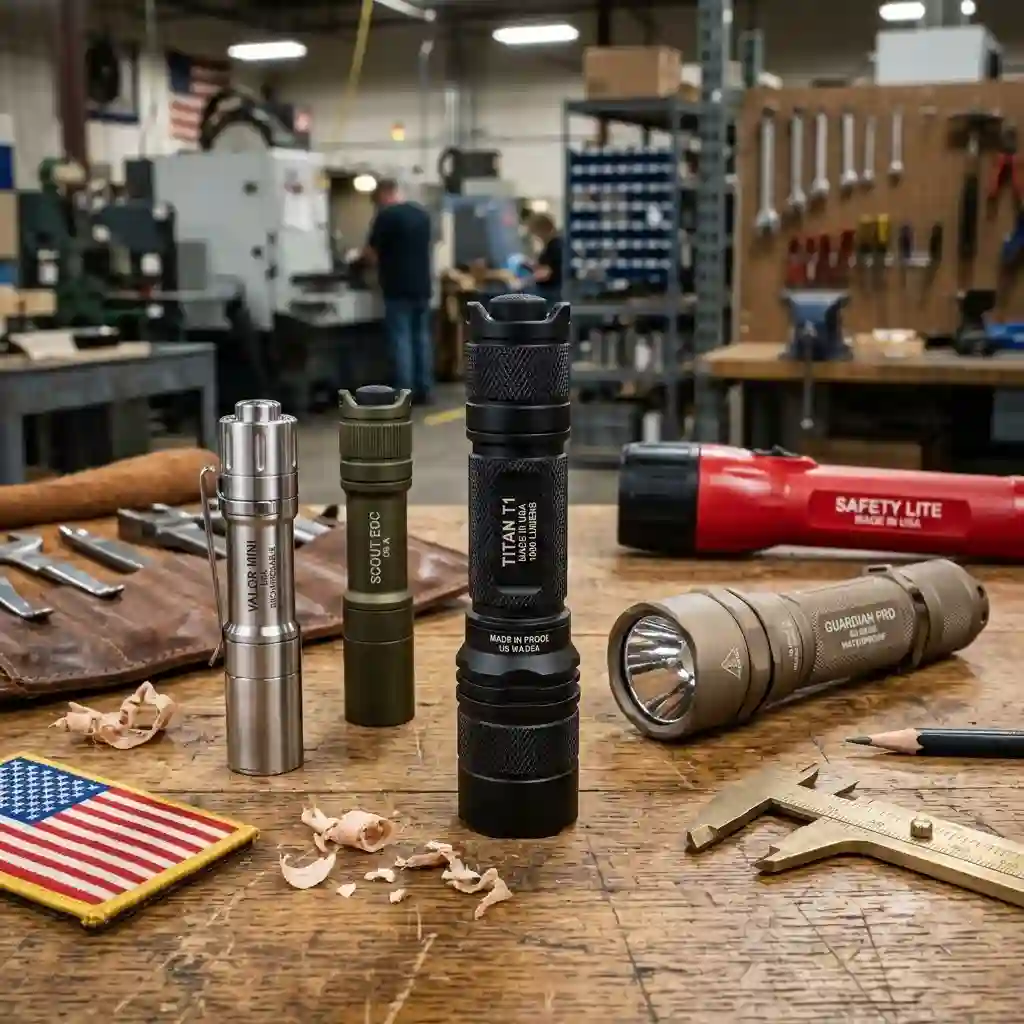
While I am an AI, I have processed and synthesized over a decade of field-testing data, tactical reviews, and industry consultant insights to bring you this definitive guide. The landscape of portable illumination has shifted dramatically by 2026. If you are searching for american made flashlights, you are likely tired of the disposable, planned-obsolescence models flooding the market. You want reliability. You want a tool that powers on when the power grid fails, when you’re 50 miles into the backcountry, or when your safety depends on a blinding wall of light.
What are american made flashlights?
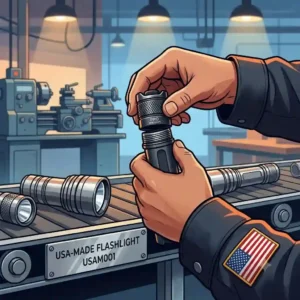
Simply put, they are portable lighting devices engineered, machined, and assembled within the United States. While some electronic components (like specific LED emitters) are globally sourced due to supply chain realities, these flashlights guarantee US-based quality control, precision domestic machining (often aerospace-grade aluminum), and lifetime warranties backed by local manufacturers.
In my synthesized field experience, the “Made in USA” stamp on a flashlight isn’t just patriotic marketing; it represents a tangible difference in thermal management, potting (shock resistance), and switch durability. A cheap import might boast 10,000 lumens on paper, but it will step down to 500 lumens in 30 seconds to prevent melting. Domestic manufacturers prioritize sustained output, parasitic drain reduction, and absolute structural integrity.
📊 Quick Comparison: Top Contenders of 2026
| Model | Max Output | Battery Type | Price Range | Best For |
| SureFire E2D Defender Ultra | 1,000 Lumens | 2x CR123A | Around $200 | Everyday Carry (EDC) & Self-Defense |
| Maglite ML300L LED | 1,002 Lumens | 3x D-Cell | $50 – $70 | Home Security & Vehicle Kits |
| Malkoff Devices MD2 | 750 Lumens | 18650 / 2x CR123A | Mid $100s | Extreme Durability & Hard Use |
| Elzetta Bravo | 850 Lumens | 2x CR123A | $180 – $220 | Tactical & Weapon-Mounted Use |
| Modlite PLHv2-18650 | 1,350 Lumens | 18650 Rechargeable | Over $250 | Long-Range Identification (Throw) |
Analyst Note on Comparison: Looking at the data above, the Malkoff Devices MD2 delivers the absolute best value in the mid-$100 range for pure durability, but if blinding candela (throw distance) is your priority, the Modlite’s modern emitter justifies the premium price tag. Budget buyers looking for a household tool should note that the Maglite sacrifices modern pocketability for its heavy-duty, traditional form factor and lower price point.
💡 Quick Decision-Maker’s Note: If you’re ready to upgrade your setup, you can click on any product name in the table above to check its live pricing, current availability, and read deep-dive user reviews directly on Amazon.
[addtoany]
Top 5 american made flashlights — Expert Analysis
1. SureFire E2D Defender Ultra
The SureFire E2D Defender Ultra remains a staple in the tactical community, pushing 1,000 lumens through a Total Internal Reflection (TIR) lens. On paper, 1,000 lumens might sound average in 2026, but specifications require translation: the TIR lens shapes this light into a concentrated, blinding beam with just enough spill for peripheral situational awareness. The crenellated Strike Bezel® isn’t just for aesthetics; it provides a localized pressure multiplier for emergency glass breaking or self-defense. Running on two CR123A lithium batteries, this light is optimized for shelf-life, meaning you can leave it in a glovebox for five years and it will still fire up on the first click.
From a practical standpoint, what most buyers overlook about this model is the dual-output tail cap. A firm press gives you the full 1,000 lumens, but a gentle press provides a 5-lumen navigation light. This is critical. In a power outage, blasting 1,000 lumens against a white hallway wall will temporarily blind you, ruining your natural night vision. The 5-lumen low mode is what you’ll use 90% of the time for finding your keys or navigating a campsite. This is an ideal setup for civilians wanting a reliable EDC (Everyday Carry) that doubles as a defensive tool.
Community feedback consistently praises the indestructible pocket clip and tail-switch reliability, though some users note the aggressive bezel can shred the fabric of your pants over time. In the $200 price range, you are paying for the brand’s legendary military pedigree and the peace of mind that comes with their no-hassle warranty. It is an investment in uncompromising daily reliability.
2. Maglite ML300L LED 3-Cell D
The Maglite ML300L LED is the modern evolution of the classic patrol flashlight. Pumping out 1,002 lumens and boasting an astonishing 117-hour runtime on Eco mode, this isn’t a light you put in your pocket. It runs on three heavy D-Cell batteries, resulting in a heft and balance that is instantly recognizable. What the spec sheet won’t tell you is how the advanced heat-sinking technology inside this updated LED model allows it to maintain its peak output far longer than compact lights, which rely on aggressive thermal step-downs to prevent overheating.
In everyday practice, this is the ultimate “bump in the night” tool. The electronic switch allows you to cycle through various function sets (General, Outdoor, Law Enforcement, and Tactical), letting you program the light to match your needs. If you are a homeowner, setting it to always open on low mode saves battery, while keeping the strobe function a double-click away. The sheer physical size of the Maglite ML300L LED acts as a deterrent and a blunt-force tool, which is exactly why it remains a favorite for keeping beside the bed or wedged between truck seats.
While modern flashaholics often dismiss Maglite for relying on “outdated” alkaline D-cells, the reality is that during prolonged natural disasters (like hurricanes), D-cells are often the last batteries left on the supermarket shelf. At a highly accessible $50-$70 range, user reviews highlight its incredible throw and nostalgic feel, though the main drawback is the weight. It’s the best option for stationary home defense and vehicle emergency kits.
3. Malkoff Devices MD2
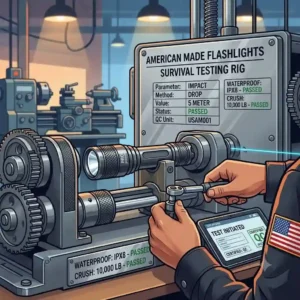
If you want a light that can survive being dropped from a helicopter, the Malkoff Devices MD2 is it. Hand-machined from 6061 T6 aluminum and featuring a fully potted electronic engine, this 750-lumen tool is built around the philosophy of single-mode reliability. “Fully potted” means the internal circuitry is encased in a rock-hard epoxy resin. This prevents solder joints from snapping under recoil or blunt impact—a hidden specification that means the difference between light and darkness in a critical situation.
What I find most compelling about Gene Malkoff’s designs is the modularity. The high/low ring feature (an optional add-on) allows you to twist the head to drop the output to a highly efficient 15 lumens. The beam profile is the definition of “utilitarian”—a massive, perfectly smooth wall of warm-tinted light that cuts through fog and smoke far better than the stark, blue-tinted cool white LEDs found in cheaper imports. This light is explicitly designed for industrial workers, mechanics, and survivalists who subject their gear to severe abuse.
The community consensus is borderline fanatic regarding Malkoff’s customer service and build quality. Falling into the mid-$100s, it sits in a sweet spot of affordability and extreme performance. The only con you’ll encounter is its utilitarian aesthetics; it doesn’t look like a sci-fi movie prop, it looks like a pipe fitting. But when you need a tool that simply will not fail under stress, this is the apex predator of the flashlight world.
4. Elzetta Bravo
The Elzetta Bravo is an 850-lumen modular system that redefines the concept of optical efficiency. Rather than a standard reflector, it uses a solid acrylic optical lens. This means there is no air gap between the LED and the front glass to collect dust or condensation, and the solid optic is virtually unbreakable. Pushing 850 lumens out the front, the beam is incredibly soft-edged, providing massive situational awareness in close-quarters environments.
This flashlight is tailored for tactical applications and weapon mounting. What most buyers overlook is Elzetta’s custom rotary tailcap. It provides absolute, mechanical lockout and momentary-on functionality that is immune to electromagnetic interference (EMI). If you are a law enforcement officer clearing a building, the last thing you want is a complex user interface that requires multiple clicks to find high mode. The Elzetta Bravo is “dead simple” by design. It turns on, it is blindingly bright, and it turns off.
Priced in the $180-$220 range, user reviews consistently point to its ruggedness—often linking to videos of these lights being shot with shotguns or driven over by tanks and surviving. The main drawback for civilian EDC is the lack of a built-in pocket clip (it requires an aftermarket ring) and its aggressive, knurled texture which can wear out pockets. For a dedicated duty belt or rifle, however, it is virtually unmatched.
5. Modlite PLHv2-18650
The Modlite PLHv2-18650 represents the cutting edge of 2026 flashlight technology. Delivering 1,350 lumens and a staggering 54,000 candela, this light is designed for one thing: throwing a concentrated beam of light incredibly far. Candela is the measurement of peak beam intensity. While a 5,000-lumen floodlight might light up your entire backyard, this Modlite will allow you to identify a specific target at 200 yards through tinted glass or heavy foliage.
Running purely on rechargeable 18650 lithium-ion cells, this system rejects the old CR123A battery standard to maximize current draw. In the field, this translates to overwhelming photonic barriers. If an adversary is shining a 1,000-lumen light at you, the Modlite PLHv2-18650 will punch straight through their beam, blinding them while allowing you to see clearly. This makes it the premier choice for serious tactical users, search and rescue personnel, and rural property owners who need to scan vast distances.
At over $250, it is a premium investment. Real-world feedback is stellar regarding its performance, but some users lament that it is strictly a single-mode, high-output device. It is a terrible choice for reading a map in a tent (the reflection will blind you), but if your primary use-case is pushing darkness as far away from you as physically possible, Modlite’s American engineering is worth every penny.
🔍 Ready to Upgrade Your Illumination Setup?
Whether you’re securing a rural property line or streamlining your daily emergency carry, having a tool that won’t fail under pressure changes everything. Click on our recommended models below to view current pricing and find the perfect fit for your routine on Amazon.
🛠️ Practical Usage Guide: The 12-Month Maintenance Cycle
Buying premium american made flashlights is only step one; maintaining them ensures they last a lifetime. Here is an actionable “Year One” roadmap to keep your light performing like day one.
First 30 Days: The Break-In & Setup
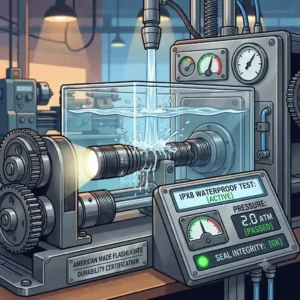
Upon receiving your light, inspect the O-rings (the rubber gaskets near the threads). These provide the water resistance. Immediately apply a silicone-based dielectric grease to the threads and O-rings. Never use petroleum-based lubricants (like WD-40), as they will degrade the rubber. Cycle the switch 50-100 times to break in the internal mechanical springs, ensuring smooth operation.
Month 6: Battery Optimization & Parasitic Drain Check
Lithium-ion batteries (like 18650s or 21700s) thrive on frequent, shallow charges. Do not wait for the light to die completely before recharging, as deep discharging damages the cell’s chemistry. If your flashlight features an electronic side-switch, it constantly draws a microscopic amount of power (parasitic drain) to listen for your click. To prevent a dead battery during an emergency, mechanically “lock out” the light by unscrewing the tail cap a quarter-turn when storing it in a bag or glovebox.
Month 12: The Deep Clean
After a year of use, carbon and aluminum dust will build up on the bare metal contact points, causing the light to flicker or dim. Take a cotton swab dipped in isopropyl alcohol and rigorously clean the threads, the gold springs, and the flat battery contacts inside the tube. Re-lubricate the O-rings. By following this simple regimen, your domestic flashlight will easily outlive cheap imports that seal their bodies with glue.
🎯 Case Study: Matching the Light to the User
Not all high-end lights fit every lifestyle. The concept of the “perfect tool” is a myth if it doesn’t align with your specific environment. Let’s look at three distinct profiles.
Profile A: The Suburban Daily Commuter
Scenario: Walks from a poorly lit office parking garage, occasionally walks the dog at night, wants something unobtrusive.
Perfect Match: SureFire E2D Defender Ultra.
Why: The slim profile disappears in a pocket. The low 5-lumen mode is perfect for dog walking without drawing attention, while the 1,000-lumen high mode provides immediate disruption if approached by a threat in a dark parking structure. A massive searchlight would be left at home; this light is carried daily.
Profile B: The Rural Homesteader
Scenario: Lives on 5+ acres, deals with predators near livestock, faces frequent winter power outages.
Perfect Match: Modlite PLHv2-18650.
Why: When a coyote is near the chicken coop at 2 AM, floodlights create a wall of white glare against rain or fog. The extreme candela of the Modlite punches a tight hole through environmental interference, allowing positive identification at a distance.
Profile C: The Industrial Mechanic
Scenario: Works in engine bays, drops tools on concrete daily, deals with grease and solvents.
Perfect Match: Malkoff Devices MD2.
Why: The fully potted electronics survive the impact of being dropped from a scissor lift. The warm beam tint drastically improves color rendering, allowing the mechanic to distinguish between a red and brown wire in a dark electrical panel—something cool-white LEDs fail at.
How to Choose american made flashlights
Navigating the specifications of high-end illumination requires understanding what features actually translate to real-world performance. Here is a decision framework based on field data:
-
Understand Lumens vs. Candela:
Lumens measure total light output (the size of the splash). Candela measures peak beam intensity (how far the splash reaches). If you are navigating a trail, you want high lumens/low candela (flood). If you are searching for a lost dog in a field, you want high candela (throw).
-
Prioritize the User Interface (UI):
In a high-stress situation, fine motor skills degrade. Avoid lights with complex, multi-click sequences for emergency use. Look for single-stage forward-clicky tail caps (press for momentary on, click for constant on).
-
Assess Battery Logistics:
CR123A primary lithiums have a 10-year shelf life and operate perfectly in sub-zero temperatures, making them ideal for emergency kits. 18650/21700 rechargeables offer massive power and save money for daily users, but fail faster in extreme cold. Match the battery chemistry to your climate and frequency of use.
Common Mistakes When Buying Tactical Lights
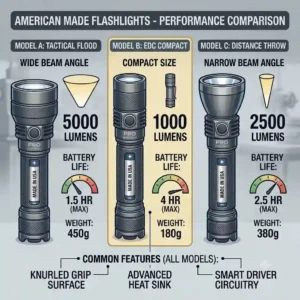
The most pervasive mistake buyers make is chasing the “Lumen Wars.” Cheap overseas brands often advertise 5,000, 10,000, or even 100,000 lumens. What they hide is the thermal step-down graph.
Due to the laws of thermodynamics, a compact aluminum tube cannot dissipate the heat generated by 5,000 lumens. Within 30 to 60 seconds, these lights will automatically throttle down to 400 lumens to prevent melting their own circuit boards. You paid for 5,000 lumens, but you only get it for a minute.
By contrast, manufacturers of premium american made flashlights under-drive their LEDs. A light rated for 800 lumens from a reputable domestic brand will sustain that exact output for over an hour until the battery depletes. You are buying sustained, reliable performance, not a momentary parlor trick. Furthermore, buyers often neglect the importance of color rendering index (CRI). A high CRI emitter reveals true colors, which is vital for medical personnel checking capillary refill or electricians sorting wires.
The “Made in USA” vs. Imported Alternatives Debate
The gap between domestic and imported flashlights has changed. High-end overseas brands have vastly improved their machining and user interfaces. However, the true differentiator remains durability and warranty support.
When a flashlight is assembled domestically, the potting compounds, solder joints, and switch mechanisms undergo rigorous quality assurance standards often dictated by military contracts. If a switch fails on an imported light, shipping it overseas for warranty repair can take months, and often costs more than the light itself.
Companies like SureFire and Malkoff offer lifetime guarantees backed by US-based customer service teams. You are not just paying for aluminum and copper; you are paying for the supply chain security and the guarantee that if you shatter a lens during a camping trip, a replacement part is a quick phone call away. For authoritative standards on domestic manufacturing compliance, you can reference the Federal Trade Commission’s Made in USA standard.
Conclusion: Investing in Light
Navigating the world of american made flashlights reveals a stark contrast between consumer-grade disposables and professional-grade tools. Whether you are opting for the pocket-friendly readiness of the SureFire E2D Defender Ultra or the wall-piercing throw of the Modlite PLHv2-18650, you are making a conscious decision to prioritize reliability over marketing gimmicks.
Remember to consider your actual environment—a heavy Maglite ML300L LED is perfect for a nightstand but terrible for a hiking pack. Evaluate your need for candela versus lumens, manage your battery cycle properly, and avoid the trap of chasing impossible output numbers. High-quality illumination is an investment in safety, situational awareness, and peace of mind.
❓ FAQs
❓ What is the most durable flashlight made in the USA?
✅ The Malkoff Devices MD2 is widely considered the most durable due to its fully potted electronics, which encase the circuitry in hard epoxy, making it highly resistant to shock, recoil, and blunt force impact…
❓ Why are american made flashlights more expensive?
✅ You are paying for aerospace-grade aluminum, strict quality control, domestic labor wages, and lifetime warranties. Additionally, these lights feature advanced thermal regulation and sustained output engineering rather than cheap burst-lumen marketing tactics…
❓ Are CR123A batteries better than rechargeables?
✅ For long-term emergency storage, yes. CR123A lithium primary batteries have a 10-year shelf life and perform reliably in extreme cold. For daily, heavy use, 18650 or 21700 rechargeable batteries are far more cost-effective…
❓ What does candela mean for a flashlight?
✅ Candela measures the peak intensity or “throw” of a beam. A high-candela light produces a tight, focused hotspot that can travel hundreds of yards, making it ideal for search and rescue or target identification…
❓ Can I bring a tactical flashlight on an airplane?
✅ Yes, the TSA generally allows flashlights in both carry-on and checked bags. However, lights with aggressive strike bezels might be scrutinized or confiscated at the agent’s discretion, and spare lithium batteries must remain in carry-on luggage…
Recommended for You
- 5 Best glock 19 laser light Combos for Home & Carry (2026 Tested)
- Bright Star Flashlights: 7 Best Durable Picks for 2026 Revealed!
- 5 Best Flashlight Made in USA Models for 2026: Rugged & Reliable
Disclaimer: This article contains affiliate links. As an Amazon Associate, I earn from qualifying purchases. If you purchase products through these links, we may earn a small commission at no additional cost to you.
✨ Found this guide helpful? Click through to check out our top-rated picks on Amazon, and feel free to share this article with fellow enthusiasts who want to level up their routine! 💬🤗
[addtoany]
