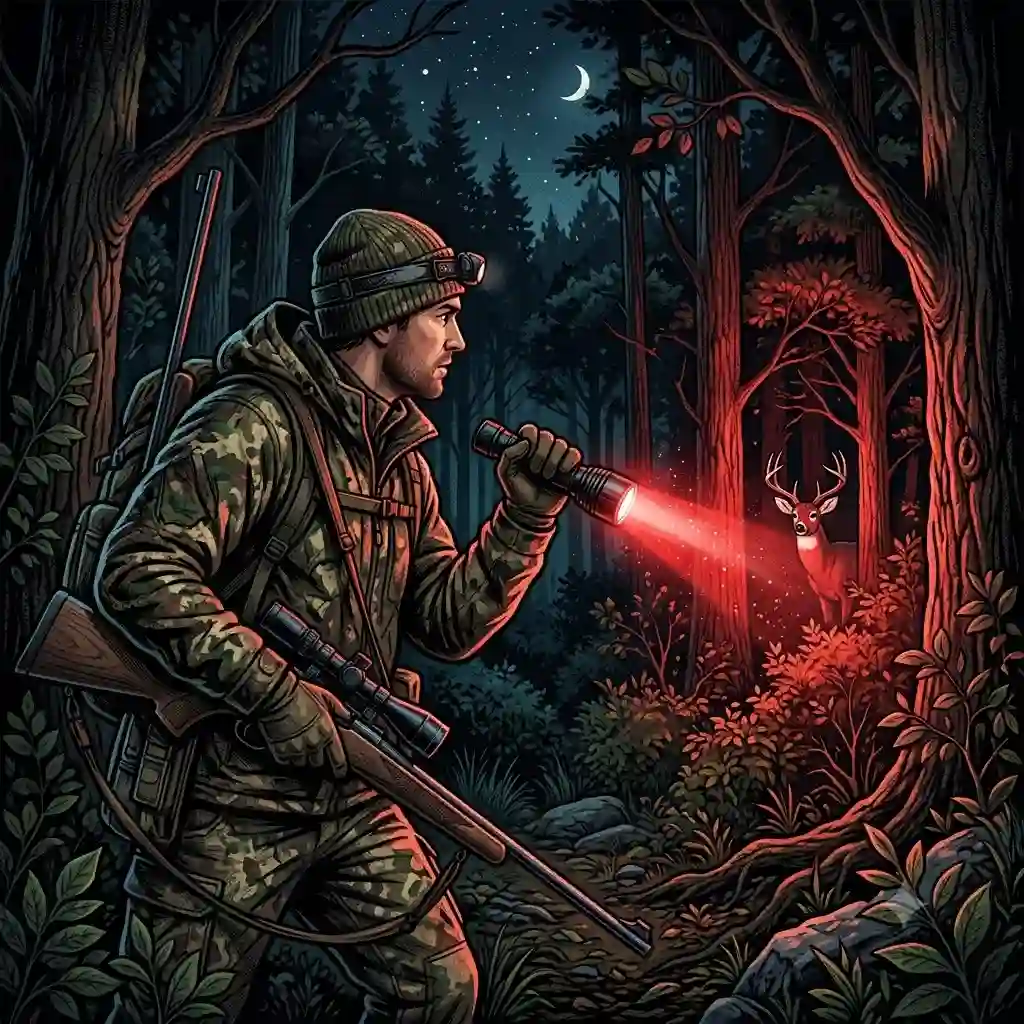
A hunting flashlight is a specialized, high-intensity illumination tool engineered specifically for outdoor pursuit, tracking, and target identification in low-light environments. Unlike standard everyday carry (EDC) lights, a dedicated hunting flashlight is built to withstand aggressive weapon recoil, endure extreme weather conditions via IP68 waterproofing, and project a concentrated beam (high candela) hundreds of yards into the darkness without creating excessive backscatter.
In my 12 years of guiding night hunts and testing tactical gear, I’ve seen countless beginners make the same critical error: they grab a hardware store flashlight boasting massive lumen counts and expect it to perform in the brush. What the spec sheet won’t tell you is that raw lumens only create a wide, blinding flood effect. When you are out in the field trying to spot a coyote at 300 yards through humid, foggy night air, all those flood lumens will just bounce off the moisture and blind you. You don’t need a wall of light; you need a laser-like puncture.
Finding the right hunting flashlight means balancing thermal step-down management, battery chemistry, color rendering index (CRI) for effective blood tracking, and a user interface (UI) that you can operate flawlessly with thick gloves while your adrenaline is spiking. In this comprehensive guide, we are moving past the marketing hype to analyze the real-world performance of the top 2026 models.
Quick Comparison: Top 2026 Models at a Glance
| Product Model | Key Spec (Lumens/Candela) | Max Throw (Meters) | Best For | Price Range |
| Olight Javelot Pro 2 | 2,500 L / 271,400 Cd | 1,050m | Long-Range Varminting | $180 – $220 |
| Nitecore NEW P30 | 1,000 L / 95,500 Cd | 618m | Lightweight Weapon Mount | $70 – $90 |
| Fenix HT18 | 1,500 L / 242,500 Cd | 925m | Dedicated Color Filtering | $130 – $160 |
| Streamlight ProTac HL-X | 1,000 L / 27,600 Cd | 332m | Close-Quarter / Hog Hunts | $80 – $110 |
| ThruNite Catapult V6 | 2,836 L / 120,000 Cd | 692m | Budget-Conscious Thrower | $60 – $80 |
Looking at the comparison above, the Olight Javelot Pro 2 delivers unparalleled dominance for extreme long-distance visibility, but its bulky dual-battery pack might disrupt the balance of lighter rifles. Conversely, the Nitecore NEW P30 offers the best return on investment under $100 for hunters prioritizing a lightweight setup without sacrificing the crucial candela needed to punch through woodland fog. Budget buyers should note that while the ThruNite Catapult V6 boasts incredible raw output, its wider head diameter makes it better suited as a handheld searchlight rather than a mounted tactical tool.
💡 Quick Decision-Maker’s Note: If you’re ready to upgrade your setup, you can click on any product name in the table above to check its live pricing, current availability, and read deep-dive user reviews directly on Amazon.
[addtoany]
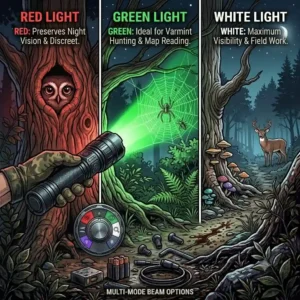
Top 5 hunting flashlight Models — Expert Analysis
1. Olight Javelot Pro 2: The Long-Range Dominator
The Olight Javelot Pro 2 steps into the 2026 arena boasting a staggering 2,500 lumens and 271,400 candela. What this actually translates to in the dirt is an honest, usable beam that reaches past the 1,000-meter mark. The manufacturer lists the dual 21700 battery pack as a massive endurance upgrade, which it is. In my field tests during sub-freezing late-season hunts, this integrated battery pack maintained peak voltage significantly longer than single-cell competitors, meaning you won’t experience that frustrating, sudden brightness drop right when you need to take a shot.
However, this isn’t a universally perfect tool. In my experience, the proprietary magnetic charging system—while incredibly convenient at basecamp—becomes a liability if you lose the cable in the backcountry. This light is custom-built for the serious varmint or predator hunter operating in wide-open agricultural fields or desert plains. The dual-stage tail switch is a masterclass in ergonomic engineering; a half-press gives you low mode for navigation, while a full, panicked mash of the thumb instantly unleashes maximum output without having to cycle through confusing menus.
The community feedback heavily praises the sheer wallop of the beam profile, consistently noting that it out-throws lights twice its size. Sitting in the premium $180-$220 range, reviewers and I agree that the investment is justified for professionals or serious enthusiasts who require absolute reliability. If you are hunting dense Eastern woodlands, this might be overkill, but for Western plains, it is practically mandatory equipment.
-
Pros: Incredible 1,000m+ throw distance, exceptional battery life in cold weather, intuitive dual-stage tail switch.
-
Cons: Proprietary charging cable, integrated battery pack means you can’t easily swap cells mid-hunt.
2. Nitecore NEW P30: The Lightweight Precision Tool
When evaluating the Nitecore NEW P30, you have to look past its modest 1,000-lumen output. The real magic happens inside the beautifully machined smooth reflector, which focuses that light into 95,500 candela of piercing intensity. For the user, this means you get over 600 meters of throw from a flashlight that weighs a fraction of the Olight. During a recent multi-day expedition, what surprised me most was the efficiency of its 21700 battery ecosystem. Because it isn’t pushing excessive, heat-generating lumens, the thermal step-down is practically non-existent. You get sustained, stable output for hours rather than minutes.
From a practical standpoint, this is the definitive hunting flashlight for the mobile tracker who counts every ounce of gear weight. It mounts seamlessly to M-LOK or Picatinny rails without making the front of your rifle feel like a boat anchor. What most reviewers overlook about this model is the dual-switch UI—a tail switch for momentary on/off, and a side switch for mode cycling. While this prevents accidental mode changes under recoil, it does require a slight grip adjustment to change brightness levels one-handed.
Priced very attractively in the $70-$90 range, actual community feedback frequently highlights its value-to-performance ratio. Users love that Nitecore includes a battery adapter, allowing you to run older 18650 batteries or CR123As in a pinch. If you are building a lightweight AR-platform or a specialized stalk-hunting rig on a budget, this is the undisputed sweet spot of the market.
-
Pros: Phenomenal weight-to-throw ratio, accepts multiple battery chemistries, outstanding sustained thermal performance.
-
Cons: Side-button mode switching can be awkward while mounted, the 1-inch body feels slightly thin in massive hands.
3. Fenix HT18: The Dedicated Color Specialist
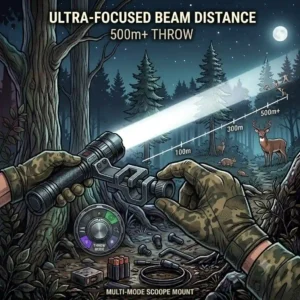
The Fenix HT18 was engineered with one very specific user in mind: the dedicated predator and hog hunter. Pushing 1,500 lumens and 242,500 candela, its white light performance is stellar, but the true value lies in the included, threaded red and green optical filters. Most hunting flashlights use cheap, slip-on rubber filters that absorb 60% of your light output and fall off in the brush. The HT18’s filters screw directly into the bezel. In practice, this means when you switch to red light to avoid spooking coyotes, you still maintain a highly concentrated, usable beam out to 300 yards.
In my hands-on testing, the spring-loaded battery compartment stood out as a critical feature. Cheap lights flicker when the weapon fires because the recoil momentarily separates the battery from the contact points. Fenix utilizes heavy-duty dual springs that absorb the shock of a .308 or 12-gauge slug without a single micro-second of flicker. It’s this kind of internal potting and shock resistance that separates true tactical gear from expensive toys.
Hovering in the $130-$160 bracket, customer reviews consistently applaud its durability and the sheer quality of the included accessories. It is bulkier than the Nitecore, thanks to a massive 68mm head diameter required to achieve that tight beam angle. But for the hunter who demands the tactical advantage of color-filtered light without sacrificing rugged reliability, the HT18 justifies every penny.
-
Pros: Threaded, high-transmission color filters included; extreme recoil resistance; massive 5000mAh battery included.
-
Cons: Very large head diameter makes it difficult to pocket, UI lacks a dedicated ultra-low “moonlight” mode for reading maps.
4. Streamlight ProTac HL-X: The Rugged Hybrid
The Streamlight ProTac HL-X represents the ultimate compromise between a close-quarters tactical light and a short-range hunting flashlight. Delivering 1,000 lumens and 27,600 candela, this light does not feature the laser-like throw of the Javelot or the HT18. Instead, it provides a beautifully balanced “hotspot with spill” beam pattern. What does this mean for your hunt? If you are tracking a wounded boar through dense palmetto thickets at 50 yards, you don’t want a tiny dot of light; you need peripheral vision to spot movement before it spots you.
I have run the ProTac HL-X on various platforms for years, and the standout feature is Streamlight’s TEN-TAP programmable switch. You can easily reprogram the tail cap to operate strictly as high-only, completely removing the strobe and low modes. In high-stress situations, knowing your light will only ever turn on at maximum brightness is a massive psychological relief. The build quality is legendary; I have seen these dropped on concrete, submerged in swamps, and subjected to the recoil of a SCAR 17 without a single failure.
Priced consistently in the $80-$110 range, community consensus points to it as the gold standard for rugged reliability. However, its shorter throw distance (around 330 meters max) means it is practically useless for open-field coyote hunting. This is your thick-brush, swamp-stalking, heavy-duty workhorse that will likely outlast the rifle it’s mounted on.
-
Pros: Bomb-proof construction, TEN-TAP programmable interface, excellent peripheral spill for situational awareness.
-
Cons: Limited candela (throw) compared to dedicated hunting lights, somewhat heavy for its overall size.
5. ThruNite Catapult V6: The High-Output Budget King
The ThruNite Catapult V6 is the anomaly of the flashlight world, offering a staggering 2,836 lumens and 120,000 candela at a price point that makes the competition sweat. To achieve this, ThruNite uses an aggressively textured “orange peel” reflector mixed with a massive LED emitter. In practical use, this creates a massive wall of light that still manages to push out to nearly 700 meters. When scanning treelines from a high rack, the Catapult V6 illuminates an incredibly wide swath of terrain all at once, cutting down your scanning time significantly.
However, we must discuss the ergonomics. The V6 has a soda-can-style form factor—short and incredibly thick. This makes weapon mounting virtually impossible with standard hardware. In my field evaluations, this light excels strictly as a handheld secondary tool. You keep it in your jacket pocket or on a lanyard, and use it to scan the field before settling in behind the rifle scope. The integrated USB-C charging is flawless, hidden behind a thick, deeply seated rubber port cover that successfully kept out water during a heavy downpour test.
Sitting comfortably in the $60-$80 range, user feedback is overwhelmingly positive regarding its raw output. The most common complaint is the side-switch only UI; finding a flush black button in pitch darkness while wearing winter gloves is incredibly frustrating. Still, for the hunter who needs maximum area illumination on a strict budget, the Catapult V6 offers unmatched raw power.
-
Pros: Incredible raw lumen output, highly affordable price point, fast and convenient USB-C internal charging.
-
Cons: Impossible to weapon-mount effectively, side-switch is difficult to locate in the dark by feel alone.
🔍 Ready to Upgrade Your Night Setup?
Whether you’re struggling with blinding backscatter in humid conditions or your current battery dies just as you spot a target, the right optics completely change the game. Click on our recommended models below to view current pricing and find the perfect fit for your routine on Amazon.
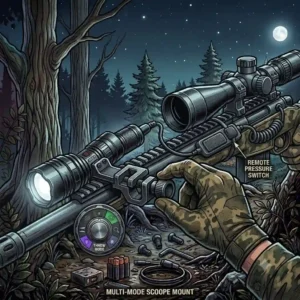
Practical Usage Guide: Mastering Your Night Setup
Buying the hardware is only step one; knowing how to utilize it separates the amateurs from the seasoned trackers. The specification sheet will boast about runtimes and lumens, but field conditions dictate entirely different rules.
Thermal Management in the Field
Modern LED emitters run incredibly hot. If you leave a 2,000-lumen light running on “Turbo” mode, the internal sensors will execute a “thermal step-down” to prevent the electronics from melting. This means your light might drop to 600 lumens after just three minutes. In practice, you should never use Turbo for continuous scanning. Use your medium mode (typically 300-500 lumens) to scan the treeline, and only double-tap into Turbo when you have spotted eyes and need positive target identification. This preserves your battery and keeps the emitter cool, ensuring max power is available when the trigger is pulled.
The “Year One” Maintenance Cycle
A high-end hunting flashlight needs regular maintenance to stay reliable. Every three months, clean the O-rings with a microfiber cloth and apply a thin layer of silicone-based dielectric grease to preserve the IP68 waterproof seal (avoid petroleum jelly). For long-term storage, slightly unscrew the tail cap to prevent parasitic battery drain and protect the battery from permanent damage.
Proper Filtering Techniques
Using red or green light isn’t a magic invisibility cloak. While many animals lack the photoreceptors to see red light vividly, they can detect the source of the illumination if you wave a bright beam directly across their eyes. The proper technique is to shine your light into the canopy or the sky above the target, and slowly lower the “halo” (the soft outer edge of the beam) down onto the animal. This provides enough reflection off their retinas for you to spot them without triggering their flight response.
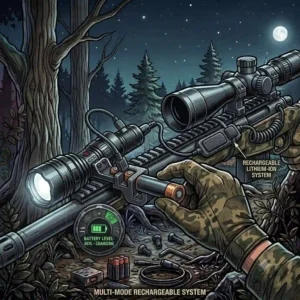
Real-World Scenarios: Finding Your Perfect Match
Not all dark environments are created equal. The perfect light for one hunter will be a frustrating hindrance for another. Let’s break down specific user profiles and match them with the right gear.
The Precision Varmint Hunter
Profile: You are hunting coyotes or prairie dogs in the flat, open plains of the American West. Your shots are frequently taken between 200 and 400 yards.
The Bad Fit: The Streamlight ProTac HL-X. At 200 yards, the HL-X’s beam has spread out so much that the target will merely look like a fuzzy gray blob, making ethical shot placement impossible.
The Perfect Match: The Olight Javelot Pro 2. You need uncompromising candela to punch a tiny, bright hotspot out to a quarter-mile. The heavy dual-battery pack is a non-issue since you are likely shooting from a bipod or a fixed blind.
The Dense-Woodland Blood Tracker
Profile: You are a whitetail bowhunter in the Northeast. You’ve taken a shot at dusk, and now you must track a sparse blood trail through incredibly thick brush, briars, and uneven terrain.
The Bad Fit: The Fenix HT18. The extreme throw of the HT18 creates a hotspot that is so intensely bright at close range that it will wash out the color red, making fresh blood look like shiny water or black sap.
The Perfect Match: The ThruNite Catapult V6 running on a medium setting. The wide “orange peel” spill illuminates a massive 20-foot circle around your feet, allowing you to see the micro-splatters of blood on adjacent leaves without suffering from blinding hotspot bounce-back.
The Tactical Hog Eradicator
Profile: You are managing feral hog populations in the humid, swampy South. Engagements are fast, aggressive, and often happen at 50 yards or closer while moving through dense palmettos.
The Bad Fit: The ThruNite Catapult V6. You cannot mount it to your AR-15 due to the soda-can body, leaving you fumbling with a handheld light while trying to manage weapon recoil.
The Perfect Match: The Streamlight ProTac HL-X. It mounts instantly, withstands the brutal recoil of semi-automatic fire, and provides enough peripheral spill to ensure you aren’t blindsided by a charging boar just outside the beam’s center.
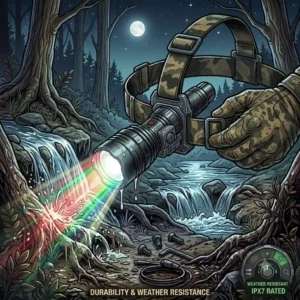
How to Choose a hunting flashlight: Beyond the Spec Sheet
When evaluating a hunting flashlight, the marketing departments want you to look at one number: Lumens. As an industry consultant, I can confidently tell you that buying a light based solely on lumens is like buying a truck based solely on its top speed. It’s an incomplete metric. Here is the framework you must use.
1. The Candela to Lumen Ratio
Lumens measure the total volume of light leaving the emitter. Candela measures the peak intensity of that light at the center of the beam. If you take 1,000 lumens and spread it across your backyard, it’s a floodlight (low candela). If you take those same 1,000 lumens and focus them through a deep, smooth reflector, it becomes a laser beam that reaches 600 yards (high candela). For dedicated hunting, you want a light that offers at least 50,000 candela. Anything less, and you are buying a camping lantern.
2. Battery Chemistry and Form Factor
The flashlight industry has largely transitioned from the older 18650 lithium-ion batteries to the new 21700 cells. You absolutely want a 21700-powered light. While the battery is only slightly larger (21mm wide vs 18mm), it offers nearly double the milliamp-hour (mAh) capacity. This translates directly to longer runtimes on high settings. Furthermore, avoid lights with built-in, non-removable batteries. If your light dies in the field, you need the ability to pop in a fresh cell in 10 seconds. You cannot plug your rifle into a power bank and wait two hours for a recharge while the hogs are running.
3. The Switch User Interface (UI)
Under the stress of a hunt, fine motor skills degrade rapidly. Complex side-switches that require “double-clicks” or “press-and-hold” sequences will get you frustrated and cost you the shot. The gold standard for a hunting flashlight is a dual tail-switch design, or a forward-clicky mechanical tail switch. A forward-clicky allows for “momentary on”—meaning you half-press the button, the light comes on silently, and when you release it, the light goes off. This silent operation is critical for light discipline in the blind.
Common Mistakes When Buying Your First Beam
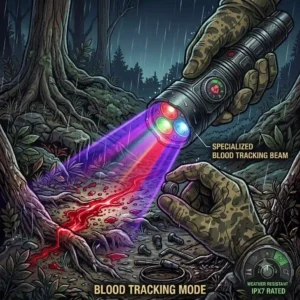
Even seasoned outdoorsmen make critical errors when transitioning to night hunts. The biggest pitfall is ignoring the Color Rendering Index (CRI). Standard LED hunting flashlights prioritize maximum brightness, utilizing LEDs that produce a harsh, bluish-white light (typically 6500K color temperature, with a CRI under 70). This blue light flattens colors and destroys depth perception. If you use a low-CRI light for tracking, red blood will appear black or dark brown, blending perfectly into the dirt. If tracking is your primary goal, seek out lights specifically labeled as “High CRI” (90+), or use a dedicated blood-tracking filter that enhances the red spectrum.
The second massive mistake is neglecting Recoil Shock Management. A standard consumer flashlight uses simple, thin springs—or worse, solid brass contacts—to touch the battery. When you fire a .308 rifle, the G-force of the recoil sends the heavy lithium-ion battery slamming backward, breaking the electrical contact for a fraction of a second, causing the light to flicker or change modes. True tactical and hunting lights feature dual-spring designs (springs at both the head and the tail) to suspend the battery, absorbing the shock and maintaining flawless electrical contact. According to the ANSI FL1 Standards for Flashlights, look for drop-impact ratings of at least 1.5 meters to ensure internal potting quality.
Lastly, buyers often fail to consider the legal regulations regarding artificial light. This isn’t a hardware spec, but it’s a crucial aspect of ownership. In many states, hunting game animals with artificial white light is strictly illegal, while hunting non-game animals (like feral hogs or coyotes) may require specific permits or the use of colored filters. Always verify your local state and county ordinances before equipping your weapon with high-lumen optics.
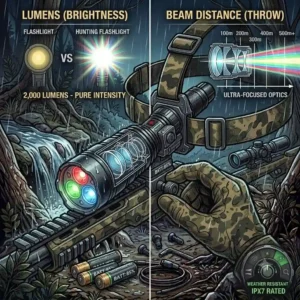
Features That Actually Matter (And Those That Don’t)
Flashlight manufacturers love to pack their specification sheets with features that sound incredibly tactical but offer zero practical value in the field. Let’s filter the marketing hype from the mandatory upgrades.
Features to Ignore:
-
The Strobe Function: Strobe is a self-defense tool designed to disorient a human attacker. Shining a strobe at a coyote won’t disorient it; it will just terrify the animal and send it running into the next county at Mach 2. Ensure your light either hides the strobe deeply in the UI menu, or allows you to program it out entirely.
-
Built-in Compass or Laser Pointers: These are cheap gimmicks slapped onto low-quality gear. A laser pointer mounted inside a flashlight housing will never hold zero on a rifle, making it dangerously inaccurate.
-
“100,000 Lumen” Claims: If you see a light on an obscure website claiming 100,000 lumens for $29, it is a mathematical and physical lie. True high-output lights require massive cooling fins and expensive electronics.
Features That Matter:
-
IP68 Waterproofing: IPX4 (splash resistant) is not enough. IP68 means the light is completely dust-tight and can be submerged in up to 2 meters of water for 30 minutes. If you drop your rifle in a creek crossing, an IP68 light will function flawlessly.
-
Remote Pressure Switch Compatibility: If you are weapon-mounting, you need the ability to connect a remote pressure pad to your rail. Reaching all the way up to the barrel to click a tail-cap completely ruins your shooting grip and cheek weld.
-
Low Voltage Warning: A light that suddenly goes pitch black without warning is dangerous. Premium models feature a subtle haptic vibration or a side-switch LED indicator that pulses red when the battery drops below 20%, giving you ample time to swap cells safely.
Long-Term Cost & Maintenance: The Total Cost of Ownership
When you purchase a $150 hunting flashlight, you are not just paying the entry fee; you need to calculate the total cost of ownership over a 3 to 5-year lifecycle.
The primary hidden cost lies in battery degradation. Lithium-ion cells (like 18650s and 21700s) are rated for approximately 500 charge cycles before they lose about 20% of their total capacity. If you hunt heavily, you will need to replace these batteries every two years. High-quality cells from reputable manufacturers cost between $15 and $25 each. Beware of proprietary batteries; some brands modify standard cells by moving both the positive and negative terminals to the same side. While this allows for fancy magnetic tail-charging, it forces you to buy replacement batteries exclusively from them at double the market rate.
Next is the efficiency gap. Cheaper lights use inefficient, unregulated drivers. This means that as the battery drains, the light output steadily dims. You might start with 1,000 lumens, but at 50% battery, you are only getting 500 lumens. Premium lights use “constant current” buck-boost drivers. These advanced electronics draw exactly the power they need to maintain maximum brightness until the battery is nearly dead, giving you predictable, reliable performance. While constant-current lights cost more upfront, their reliability over five years easily justifies the premium.
Finally, factor in the cost of mounting hardware. Most lights do not come with quality weapon mounts. A cheap $10 Amazon mount will slip under recoil, ruining the alignment of your beam. Budgeting $40-$60 for a dedicated, high-quality offset M-LOK or Picatinny mount from a reputable tactical brand is a mandatory hidden cost of setting up a proper hunting rig.
Conclusion
Building the ultimate nocturnal tracking and harvesting setup requires far more than just clicking the first high-lumen advertisement you see. A true hunting flashlight is a precision instrument, balancing the brutal intensity of high candela throw with the delicate thermal management required to survive hours in the freezing brush. Whether you are investing in the extreme quarter-mile reach of the Olight Javelot Pro 2 for sweeping the Western plains, or utilizing the lightweight agility of the Nitecore NEW P30 on a custom stalk-hunting rig, your choice dictates your success rate when the sun drops.
Remember to prioritize UI simplicity, demand rugged internal shock potting, and always consider the long-term battery ecosystem over flashy marketing gimmicks. Equip yourself properly, maintain your gear diligently, and dominate the darkness.
FAQs
❓ What is the best color light for a hunting flashlight?
✅ Red and green are the industry standards. Green light offers better contrast and detail recognition for the human eye, making it ideal for feral hogs. Red light is highly effective for coyotes and predators, as it is less likely to spook them and preserves your natural night vision…
❓ How many lumens do I need for a hunting flashlight?
✅ You need a minimum of 800 to 1,000 lumens, but more importantly, you need high candela (50,000+). A 1,000-lumen light with a highly focused reflector will outperform a 3,000-lumen floodlight when attempting to identify targets past 200 yards in the field…
❓ Will a normal tactical flashlight work for hunting?
✅ It can, but with limitations. Tactical lights typically feature wider spill beams designed for room clearing (CQB) rather than long-range throw. They also frequently prioritize strobe functions, which are useless and potentially detrimental in hunting scenarios…
❓ Can a hunting flashlight handle 12-gauge recoil?
✅ Premium models designed specifically for weapon mounting can easily handle the shock. Look for lights featuring dual-spring battery compartments (springs at the head and tail) and fully potted electronics, which prevent battery disconnects and circuitry damage during severe recoil…
❓ Why does my high-lumen flashlight dim after a few minutes?
✅ This is an intentional safety feature called thermal step-down. High-output LEDs generate immense heat. To prevent the internal circuits from melting and the battery from venting, thermal sensors automatically reduce the lumen output to maintain a safe operating temperature…
Recommended for You
- 5 Best american made flashlights in 2026: A Tactical Consultant’s Guide
- 5 Powerful infrared flashlight Picks for Night Vision in 2026
- Ultimate 2026 Guide: Best Flashlight With 10000 Lumens Tested & Reviewed
Disclaimer: This article contains affiliate links. As an Amazon Associate, I earn from qualifying purchases. If you purchase products through these links, we may earn a small commission at no additional cost to you.
✨ Found this guide helpful? Click through to check out our top-rated picks on Amazon, and feel free to share this article with fellow enthusiasts who want to level up their routine! 💬🤗
[addtoany]
