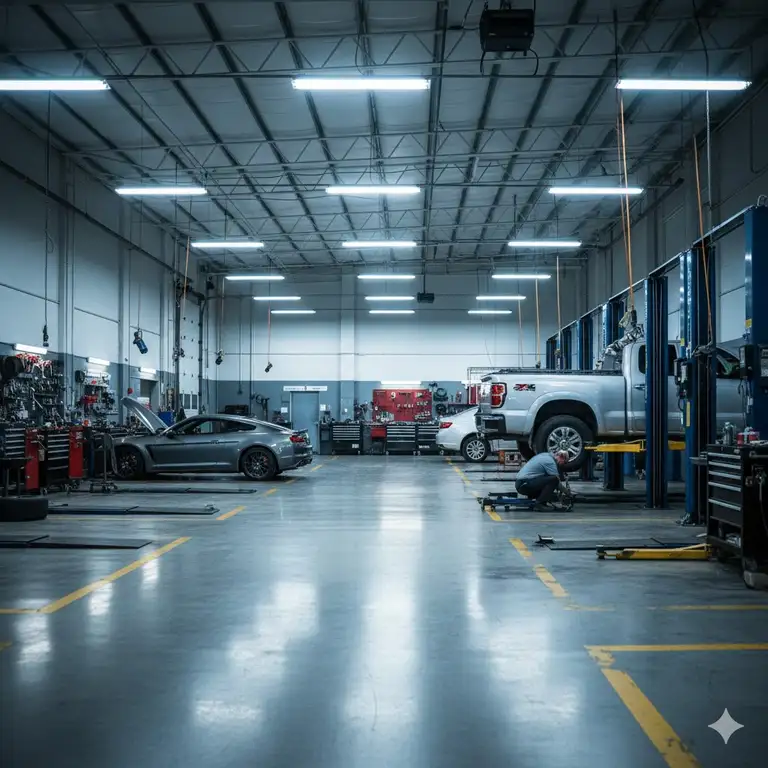
I’ve spent more hours than I’d like to admit squinting at a greasy 10mm bolt head, wondering if it’s actually stripped or if my eyes are just playing tricks on me in the shadows. We’ve all been there, right? Working in a dimly lit garage is like trying to perform surgery in a cave. It’s frustrating, it’s slow, and honestly, it’s a safety hazard. If you want to stop the madness, you need to invest in serious mechanic shop lights.
✨Was this helpful? Spread the word! 🚀
[addtoany]
Whether you are a professional tech or a weekend warrior working on a project car, the right lighting isn’t just a luxury; it’s a tool. It’s the difference between spotting a hairline crack in a brake line and missing it entirely. Today, we are diving deep into the world of high-performance illumination. We aren’t just looking at “bulbs”; we are looking at lighting systems that transform a dingy workspace into a pro-level bay.
Quick Comparison: mechanic shop lights vs. Traditional Lighting
Before we get into the heavy hitters, let’s see how modern LED options stack up against the old-school stuff we used to hang from the rafters.
| Feature | LED mechanic shop lights | Old Fluorescent Tubes | Halogen Work Lights |
| Energy Efficiency | High (Up to 80% less energy) | Moderate | Very Low (High Heat) |
| Lifespan | 50,000+ Hours | 10,000 – 20,000 Hours | 2,000 Hours |
| Brightness (Lumens) | Extremely High/Adjustable | Fades over time | High but inconsistent |
| Durability | Shatter-resistant/Solid State | Fragile glass tubes | Very fragile bulbs |
| Heat Output | Minimal | Low to Moderate | Extremely High (Burn risk) |
| Instant On | Yes (No flicker) | Often requires warm-up | Yes |
Top 7 mechanic shop lights: Expert Analysis
I have scoured the specs, read the teardowns, and analyzed real-world feedback to bring you the best of the best. These are actual products available right now that will change the way you see your work.
1. Honeywell 4ft LED Shop Light (Model: SH450305CH128)
The Honeywell 4ft LED Shop Light is a staple in many American garages for a reason. It is a no-nonsense, plug-and-play fixture that delivers a massive amount of light without a massive electric bill. I personally love the pull-chain design because sometimes, the simplest tech is the most reliable when your hands are covered in gear oil.
-
Technical Specifications: 5000 Lumens, 42 Watts, 5000K Daylight color temperature, 120V, Linkable up to 10 units.
-
Customer Review Analysis: Users consistently praise the “instant-on” feature with zero buzzing. A common highlight is the lightweight aluminum construction which makes one-person installation a breeze. Some users noted that the hanging chains could be a bit longer for high-ceiling shops.
-
Warranty: 5-Year Limited Warranty.
-
Professional Applications: General overhead lighting for main bays, detailing stations, and woodworking areas.
-
Pros: High lumen-to-watt ratio, very reputable brand, easy mounting.
-
Cons: Non-dimmable, power cord is a bit short (5 feet).
2. Barrina LED Shop Light 4FT (Model: INWT504020650Bc)
If you want that “spaceship” look where the entire ceiling is a grid of light, the Barrina LED Shop Light 4FT is your best friend. These are V-shaped, meaning they have two rows of LEDs that spread light at a 270-degree angle.
-
Technical Specifications: 5000 Lumens per tube, 40 Watts, 6500K (Super White), T8 Integrated Fixture, Clear Cover.
-
Customer Review Analysis: “Total game changer” is the phrase that pops up most. People love how thin they are, allowing them to be tucked between rafters. Some professional mechanics mention that the 6500K color can be a bit harsh on the eyes after 8 hours, but the visibility is unmatched.
-
Warranty: 2-Year Warranty.
-
Professional Applications: High-density lighting grids, under-cabinet lighting for tool chests, and wrap-around lighting for lifts.
-
Pros: Incredible spread of light, comes in multi-packs (6 or 10), very affordable.
-
Cons: The plastic covers feel a bit thin; clips can be finicky.
3. Antlux 4FT LED Shop Light (Model: FT-ALSL40W)
The Antlux 4FT LED Shop Light is designed for those who want a cleaner, more finished look. It features a frosted cover that diffuses the light, reducing the “dots” of glare you sometimes get with cheaper LEDs. This makes it one of the better mechanic shop lights for working on reflective surfaces like fresh paint or chrome.
-
Technical Specifications: 4800 Lumens, 40 Watts, 5000K, 1-10V Dimmable (with compatible switch), ETL Certified.
-
Customer Review Analysis: Mechanics appreciate the frosted lens because it reduces eye fatigue during long shifts. The build quality is noted as being superior to “budget” brands. Some DIYers found the wiring slightly more complex if they chose to hardwire it.
-
Warranty: 5-Year Warranty.
-
Professional Applications: Paint booths, precision engine assembly rooms, and office/garage hybrids.
-
Pros: Dimmable capability, elegant design, very sturdy housing.
-
Cons: Slightly lower lumens than some competitors; higher price point.
4. Big Ass Fans Garage Light (Model: P-GARA-5K-01)
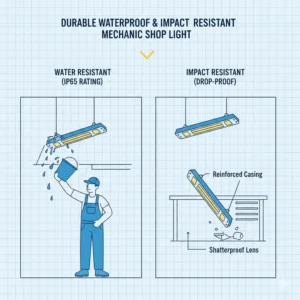
Yes, the name is funny, but the performance is deadly serious. The Big Ass Fans Garage Light is essentially the “tank” of the lighting world. It is built from heavy-duty anodized aluminum and is designed to survive in shops that get hot, dusty, and generally abusive.
-
Technical Specifications: 13,000 Lumens, 122 Watts, 5000K, Rated for 150,000 hours of life.
-
Customer Review Analysis: Professionals rave about the build quality. One reviewer mentioned it “survived a direct hit from a ladder.” It’s incredibly bright—one of these can replace four standard 4ft tubes. The only downside is the high entry cost.
-
Warranty: 7-Year Warranty.
-
Professional Applications: Heavy equipment repair, industrial warehouses, and large commercial bays.
-
Pros: Virtually indestructible, insane brightness, long-term ROI.
-
Cons: Very expensive, heavy (requires solid mounting).
5. Braun 5500 Lumen LED Tough Shop Light
The Braun 5500 Lumen LED Tough Shop Light is a favorite among those who shop at Harbor Freight but want something that actually lasts. It’s built for the rugged environment of a mechanic’s shop, featuring a diamond-plate style housing that looks the part.
-
Technical Specifications: 5500 Lumens, 60 Watts, 5000K, Integrated outlets for daisy-chaining.
-
Customer Review Analysis: Users like the “tough” look and the fact that it has an onboard outlet to plug in other tools. Some reviews mention that the light distribution is very directional (downward), which is great for workbenches but less so for general room filling.
-
Warranty: 90-Day (Standard) to 2-Year (Extended).
-
Professional Applications: Workbench task lighting, small engine repair, and mobile tool trailers.
-
Pros: Very bright, built-in outlets, rugged aesthetic.
-
Cons: Shorter warranty than others, runs slightly warmer than other LEDs.
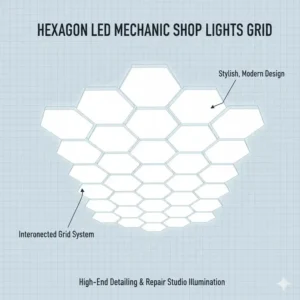
6. Sunco Lighting 4FT LED Shop Light (Model: SC-4FT-SL-40W-5K)
Sunco Lighting 4FT LED Shop Light is the “safe bet” for mass-outfitting a shop. If you have a 40×60 shop and need 20 lights, this is the cost-effective way to get high-quality illumination without going bankrupt.
-
Technical Specifications: 4000 Lumens, 40 Watts, 5000K, Frosted Lens, Plug-in with on/off switch.
-
Customer Review Analysis: Customers love the consistency. You buy ten, and all ten work perfectly out of the box. They are praised for being UL-listed, which is important for insurance compliance in commercial buildings.
-
Warranty: 7-Year Warranty.
-
Professional Applications: Fleet maintenance facilities, storage units, and home garages.
-
Pros: Excellent warranty, UL-listed for safety, very consistent quality.
-
Cons: Lowest lumen output on this list; basic mounting hardware.
7. Bbounder 4FT LED Shop Light (Model: BB-SL4FT-40W)
The Bbounder 4FT LED Shop Light is the value king. It’s a no-frills, high-efficiency light that often comes in bulk packs at a price that makes you double-check the listing.
-
Technical Specifications: 4000 Lumens, 40 Watts, 5000K, Linkable up to 4 units.
-
Customer Review Analysis: The feedback is centered on “value for money.” It’s light, it’s bright, and it’s cheap. Some users mention the power cords are a bit thin, so you’ll want to be careful not to yank on them.
-
Warranty: 5-Year Warranty.
-
Professional Applications: Temporary workspaces, basement shops, and budget garage renovations.
-
Pros: Incredible price point, easy to daisy chain, lightweight.
-
Cons: Plastic feel, not as durable as the Big Ass Fans or Honeywell models.
🔍 Don’t Miss These Exclusive Deals!
🔍 Take your mechanic shop to the next level with these carefully selected products. Click on any highlighted item to check current pricing and availability. These lighting solutions will help you see every detail your car project needs! ✨
💬 Just one click – help others make better buying decisions too!😊
[addtoany]
Technical Specifications Matrix (Spec Matrix)
| Product Name | Lumens | Watts | Color Temp | Warranty | Best For |
| Honeywell 4ft | 5000 | 42W | 5000K | 5 Years | Reliability |
| Barrina V-Shape | 5000 | 40W | 6500K | 2 Years | Maximum Spread |
| Antlux Dimmable | 4800 | 40W | 5000K | 5 Years | Detail Work |
| Big Ass Fans | 13000 | 122W | 5000K | 7 Years | Large Bays |
| Braun Tough | 5500 | 60W | 5000K | 90 Days | Workbenches |
| Sunco Lighting | 4000 | 40W | 5000K | 7 Years | Large Installs |
| Bbounder Value | 4000 | 40W | 5000K | 5 Years | Budget Builders |
The Science of mechanic shop lights: More Than Just Brightness
When you start looking for shop lights for garage use, it’s easy to get blinded by lumen counts. But if you’ve ever worked under a light that made your red paint look brown or gave you a pounding headache after an hour, you know there’s more to it than just “more light.”
Understanding Color Rendering Index (CRI)
CRI is a scale from 0 to 100 that measures how accurately a light source reveals the true colors of objects. For led shop lights for mechanic use, you want a CRI of at least 80. Why? Because you need to be able to tell the difference between a red wire and an orange wire. You need to see the subtle discoloration on a spark plug that tells you the engine is running lean.
A light with a low CRI makes everything look gray and washed out. High CRI lights (90+) are usually more expensive but are a godsend for detailers and painters.
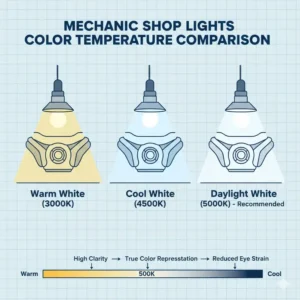
Color Temperature: Kelvin (K)
The color of the light is measured in Kelvin.
-
3000K (Warm White): Too yellow for a shop. It feels like a living room. You’ll want to fall asleep under your car.
-
4000K (Neutral White): Clean and clear. Good for long hours.
-
5000K (Daylight): This is the sweet spot for best shop lights for mechanics. it mimics the sun at noon, keeping you alert and making details pop.
-
6500K (Cool White): Has a blue tint. It’s very bright but can be harsh on the eyes during late-night sessions.
Lumens vs. Lux: The Ground Truth
Lumens are the total amount of light a fixture puts out. Lux is the amount of light that actually reaches your work surface. If you hang a 10,000-lumen light 20 feet in the air, the Lux at your workbench will be low. This is why portable mechanic shop lights are so important for localized tasks.
Budget vs. Premium Comparison
| Category | Budget ($20-$40 per unit) | Premium ($100-$400+ per unit) |
| Housing Material | Thin Plastic / Pressed Steel | Anodized Aluminum / Heavy Duty Poly |
| Driver Quality | Standard (May have slight flicker) | High-End (No flicker, EMC interference protection) |
| Light Quality | 80 CRI | 90+ CRI |
| Extras | Simple pull chain | Dimmable, Motion Sensors, Remote Control |
| Typical Brand | Bbounder, Sunco | Big Ass Fans, Cree |
Why You Need Specialty mechanic workshop lighting
Standard ceiling lights are great for walking around without tripping over the floor jack, but they are terrible for actually working on a car. Shadows are the enemy. When you are leaning over a fender, your body blocks the overhead light. This is where a layered approach to mechanic lighting fixtures comes in.
The Layered Lighting Strategy
-
Ambient Lighting: These are your 4ft or 8ft overhead LED tubes (like the Honeywell or Sunco). They provide the baseline brightness for the whole room.
-
Task Lighting: These are lights focused on your workbench. The Braun Tough Shop Light is perfect here because it’s rugged and puts the light exactly where you are rebuilding a carburetor.
-
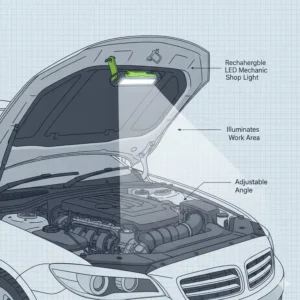
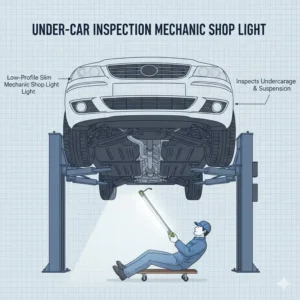
Localized Lighting: Under-hood lights that clip to the bonnet, or magnetic “puck” lights that stick to the frame. These fight the shadows that ambient lights can’t reach.
Features/Benefits Comparison: LED vs. Legacy Systems
| Benefit | Modern LED Fixtures | Old T12/T8 Fluorescent |
| Cold Weather Start | Instant start even at -20°F | Flickers, buzzes, and dims in cold |
| Radio Interference | Minimal (if shielded) | Often ruins radio/Wi-Fi reception |
| Maintenance | Zero (No bulbs to change) | Frequent tube and ballast replacement |
| Environmental | No Mercury | Contains toxic Mercury vapor |
| Directionality | 100% focused down | 360° (wastes light going up) |
Addressing the “Macanic Shop Lights” Dilemma: Installation Tips
(Yes, I know some of you type “macanic shop lights” into Google after a few beers in the garage—no judgment here!) Regardless of how you spell it, installing these things correctly is what makes the difference.
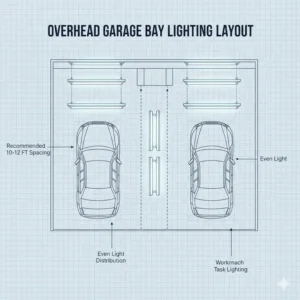
1. The 10-Foot Rule
For most home garages with 8 to 10-foot ceilings, you want your light rows spaced about 8 to 10 feet apart. If you place them too close, you waste energy. Too far, and you get “dark spots” between the bays.
2. Daisy-Chaining
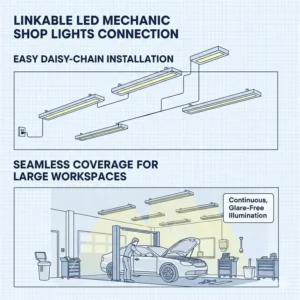
Most modern mechanic shop lights allow you to “daisy chain” them. This means you plug one light into the next. It’s a lifesaver because you don’t need an outlet for every single fixture. However, pay attention to the manufacturer’s limit. If they say “link up to 4,” don’t try to link 8, or you might melt a connector or trip a breaker.
3. Orientation Matters
If you are installing lights over a car lift, orient them parallel to the vehicle. If you put them perpendicular, the roof of the car will block almost all the light from reaching the engine bay or the interior.
Performance Metrics: Quantifying the Upgrade
| Metric | Before (Old Fluorescent) | After (High-Quality LEDs) |
| Avg. Lux at Workbench | 150 Lux | 500+ Lux |
| Monthly Operating Cost | $45.00 | $12.00 |
| Heat Load in Summer | Significant (+5 degrees) | Negligible |
| Time Spent Finding Tools | “Where is that wrench?!” | “There it is.” |
Maintenance and Safety of mechanic lighting fixtures
One of the biggest lies in the world of led shop lights for mechanic shops is that they are “maintenance-free.” While you don’t have to swap bulbs, you do have to keep them clean.
-
Dust is a Heat Killer: LEDs hate heat. In a shop, sawdust and overspray can coat the top of the fixtures, trapping heat and shortening the life of the internal “driver” (the brain of the LED). Give them a quick wipe with a dry cloth every few months.
-
Electrical Safety: If you are using portable mechanic shop lights, always check the cords for frays. Working around sharp metal edges and moving parts (like fans or belts) is a recipe for a cut cord.
-
Eye Safety: Never look directly into a high-lumen LED. They can cause temporary “flash blindness” or even permanent retinal damage if they are powerful enough (like the Big Ass Fans model).
The Economics of Better Lighting
I once heard a shop owner say he couldn’t afford to upgrade to LED mechanic shop lights. A year later, he realized his electric bill and the cost of replacing old ballasts were triple what the upgrade would have cost.
ROI Calculation (Example)
Let’s say you have 10 old fluorescent fixtures drawing 100W each. You switch to 10 Sunco Lighting LEDs drawing 40W each.
-
Energy Saved: 600W per hour.
-
Usage: 40 hours a week = 24kWh saved per week.
-
Cost Savings: At $0.15/kWh, that’s $3.60 a week, or about $187 a year.
-
Payback Period: The lights pay for themselves in less than a year just on electricity—not even counting the fact that you aren’t buying replacement tubes anymore.
User Compatibility & Application Table
| User Type | Recommended Setup | Primary Light Source |
| The Hobbyist | 2-Car Garage | Honeywell or Bbounder 4-packs |
| The Pro Tech | Multi-Bay Commercial | Big Ass Fans or Antlux (Dimmable) |
| The Detailer | High-Gloss Focus | Antlux (High CRI/Frosted) |
| The Mobile Mechanic | Van/Trailer | Barrina (Slim profile) |
| The Fabricator | Welding/Grinding | Braun Tough (Shatter resistant) |
🔍 Don’t Miss These Exclusive Deals!
🔍 Ready to finally see what you’re doing? Click on any of the product names above to see the latest prices on Amazon. Investing in your shop’s lighting is an investment in your own sanity! ✨
Conclusion: Lighting the Way to Better Repairs
At the end of the day, your shop is your sanctuary. It’s where problems get solved and projects come to life. Why work in the dark? Upgrading to high-quality mechanic shop lights is one of the single most impactful things you can do for your workspace.
From the brute strength of the Big Ass Fans Garage Light to the incredible value of the Bbounder LED Shop Light, there is an option for every budget and every bay. Better lighting means fewer mistakes, faster work, and a much more enjoyable experience under the hood. I’ve never met a single person who regretted making their shop brighter—but I’ve met plenty who regretted waiting so long to do it.
So, take a look at your ceiling. If you see flickering tubes or dark corners, it’s time for a change. Your eyes (and your knuckles) will thank you.
Frequently Asked Questions
❓ How many lumens do I need for a 2 car garage?
❓ What is the best color temperature for mechanic shop lights?
❓ Can I use LED shop lights in a cold garage?
❓ Is it better to hang shop lights or flush mount them?
❓ Do LED shop lights interfere with radio or garage door openers?
Recommended for You
- Rechargeable EDC Flashlight: 7 Best Powerhouse Picks for 2026
- Best Mechanic Flashlight: 7 Top Picks to Save Your Knuckles in 2026
- 7 Best Automotive Shop Lights for a Brighter Garage in 2026
Disclaimer: This article contains affiliate links. If you purchase products through these links, we may earn a small commission at no additional cost to you.
✨ Found this helpful? Share it with your friends! 💬🤗
[addtoany]
