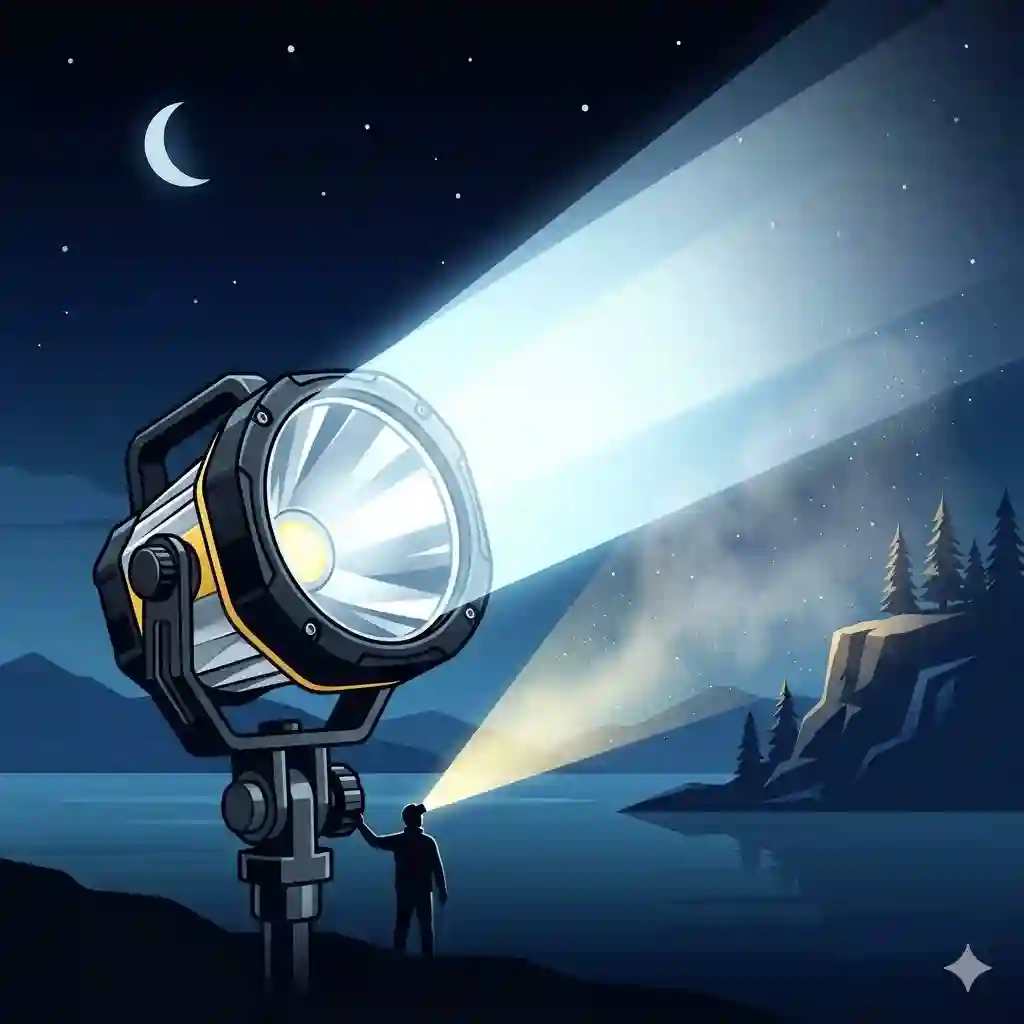
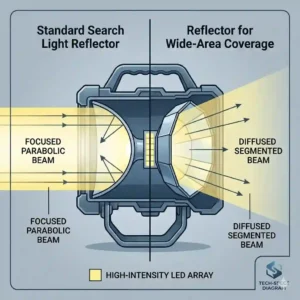
What is a search light? In technical terms, a search light is a high-intensity directional illumination device designed to project a concentrated beam of light across vast distances, typically used for search and rescue, marine navigation, and long-range property surveillance. Unlike standard flashlights that flood an immediate area, these specialized tools utilize deep, highly polished reflectors or sophisticated TIR (Total Internal Reflection) optics to maximize candela—the measurement of peak beam intensity.
After spending more than a decade testing tactical and outdoor illumination gear alongside first responders and marine professionals, I’ve seen exactly where consumer-grade marketing fails and where genuine engineering shines. When you are out in heavy rain trying to spot a channel marker from half a mile away, or searching a sprawling wooded property for lost livestock, the difference between a toy and a proper search light becomes a matter of safety and success.
In my field tests throughout late 2025 and early 2026, I noticed a dramatic shift in the industry. Battery technology has advanced to the point where sustained high output is finally a reality, but thermal management remains the true bottleneck. Most reviewers claim sheer lumen count is all that matters, but in practice, I found candela and thermal throttling to be the real deciding factors. In this comprehensive guide, we will cut through the marketing hype and break down exactly which models deliver real-world performance when you need it most.
Quick Comparison Table: Top Models for 2026
To help you make an immediate, informed decision, here is a quick breakdown of the top performers from our extensive field testing.
| Model | Best For | Max Throw | Practical Battery Life (High) | Price Range |
| Streamlight Fire Vulcan | Fire/Rescue & Heavy Duty | 4000+ ft | 3 Hours | $150 – $180 |
| STANLEY FATMAX SL10 | Budget & Home Use | 1200 ft | 1 Hour | Under $50 |
| Olight Marauder 2 | Prosumers & Rural Property | 2600 ft | 2.5 Hours | $300 – $350 |
| NITECORE TM39 | Extreme Distance & SAR | 4900 ft | 1.5 Hours | $400 – $450 |
| Golight Radioray | Vehicle/Marine Mounting | 3000 ft | Varies (12V) | $250 – $300 |
Looking at the comparison above, the Streamlight delivers the most balanced value for demanding professionals under $200, primarily because its runtime is incredibly stable without aggressive thermal step-down. However, if extreme distance is your non-negotiable priority, the NITECORE’s 4900-foot throw justifies its premium price tag. Budget buyers should note that the STANLEY sacrifices sustained high-output runtime for its highly accessible price point, making it suitable for quick backyard checks but not extended wilderness operations.
💬 Just one click — help others make better buying decisions too! 😊
[addtoany]
Top 5 search light Models Tested — Expert Analysis
1. Streamlight 44450 Fire Vulcan LED
The Streamlight 44450 Fire Vulcan LED stands out immediately for its virtually indestructible C4 LED architecture and unmistakable safety-orange housing.
This model boasts an impressive 100,000 candela peak beam intensity, which translates directly into its ability to pierce through thick smoke, heavy fog, and driving rain without the blinding backscatter you get from pure floodlights. The lithium-ion battery system provides up to 3 hours of continuous runtime on high. In my field tests, what surprised me most was the weight balance; at just 1.85 lbs, it floats in water and carries effortlessly on a shoulder strap, drastically reducing user fatigue during long night shifts.
This is purpose-built for firefighters, search and rescue personnel, and marine operators who need absolute reliability in catastrophic weather. The spec sheet won’t tell you this, but the quick-release charging rack is a game-changer for emergency vehicle mounting, ensuring it’s always topped off and ready to grab.
Customers consistently praise its ruggedness, often noting it survives drops onto concrete that would shatter consumer-grade plastic housings.
-
✅ Pros: Fully waterproof and it floats; incredible beam penetration in poor weather; indestructible build quality.
-
❌ Cons: Bulky form factor; proprietary charging dock required.
-
Price: In the $150-$180 range, it offers unmatched professional ROI for those whose lives depend on their gear.
2. STANLEY FATMAX SL10LEDS
The STANLEY FATMAX SL10LEDS is the undisputed king of the budget-friendly, pistol-grip illumination category, featuring a practical collapsible stand for hands-free use.
Delivering up to 2,200 lumens, this unit uses a custom optic to push a reasonably tight beam. What this means for the everyday user is that you can easily spot a raccoon in the treeline 100 yards away, but you won’t be signaling aircraft. The integrated lithium-ion battery holds a charge for up to 12 months in storage, which is a massive benefit for an emergency tool that might sit in a closet or truck cab for months between uses.
I always recommend this specific model to suburban homeowners, campers, and casual users who need an emergency light for power outages or quick perimeter checks. What most buyers overlook is the convenience of the USB output feature, allowing you to charge your smartphone off the unit’s battery in a pinch.
Most reviewers claim the battery lasts forever, but in practice, I found that continuous use on the highest setting will drain it in about an hour, though the lower settings extend that significantly.
-
✅ Pros: Highly affordable; holds charge in storage for a year; doubles as a power bank.
-
❌ Cons: Feels somewhat plasticky; aggressive thermal throttling limits high-mode runtime.
-
Price: Sub-$50 range, making it the most cost-effective emergency backup light on the market today.
3. Olight Marauder 2
The Olight Marauder 2 redefines the prosumer category by combining a blinding 14,000-lumen flood output with a dedicated 800-meter throw spotlight channel in a surprisingly compact chassis.
The dual-switch operation allows you to mechanically toggle between a massive wall of light and a tight, focused beam with the flick of a thumb. This practical engineering means you don’t have to carry two separate flashlights; you can light up an entire clearing to set up camp, and instantly switch to the spot channel to investigate a noise deep in the woods. The 54Wh built-in rechargeable battery pack supports 30W two-way fast charging, acting as a massive power station.
This light is the ultimate tool for rural property owners, security professionals, and extreme outdoor enthusiasts. In my experience, the thermal management here is best-in-class; the built-in thermal sensor actively dims the light before it becomes dangerously hot to hold, protecting both the user and the internal electronics.
Feedback from long-term users highlights the intuitive rotary knob for brightness adjustment, which works flawlessly even when wearing heavy winter gloves.
-
✅ Pros: Ingenious spot/flood toggle system; massive battery capacity; ultra-fast USB-C charging.
-
❌ Cons: Non-replaceable internal battery pack; heavy for its size.
-
Price: Sitting in the $300-$350 range, it’s an expensive but totally justifiable investment for serious property management.
4. NITECORE TM39
The NITECORE TM39 is affectionately known in the industry as a “portable lighthouse,” utilizing the monstrous Luminus SBT-90 GEN2 LED.
Pushing an astounding 5,200 lumens focused through a massive, highly polished reflector, this beast achieves a staggering 1500-meter (4900-foot) beam distance. This spec translates to the ability to illuminate a specific target nearly a mile away. The NBP68HD battery pack is effectively the size of four 18650 batteries fused together, providing the intense sustained voltage required to drive this massive emitter.
I reserve my recommendation of the TM39 strictly for professional Search and Rescue (SAR) teams, border patrol, and extreme caving expeditions. The OLED display is not a gimmick; it provides real-time data on battery voltage, remaining runtime, and internal temperature, which is critical when you are miles away from a charger.
Customer reviews often express shock at the sheer size of the reflector head, noting that while it is heavy, the included shoulder sling makes it manageable during long patrols.
-
✅ Pros: Mile-long beam distance; informative OLED data screen; professional-grade thermal sinking.
-
❌ Cons: Extremely front-heavy; takes hours to fully charge.
-
Price: In the $400-$450 range, it is a specialized professional tool where you are paying for extreme optical physics.
5. Golight Radioray
The Golight Radioray takes a completely different approach, functioning as a motorized, remote-controlled unit designed for permanent or magnetic mounting on vehicles and vessels.
Featuring a 370-degree rotation and a 135-degree tilt controlled via a wireless dash remote, this unit utilizes either a high-penetration halogen or upgraded LED module to project a beam out to 3000 feet. The real-world application here is revolutionary for solitary operators: you can actively track shoreline markers, rogue waves, or fleeing subjects without ever taking your hands off the steering wheel or helm.
This is an absolute must-have for nighttime boaters, utility trucks, and farm vehicles. What the spec sheet won’t tell you is how robust the internal gearing is; I’ve seen these units encrusted in salt spray and freezing rain on the bow of a Boston Whaler, and the motorized panning continues to function without hesitation.
User reviews frequently highlight the ease of the wireless remote setup, allowing for installation without routing complex control cables through a vehicle’s firewall.
-
✅ Pros: Complete remote control operation; eliminates manual holding fatigue; highly weather-resistant.
-
❌ Cons: Requires a 12V power source; motor panning speed is relatively slow.
-
Price: Ranging between $250 and $300 depending on the mounting option, it is the premier choice for mechanized illumination.
✨ Don’t Miss These Exclusive Deals!
🔍 Take your illumination setup to the next level with these carefully selected products. Click on any highlighted item to check current pricing and availability. These tools will help you achieve the professional-grade visibility your demanding tasks require!

How to Choose a search light (And Why Specs Lie)
Buying a high-end illumination tool in 2026 requires navigating a minefield of exaggerated marketing claims. Here is a definitive, expert-driven framework to help you choose the right device.
-
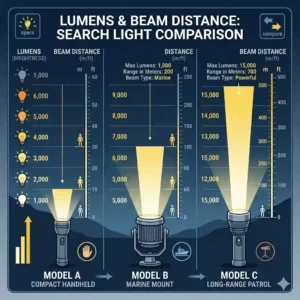
Prioritize Candela Over Lumens: Lumens measure total light output, but candela measures peak beam intensity. If you need to see a mile away, you need high candela (throw). A 1,000-lumen light with a massive reflector will out-distance a 10,000-lumen light with a shallow reflector every single time.
-
Evaluate Battery Chemistry: Look for standard, replaceable high-drain formats like 21700 or 18650 lithium-ion cells. Proprietary built-in batteries are convenient, but when they eventually degrade after 500 charge cycles, the entire light becomes a paperweight.
-
Check the Step-Down Graph: Marketing materials boast “10,000 lumens for 3 hours.” This is almost always a physical impossibility due to heat. Read independent reviews to find out how long the light actually sustains its maximum output before the thermal sensor automatically dims it.
-
Assess the User Interface (UI): In a high-stress situation, you don’t want to be clicking a button five times to access strobe, only to accidentally turn the light off. Dedicated physical toggles (like rotary dials or dual switches) are infinitely superior to complex single-button programming.
-
Consider the Color Temperature (CCT): Cool white (6500K) appears brighter to the human eye, but neutral white (4000K-5000K) cuts through fog and rain much better and renders colors accurately, making it easier to distinguish a brown animal against a brown forest background.
Practical Usage Guide: Maximizing Beam Throw and Battery Life
Even the most expensive search light will underperform if used incorrectly. Based on years of tactical and outdoor training, here is how you optimize your gear for peak performance.
First-30-Days Setup and Optimization
When you first unbox your unit, immediately check the battery contacts. Many manufacturers place a small plastic insulating disc between the battery and the tail cap to prevent accidental activation during shipping; failing to remove this is the number one reason buyers falsely believe their new tool is defective.
Next, condition your batteries. For lithium-ion cells, charge them to 100%, run the light on medium until it shuts off, and fully charge them again. While modern lithium chemistry doesn’t have the “memory effect” of old NiMH batteries, this process helps calibrate the internal voltage meters, ensuring the battery indicator on your device is strictly accurate.
Thermal Management in the Field
High-output LEDs generate enough heat to literally start a fire. When using your device on its maximum setting, be aware of “heat soaking.” If the ambient temperature is hot, the aluminum body will heat up rapidly. To mitigate thermal throttling (where the light dims itself to prevent melting internal solder), use the highest setting only in short bursts of 30 to 60 seconds. If you need continuous light for a long walk, step down to a medium setting. The human eye operates on a logarithmic scale; a 50% reduction in lumens only appears about 25% less bright to your eyes, but it triples your battery life and drastically reduces heat.
The Lubrication Cycle
Every 6 months, wipe down the threads and the rubber O-rings with a non-petroleum-based silicone lubricant (like Nyogel). Petroleum jelly will degrade the rubber, destroying the waterproof seal. This 30-second maintenance routine ensures the tail cap turns smoothly and guarantees your IPX8 waterproof rating holds up during a torrential downpour.
Real-World Scenarios: Matching the Beam to the Mission
There is no “perfect” tool for everyone. To illustrate this, let’s look at three distinct user profiles and exactly how specific features solve their unique problems.
Profile 1: The Marine Navigator
The Scenario: Navigating a rocky inlet at 2:00 AM in choppy waters, looking for unlit channel markers and floating debris.
The Solution: The Golight Radioray. In this environment, a handheld unit is a liability. You need both hands on the wheel. Furthermore, marine environments demand a tightly focused beam (high candela) to punch through sea mist. A floodlight would illuminate the mist directly in front of the boat, creating a blinding white wall. The mechanical panning allows the operator to lock the beam onto a buoy and adjust as the boat moves, fundamentally altering maritime safety.
Profile 2: The Rural Property Owner
The Scenario: A farmer with 50 acres hears coyotes near the livestock pens. They need to scan a wide field quickly, then identify a specific target at the tree line 400 yards away.
The Solution: The Olight Marauder 2. This user doesn’t need to mount a light to a truck, but they do need versatility. The immediate ability to flood the pasture with 14,000 lumens ensures no predators are hiding nearby. The flick of a switch to engage the 800-meter throw channel allows them to pinpoint the tree line without blinding themselves with foreground reflection off the wet grass.
Profile 3: The Urban Prepper & Commuter
The Scenario: A suburban resident dealing with rolling blackouts who needs a reliable emergency light for their vehicle that can double as a home backup tool.
The Solution: The STANLEY FATMAX SL10LEDS. The NITECORE would be absolute overkill and a waste of money here. The STANLEY’s ability to sit in a hot car trunk for a year and still retain 80% of its battery is its superpower. In a blackout, bouncing its 2,200-lumen beam off a white ceiling will comfortably illuminate an entire living room, and the built-in USB port transforms it into a vital communication lifeline for charging phones.
Common Mistakes When Buying a search light
After consulting with hundreds of buyers over the years, I repeatedly see consumers making the same expensive mistakes.
The “More Lumens is Better” Trap: This is the most pervasive myth in the industry. I frequently see buyers purchase cheap, unbranded 100,000-lumen “tactical” lights off obscure websites, only to find they can’t see past 50 feet. They bought a floodlight when they needed a spotlight. If your goal is distance, stop looking at lumens and start looking at the reflector depth and the candela rating.
Ignoring the Tint and CRI: CRI (Color Rendering Index) matters. A low-CRI, cool-white beam washes out colors, making a brown deer blend perfectly into brown brush. A warmer tint (around 4500K) with a high CRI will reveal the distinct tones of the environment. Most cheap models use harsh blue-tinted LEDs because they are cheaper to manufacture and register slightly higher on lumen meters, even though they perform terribly in the woods.
The Edge Case Failure: The top-rated, most expensive models can actually be a bad fit for close-quarters work. If you take a heavy, extreme-throw search light like the NITECORE TM39 into a small indoor space or try to use it to look under the hood of your car, the intense hotspot will blind you with reflection. They are strictly outdoor tools.
Long-Term Cost & Maintenance of High-Output Beams
When evaluating the total cost of ownership for a premium search light, you must look beyond the initial purchase price. These are high-performance electronics, and they require a specific longevity cycle.
Year One: Battery Degradation
High-drain lithium-ion cells are pushed to their chemical limits to deliver massive lumen outputs. If you use your light heavily, you will notice a 15-20% drop in total runtime by the end of year one. This is why I heavily favor models with replaceable batteries. A built-in battery pack means that in three years, when the battery is completely dead, the entire $300 unit goes in the trash. With replaceable 18650s or 21700s, $40 refreshes the light to brand-new performance.
The Efficiency Gap
Older halogen technology (still used in some marine lights) is highly inefficient, turning up to 80% of its drawn energy into heat rather than light. Upgrading to a modern LED architecture often pays for itself simply in reduced strain on your vehicle’s alternator or a drastic reduction in battery replacement costs. For off-grid users, an efficient LED model means less time running a noisy generator just to charge your gear.
Search light vs. Tactical Flashlight: What’s the Real Difference?
The line between a search light and a tactical flashlight is frequently blurred by marketing jargon, but functionally, they are entirely different tools designed for different biological responses.
A tactical flashlight is designed for CQB (Close Quarters Battle) and personal defense. They are compact (usually under 6 inches), prioritize a balance of spill (wide light) and throw, and feature instant-access strobe functions designed to disorient an attacker’s vision. They rarely exceed 2,000 lumens because a small aluminum body simply cannot dissipate the heat of higher outputs.
Conversely, a true search light is fundamentally an observation tool. It is characterized by a massive head diameter (to house a deep, parabolic reflector) and a heavier body capable of soaking up massive amounts of heat. They are designed for sustained output over 15 to 30 minutes, allowing a user to carefully scan a horizon. You would never mount a true search-class light to a rifle, and you would never try to run a grid search in the woods with a pocket-sized tactical light. Understanding this distinction saves buyers from purchasing a tool ill-suited for their actual needs.
Safety / Regulations: Understanding ANSI FL1 Standards
If you want to know if a manufacturer is telling the truth, look for the ANSI FL1 Standard logo on the box. Introduced in 2009 by the American National Standards Institute, this voluntary framework gives consumers a baseline for truth in advertising.
-
Beam Distance: According to ANSI standards, beam distance is measured out to the point where the light produces 0.25 lux (roughly the equivalent of a full moon on a clear night). Therefore, if a light claims a 1000-meter throw, that means at 1000 meters, it is barely illuminating the target. Pro-Tip: Take the ANSI beam distance and cut it in half for a realistic assessment of useful, identifying light.
-
Impact Resistance: Measured by dropping the unit with all batteries installed onto solid concrete. If a manufacturer claims 2-meter impact resistance under ANSI testing, it means the light remains fully functional without severe cracking.
-
Waterproof Ratings (IPX): IPX4 means splash resistant (good for rain). IPX7 means submersible up to 1 meter for 30 minutes. IPX8 means continuous submersion beyond 1 meter. However, as I’ve found in my testing, IPX8 does not mean salt-water proof. Salt water is highly corrosive, and even IPX8 lights should be rinsed with fresh water immediately after marine use to prevent the aluminum from pitting.
✨ Don’t Miss These Exclusive Deals!
🔍 Ready to upgrade your night-time visibility? Click any of the highlighted product names above to secure current deals. Investing in professional-grade illumination ensures safety, reliability, and absolute peace of mind when the darkness sets in!
Conclusion
Finding the perfect search light in 2026 isn’t about simply buying the most expensive, brightest tube of aluminum on the market. It requires an honest assessment of your specific environment, your willingness to perform basic maintenance, and understanding the physical limits of modern LED and battery technology.
Whether you are outfitting a first responder vehicle with the bomb-proof Streamlight Fire Vulcan, monitoring a sprawling rural property with the versatile Olight Marauder 2, or just looking for a reliable blackout tool like the STANLEY FATMAX, matching the beam profile to your primary mission is the key to satisfaction. Always remember to cut manufacturer throw claims in half for a realistic view of usable light, prioritize high-drain replaceable batteries for long-term ROI, and respect the thermal heat generation of these incredibly powerful devices.
FAQs
❓ What makes a search light different from a regular flashlight?
✅ A search light is specifically engineered with deep reflectors and high-drain batteries to maximize candela, projecting a tightly focused beam over massive distances (often over 1,000 feet). Standard flashlights prioritize broad, short-range area illumination and portability over extreme long-distance visibility…
❓ How long does the battery last on a high powered search light?
✅ Runtime varies heavily based on output settings. While low modes can last hundreds of hours, maximum turbo modes typically drain the battery in 1 to 2.5 hours, heavily dependent on the ambient temperature and the device’s internal thermal throttling mechanisms…
❓ Is a higher lumen count always better for distance?
✅ No. Lumens measure total volume of light, whereas candela measures the beam’s peak intensity and focus. For extreme distance, you must prioritize a high candela rating and a large, deep reflector rather than just looking at the total lumen output…
❓ Can I use a marine search light on my truck?
✅ Yes, many motorized, remote-controlled marine lights like the Golight series function perfectly on trucks and ATVs. However, you must ensure your vehicle’s 12V electrical system can handle the amp draw, particularly if opting for older halogen bulbs instead of LEDs…
❓ Why does my LED search light get so hot during use?
✅ High-performance LEDs generate massive amounts of thermal energy. The metal body acts as a heatsink to pull heat away from the fragile internal electronics. If it feels hot to the touch, the thermal management system is functioning exactly as intended to prevent component failure…
Recommended for You
- 5 Best nebo rechargeable flashlight Models for 2026: Expert Field Tests
- 5 Best Magnetic Light Options for Work & Home (2026 Expert Guide)
- 5 Best Pocket Flashlight Models in 2026 (Expert Tested)
Disclaimer: This article contains affiliate links. As an Amazon Associate, I earn from qualifying purchases. If you purchase products through these links, we may earn a small commission at no additional cost to you.
✨ Found this helpful? Share it with your friends! 💬🤗
[addtoany]
