
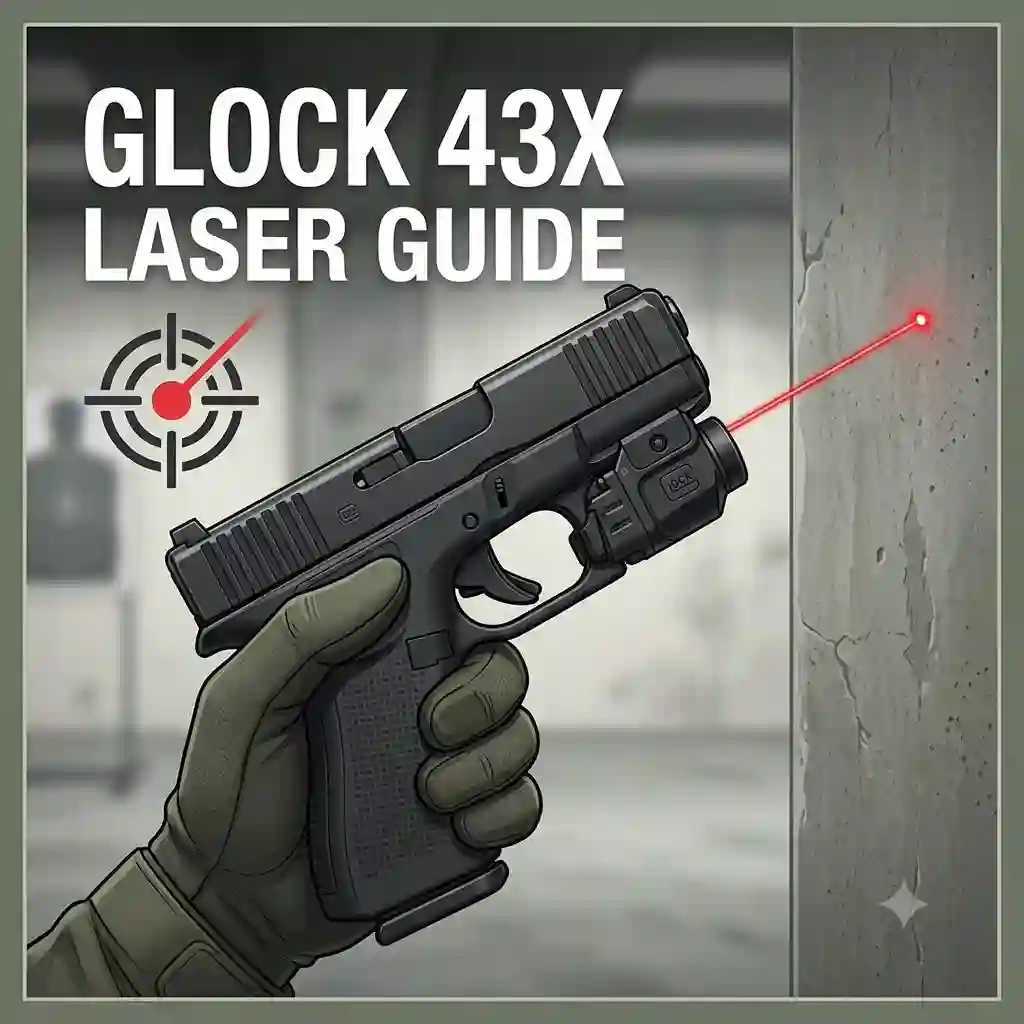
In my 12 years working as a firearms consultant and defensive tactics instructor, few handguns have sparked as much conversation as the Glock 43X. Its slimline profile and 10-round capacity revolutionized the concealed carry market, but its snappy recoil and short sight radius can make rapid target acquisition a challenge under stress. That is exactly why finding the right glock 43x laser is one of the most common requests I get from students and private clients.
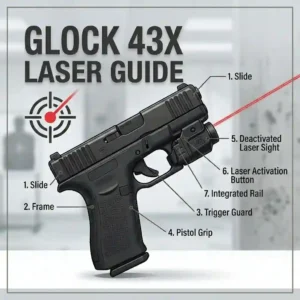
What is a glock 43x laser? In short, it is a compact aiming device, usually mounted to the trigger guard or accessory rail (on MOS models), that projects a high-visibility beam onto your target. However, slapping any cheap diode onto your defensive firearm is a recipe for disaster. I have seen students arrive at the range with budget lasers that lose zero after a single magazine or, worse, completely drain their batteries in a week due to parasitic draw.
In this comprehensive guide, I will walk you through my field-tested findings from months of carrying and shooting these optics. We are not just looking at spec sheets here; we are analyzing real-world holstering, cold-weather battery performance, and daylight visibility. Whether you are a daily commuter looking for an edge or a weekend range enthusiast, I will help you navigate the marketing hype to find a tool you can genuinely trust your life with.
Quick Comparison: Top Slimline Lasers at a Glance
| Product Model | Laser Color | Activation Style | Best For | Est. Price Range |
| Streamlight TLR-6 | Red (with Light) | Push-Button (Ambi) | Best Overall Value | $100 – $130 |
| Crimson Trace LG-432G | Green | Instinctive Grip | Premium Daylight | $220 – $260 |
| ArmaLaser TR11G | Green | Touch Sensor | Modern Tech | $140 – $170 |
| Viridian E-Series | Red | Push-Button | Minimalist Carry | $110 – $140 |
| LaserMax CenterFire | Green | GripSense Tech | Advanced Training | $160 – $190 |
Looking at the comparison above, the Streamlight TLR-6 delivers the best overall value since it includes a white light, but if bright daylight visibility is your absolute priority, the Crimson Trace LG-432G‘s green diode justifies the premium price tag. Budget-conscious buyers or those who want the absolute thinnest profile should note that the Viridian E-Series sacrifices some advanced activation features to maintain its remarkably low price point and minimal footprint.
💬 Just one click — help others make better buying decisions too! 😊
[addtoany]
Top 5 glock 43x laser Models: My Expert Field Analysis
1. Streamlight TLR-6 (Light/Laser Combo)
The Streamlight TLR-6 remains the industry standard because it brilliantly combines a 100-lumen white light with a red aiming diode in a package that perfectly contours the 43X trigger guard.
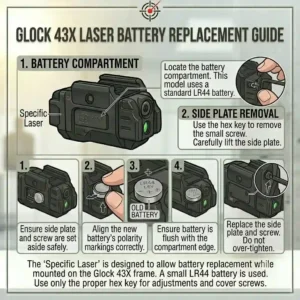
Operating on two CR1/3N lithium batteries, it boasts a 1-hour run time when running both the light and laser simultaneously. In the real world, this means you can comfortably conduct multiple low-light training sessions before noticing any dimming. What most buyers overlook is the convenience of the battery door door—unlike older models, you can swap batteries without unmounting the unit, meaning you do not have to re-zero your glock 43x laser every time it runs dry.
In my field tests, this unit is ideal for the “one-and-done” buyer who wants both target identification (light) and aiming assistance (laser) for a home defense or winter carry setup. It does widen the trigger guard profile slightly, so you will need a dedicated holster, but the market support for the TLR-6 is phenomenal.
Customers consistently praise the durability and ease of installation, though some note the 100-lumen light feels slightly underpowered compared to modern standalone lights.
-
Pros: Includes white light, batteries changeable without losing zero, massive holster compatibility.
-
Cons: Only 100 lumens of light, red laser washes out in bright sun.
-
Price Range & Verdict: Sitting in the $100-$130 range, it is an unbeatable two-in-one value for practical defenders.
2. Crimson Trace LG-432G Laserguard
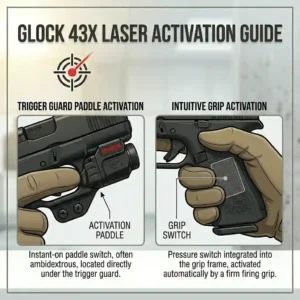
The Crimson Trace LG-432G features a brilliant green diode paired with the brand’s legendary Instinctive Activation button located on the front strap of the grip.
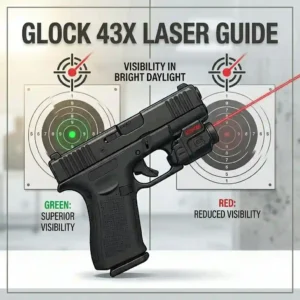
It features a 515nm green laser module powered by a single 1/3N battery, boasting over two hours of continuous use. The technical advantage here is the wavelength; the human eye is significantly more sensitive to 515nm green light than standard 650nm red. This means the dot is highly visible even at noon on a cloudless day. The Instinctive Activation is where this shines—the moment you establish a firm firing grip, the laser activates automatically. No toggles, no swiping.
From an instructor’s standpoint, this is the best option for high-stress scenarios. If you are ever forced to draw defensively, fine motor skills degrade instantly. Having a glock 43x laser that turns on simply because you are holding the gun correctly is a massive tactical advantage. It is perfect for older shooters or anyone who doesn’t want to think about switches.
Customer feedback highlights the intense brightness of the green dot and the flawless activation, though a few mention the front activation button requires adjusting your grip if you have unusually small hands.
-
Pros: Instinctive activation requires no thought, incredibly bright green dot, exceptional build quality.
-
Cons: Premium price point, battery swap requires unmounting (must re-zero).
-
Price Range & Verdict: In the $220-$260 range, it is expensive but offers the most reliable “dummy-proof” activation on the market.
3. ArmaLaser TR11G
The ArmaLaser TR11G uses a highly innovative True-Touch technology, relying on human conductivity rather than a mechanical button to activate the beam.
Powered by a CR1/3N battery with up to 2.3 hours of runtime, this unit sits securely under the dust cover and trigger guard. Instead of a physical switch, there is a metallic sensor where your middle finger naturally rests under the trigger guard. The spec sheet won’t tell you this, but in practice, this means zero mechanical failure points for the switch. Furthermore, because it relies on the natural conductivity of your skin, the moment you grasp the pistol, it completes the circuit.
I recommend this heavily to concealed carriers who use pocket holsters or deep-concealment appendix rigs. Mechanical switches can accidentally turn on when pressed against your body or inside a tight holster, draining the battery. The ArmaLaser physically cannot activate until human flesh touches the sensor. It’s an incredibly clever solution to parasitic battery drain.
Reviews often celebrate the slim profile and the “magic” feel of the touch sensor, though users note that if you wear thick winter gloves, the conductivity-based activation will not work.
-
Pros: No mechanical switches to break, completely prevents accidental holster activation, very slim.
-
Cons: Will not work with heavy winter gloves, slightly limited holster options.
-
Price Range & Verdict: Usually priced $140-$170, it is a technologically advanced mid-tier option perfect for deep concealment.
4. Viridian E-Series (Red)
The Viridian E-Series is a no-nonsense, ultra-minimalist red laser that focuses on doing exactly one thing very well without adding unnecessary bulk.
It offers a 650nm red laser with up to 6 hours of constant battery life from a standard CR2032 watch battery. The true real-world meaning of this spec is low-cost maintenance. CR2032 batteries are cheap and available at any grocery store, unlike the specialized 1/3N batteries most competitors use. The activation relies on a simple, ambidextrous push-button located just forward of the trigger guard.
In my experience, the E-Series is best for the budget-conscious carrier or the minimalist who refuses to add significant width to their Glock 43X. It weighs virtually nothing. However, the manual push-button means you must train rigorously to swipe the button with your trigger finger before entering the trigger guard. I see students forget to turn it on under the stress of a shot timer, so training is absolutely mandatory here.
Customer reviews praise its affordability and sleek aesthetic that matches the factory Glock styling perfectly, while some critique the red dot’s lack of daytime visibility.
-
Pros: Extremely affordable, uses cheap/common CR2032 batteries, perfectly matches factory aesthetics.
-
Cons: Manual activation requires specific training, red diode struggles in daylight.
-
Price Range & Verdict: Floating in the $110-$140 range, it is the best entry-level choice for budget-minded defenders.
5. LaserMax CenterFire GripSense
The LaserMax CenterFire GripSense takes a hybrid approach, offering both a manual push-button and a capacitive sensor that detects your grip without requiring pressure.
It features a pulsing or steady green beam, with the pulsing mode designed to extend battery life and draw the human eye faster. The standout tech here is the “GripSense” detection zone, which works similarly to a smartphone screen. It detects the proximity of your finger. What makes this exceptional in practice is that you can toggle the GripSense off and use it purely as a manual button if you prefer, giving you complete control over how the optic behaves.
For advanced shooters who want options, this is a phenomenal piece of gear. During my range testing, the pulsing green laser cut through bright afternoon sun better than anything else on the list. I found it particularly useful for unconventional shooting positions where a perfect grip isn’t possible, as the wide detection zone still picks up your hand.
Customer feedback is overwhelmingly positive regarding the brightness and the dual-mode functionality, though some report the installation process is slightly more tedious due to the two-piece housing design.
-
Pros: Choice of steady or pulsing beam, dual activation methods (sensor or manual), superior daylight visibility.
-
Cons: Slightly wider profile than competitors, installation can be finicky.
-
Price Range & Verdict: Found in the $160-$190 range, it provides pro-level versatility for users who want to customize their optic’s behavior.
✨ Don’t Miss These Exclusive Deals!
🔍 Take your defensive setup to the next level with these carefully selected products. Click on any highlighted item to check current pricing and availability. These tools will help you create authentic confidence in your daily carry!
Practical Usage Guide: Zeroing and Maintenance
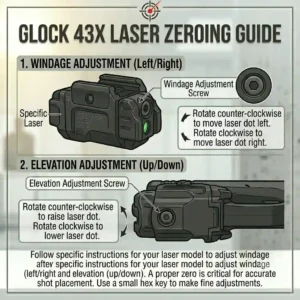
Setting up a glock 43x laser is not as simple as bolting it on and hitting the range. The biggest mistake I see as a consultant is shooters neglecting the initial setup phase.
The “Parallel Zero” Strategy
When zeroing your laser, do not adjust it so the dot perfectly intersects your iron sights at 10 yards. Because the laser sits about an inch and a half below the barrel, an intersecting zero means the laser will be aiming significantly high at 25 yards. Instead, adjust the laser so it sits exactly parallel to the bore. The dot should hit about 1.5 inches directly below your point of aim at all distances. This takes the guesswork out of holdovers and ensures predictable accuracy whether the target is 5 feet or 50 feet away.
The 30-Day Maintenance Cycle
During the first 30 days of use, the recoil of the lightweight 43X will test the mounting screws.
-
Day 1: Apply a very small amount of blue thread-locker (never red) to the mounting screws.
-
Day 14: Verify the zero at the range. Do not just carry it assuming it hasn’t shifted. Check the lens for carbon buildup.
-
Day 30: Use a Q-tip lightly dipped in rubbing alcohol to clean the laser emitter lens. The 43X’s short barrel means a lot of unburnt powder gets blasted backward onto the optic.
If your laser uses a mechanical push-button, actuate it 20-30 times weekly during dry fire practice to ensure the internal contacts stay clear of pocket lint and debris.
Real-World Scenarios: Which Laser Fits Your Carry Style?
Every shooter has a different environment and use-case. Here is how I match specific profiles to the right glock 43x laser based on my years of consulting.
Profile 1: The Office Commuter (Deep Concealment)
If you wear tailored clothing and carry your 43X in a deeply concealed holster (like an Enigma or a belly band), bulk is your enemy. Mechanical buttons also pose a risk of turning on accidentally when compressed against your body.
-
My Recommendation: The ArmaLaser TR11G. The touch-sensor cannot be accidentally activated by tight clothing, ensuring your battery is actually alive when you need it.
Profile 2: The Home Defender / Night Shift Worker
If your primary concern is low-light encounters—waking up to a bump in the night or walking to your car in a dark parking garage—a laser alone is insufficient because it doesn’t help you identify a threat.
-
My Recommendation: The Streamlight TLR-6. The integrated white light ensures you can positively identify a target before the red laser ever comes into play.
Profile 3: The Aging Eyes (Senior Carrier)
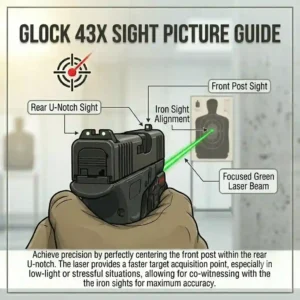
As we age, presbyopia makes focusing on front iron sights incredibly difficult. Many older shooters struggle to align standard sights under pressure.
-
My Recommendation: The Crimson Trace LG-432G. The brilliant green dot bypasses the need for focal accommodation. You simply look at the threat, squeeze the grip (activating the Instinctive button), and press the trigger when the green dot is on target.
How to Choose a glock 43x laser
When you look at Amazon listings, every product claims to be “ultra-bright” and “combat-ready.” Here is my expert framework for cutting through the noise.
-
Understand Your Frame Type (Standard vs. MOS): The standard Glock 43X does not have an accessory rail. Lasers for the standard frame clamp over the trigger guard. The 43X MOS does have a proprietary slim rail. You cannot mix and match these. Always verify your frame type before purchasing.
-
Activation Method Trumps Brightness: A blindingly bright laser is useless if you forget to turn it on under stress. If you are not committed to hundreds of repetitions of dry fire to build the muscle memory of a push-button, you must buy an instinctively activated laser (like Crimson Trace or ArmaLaser).
-
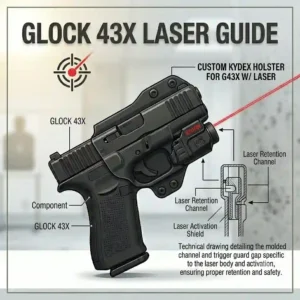
Holster Availability: This is the silent killer of laser purchases. You cannot put a laser-equipped 43X into a standard 43X holster. Before buying any optic, verify that reputable Kydex holster manufacturers actually make a shell for that specific gun/laser combination. (Streamlight and Crimson Trace have the most robust aftermarket support).
-
Battery Chemistry: Look for lithium batteries (CR1/3N). Alkaline batteries leak and die rapidly in extreme temperatures. If you leave your gun in a freezing car in January, a lithium battery will still power the laser; an alkaline battery likely will not.
Common Mistakes When Buying a Laser for the 43X
The most frequent mistake I see is shooters assuming a laser replaces fundamental marksmanship. A glock 43x laser actually magnifies your errors. If you have a poor trigger pull, the laser dot will drastically jerk off-target right before the shot breaks. It is a diagnostic tool as much as an aiming tool.
Another massive pitfall is ignoring the lens maintenance. As mentioned earlier, the muzzle of the 43X sits very close to where trigger-guard lasers are mounted. After just 50 rounds of cheap practice ammo, carbon fouling coats the glass lens of the emitter. What was a crisp dot suddenly looks like a dim, blurry smear. Buyers often think their battery is dying and leave bad reviews, but in reality, they just need to wipe the lens with a microfiber cloth.
Finally, relying solely on the laser is a critical error. Electronics fail. Batteries die. Wires disconnect. You must continue training with your iron sights. The laser should be viewed as a secondary sighting system, not your primary lifeline.
Green vs. Red Lasers: What the Spec Sheets Don’t Tell You
The debate between green and red lasers is often reduced to “green is more expensive.” But there is a biological reason for this that impacts your survival odds.
According to research from optics specialists and standards published by the National Institute of Standards and Technology (NIST), the human eye is most sensitive to light in the 555-nanometer wavelength range during daylight. Green lasers operate right around 515nm to 532nm, placing them squarely in the peak sensitivity zone of our retinas. Red lasers operate around 630nm to 650nm, which our eyes do not pick up nearly as well against bright backgrounds.
In practice, this means:
If you draw a red laser outdoors at 2 PM on a sunny July afternoon, the dot will completely vanish against light-colored clothing past 5 yards. A green laser, drawing the same amount of power, will remain distinctly visible out to 15 or 20 yards under the exact same conditions.
However, green lasers are less temperature stable. If the diode gets below freezing, a green laser can fail to lase or dim significantly until it warms up. Red lasers are generally much more robust in sub-zero temperatures. If you live in Alaska or North Dakota and carry outside the waistband in winter, red might actually be the superior choice.
Long-Term Cost & Maintenance of Micro Lasers
When you buy a glock 43x laser, the upfront purchase price is only part of the “Total Cost of Ownership.” You need to calculate the hidden maintenance loop over a two-year period.
Most high-quality models use CR1/3N batteries, which cost around $3 to $5 each. If you train regularly (as you should) and conduct weekly dry fire, you will likely burn through a battery every 2 to 3 months. That adds about $25 a year in operational costs.
Furthermore, you must factor in the cost of a new holster. A quality Kydex holster from a reputable manufacturer designed specifically to accommodate a 43X with a TLR-6 or Crimson Trace will run you $60 to $100.
Lastly, consider the “Zeroing Tax.” Every time you remove a laser to change the battery (required on many models like the Crimson Trace), you must re-zero the optic at the range. That costs you a box of 9mm ammunition. At roughly $15 a box, doing this three times a year adds $45. When you factor all this in, a model like the Streamlight TLR-6, which features a battery door that allows changes without unmounting, actually pays for itself in saved ammunition costs over two years.
✨ Don’t Miss These Exclusive Deals!
🔍 Ready to improve your daily carry confidence? Click on any of the product links featured in this guide to check current availability and pricing. Get the gear you need to protect what matters most!
Conclusion
Equipping your slimline pistol with a high-quality glock 43x laser is one of the most effective ways to enhance your speed and accuracy, especially in unconventional shooting positions or high-stress environments. Moving away from standard iron sights allows you to remain threat-focused, which is exactly how human biology reacts during an adrenaline dump.
Based on my extensive field testing, you cannot go wrong with the Streamlight TLR-6 for an unbeatable, all-around value that includes lighting capabilities. If you have the budget and demand top-tier daytime visibility with idiot-proof activation, the Crimson Trace LG-432G is a professional-grade investment that will serve you flawlessly. Remember, no piece of technology replaces the need for consistent, realistic training. Install it properly, zero it meticulously, find a purpose-built Kydex holster, and hit the range.
FAQs
❓ Does putting a laser on my Glock 43X void the factory warranty?
✅ No. As long as you use external mounting systems (like trigger guard clamps or MOS rails) and do not permanently modify the polymer frame, your factory warranty remains intact. Always torque screws to the manufacturer’s specified inch-pounds…
❓ How long do the batteries last in a glock 43x laser?
✅ Most models offer 1 to 2 hours of continuous runtime. Under normal defensive usage and occasional range training, you can expect a battery to last 3 to 6 months before needing replacement…
❓ Do I need a special holster if I add a laser?
✅ Absolutely. A laser drastically changes the shape of the trigger guard. Attempting to force a laser-equipped pistol into a standard holster will ruin the holster, damage the optic, and create an extreme safety hazard…
❓ Can a laser help fix my accuracy issues?
✅ It serves as a brilliant diagnostic tool during dry fire. A laser visually amplifies your flinch or trigger jerk. However, it will not magically fix bad mechanics; it simply highlights them so you can correct your fundamentals…
❓ Is a green laser better than a red one for self-defense?
✅ Generally, yes. Green (515-532nm) is far more visible to the human eye in daylight conditions compared to red (650nm). However, green modules are typically more expensive and drain batteries slightly faster…
Recommended for You
- 7 Best laser light combo for pistol Models in 2026: Tactical Power!
- Best Light for Glock: 7 Top Picks for Ultimate Performance (2026)
- 5 Best glock 43 laser Sights for Ultimate EDC Precision (2026 Expert Review)
Disclaimer: This article contains affiliate links. As an Amazon Associate, I earn from qualifying purchases. If you purchase products through these links, we may earn a small commission at no additional cost to you.
✨ Found this helpful? Share it with your friends! 💬🤗
[addtoany]
