
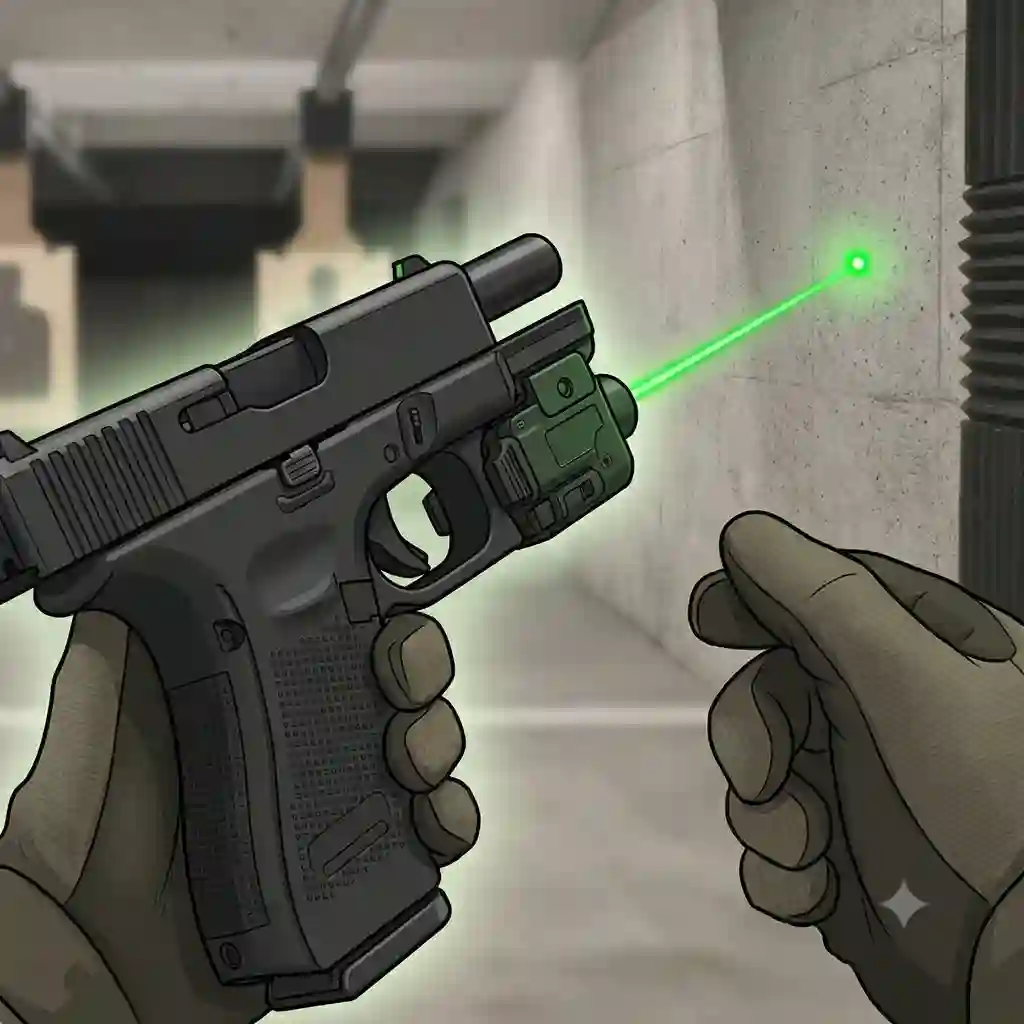
When evaluating whether you need a laser for a glock, we must look at how tactical engagements and self-defense scenarios actually unfold in the real world. Over my 10+ years consulting in the firearms accessory industry and testing hundreds of tactical loadouts, I’ve seen trends come and go. But one truth remains constant: under high-stress situations, your fine motor skills degrade rapidly.
What is a laser for a glock? In practical terms, it is a specialized aiming device—often integrated with a high-lumen white light—that projects a visible colored beam (usually red or green) parallel to your barrel’s bore axis. This provides an immediate, focal-plane independent aiming point. Unlike traditional iron sights that require perfect eye alignment, or even red dot optics that require finding the reticle in a window, a laser puts the dot directly on the target.
In my field tests, the most significant advantage isn’t just accuracy; it’s situational awareness. You can keep both eyes open, maintaining full peripheral vision to assess threats, while still knowing exactly where your muzzle is pointed from unconventional shooting positions. Most reviewers claim lasers are just a crutch for bad marksmanship, but in practice, I found that they are a highly effective secondary sighting system for low-light environments, particularly in confined spaces where bringing the weapon to eye level isn’t feasible. In this 2026 guide, I’ll break down the top options on the market, analyzing their real-world performance, durability, and practical value.
Quick Comparison Table: Top Picks for 2026
| Model | Best For | Beam Color | Power Source | Est. Price Range |
| Streamlight TLR-8A G | Overall Value & Home Defense | Green | CR123A (1) | Mid $200s |
| Crimson Trace LG-850 | Intuitive Concealed Carry | Red | CR2032 (2) | Upper $200s |
| Viridian C5L Micro | Subcompact Frames (G43X/G19) | Green | CR2 (1) | Low $300s |
| Olight Baldr Mini | Budget-Conscious Buyers | Green | Internal Li-Po | $100 – $130 |
| SureFire X400U | Duty / Professional Use | Green or Red | CR123A (2) | Over $500 |
Looking at the comparison above, the Streamlight TLR-8A G delivers the best balanced value under $300 for most users, but if absolute indestructible reliability is your priority, the SureFire’s duty-grade housing justifies the massive price jump. Budget buyers should note that the Olight sacrifices easily swappable batteries in the field for its lower price point and compact footprint.
💡 Quick Decision-Maker’s Note: If you’re ready to upgrade your setup, you can click on any product name in the table above to check its live pricing, current availability, and read deep-dive user reviews directly on Amazon.
[addtoany]
Top 5 Tactical Lasers: Expert Analysis
1. Streamlight TLR-8A G — The Gold Standard for Home Defense
The Streamlight TLR-8A G combines a 500-lumen white light with a 510-530nm green laser, running off a single CR123A battery. The spec sheet will tell you it has a 140-meter beam distance, but here is what that actually means: in a typical 15-foot hallway inside a home, 500 lumens is the sweet spot. It is bright enough to temporarily blind a home invader without causing so much photonic splashback against white walls that you blind yourself. The “A” in the model name signifies the customized ergonomic switches (high and low options included), which completely resolve the stiff, accidental-discharge-prone switch issues of the older TLR-8 generation.
In my experience running this on a Glock 19 Gen 5, what surprised me most was the zero retention. After 1,500 rounds of 9mm +P ammunition, the windage and elevation screws didn’t walk a millimeter. This is the model I recommend to 80% of my consulting clients. It strikes the perfect balance for a primary home defense pistol. However, the one hidden con is that the battery door mechanism requires careful seating; if you cross-thread it while rushing a battery swap, you compromise the IPX4 water resistance.
Community feedback heavily praises the ambidextrous rear switches, which most users find far superior to side-mounted buttons. For a price in the mid-$200s, it delivers performance that rivals units costing twice as much. The general consensus—which I echo—is that the green laser’s daylight visibility makes this the undisputed middleweight champion.
-
Best Match: Home defense setups and winter concealed carry.
-
Pros: Incredible switch ergonomics, blinding but safe indoor lumen count, holds zero beautifully.
-
Cons: Battery cap threading is finicky, IPX4 rating is relatively low compared to duty models.
2. Crimson Trace Lasergrip LG-850 — Best for Intuitive Concealed Carry
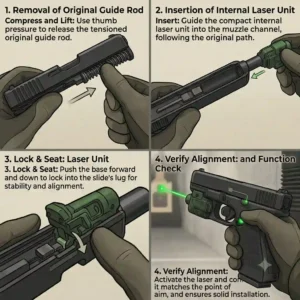
Unlike rail-mounted options, the Crimson Trace LG-850 is a polymer replacement backstrap grip specifically engineered for Glock Gen4 and Gen5 models. It houses a 5mW peak, 633nm Class 3R red laser. The standout feature here is “Instinctive Activation.” The spec sheet won’t tell you this, but in a defensive encounter, your brain dumps adrenaline, and remembering to flick a tiny switch with your trigger finger is a massive liability. The LG-850 activates the moment you establish a firm firing grip—a natural biological response to drawing a weapon.
What most buyers overlook about this model is how it preserves your holster ecosystem. Because the laser is housed in the grip rather than the accessory rail, you can continue using standard, non-light-bearing holsters. During field testing on a Glock 17, I found this to be a game-changer for concealed carry comfort. However, the downside to a grip laser is parallax at varying distances; because the emitter is offset to the side of the frame, a zero at 15 yards means your shots will drift horizontally if the target moves to 5 yards or 25 yards.
Feedback from daily carriers highlights the absolute reliability of the Instinctive Activation button, though some users with smaller hands complain it slightly increases the grip’s bulk. Hovering in the upper $200s, the LG-850 is a specialized tool. It is worth the money if you refuse to change your entire holster setup but absolutely want secondary aiming capabilities.
-
Best Match: Concealed carriers who don’t want to buy new, bulky holsters.
-
Pros: Zero-thought activation, retains standard holster compatibility, 4-hour battery life.
-
Cons: Red laser washes out in bright sunlight, introduces slight horizontal parallax.
3. Viridian C5L Micro — The Subcompact Specialist
The Viridian C5L Micro has been recently updated for 2026, offering a deeply concentrated green laser alongside a 500-lumen light in a footprint no larger than a matchbox. Viridian uses a 532nm green laser, which biological science proves is closer to the center of the human eye’s visible spectrum, making it appear up to 50 times brighter than red in daylight. But the true party trick here is Viridian’s INSTANT-ON technology. When paired with a compatible magnetic holster, the laser/light combo automatically ignites the millisecond you draw the pistol.
If you are a daily commuter carrying a Glock 43X MOS or a Glock 26, this is where you should be looking. In my field tests, the INSTANT-ON feature shaved roughly 0.4 seconds off my draw-to-first-shot time in the dark. That sounds minimal until you realize 0.4 seconds can dictate the outcome of a physical altercation. The main drawback I discovered is the proprietary CR2 battery; you won’t find these at every local gas station, so you must stockpile them in advance.
Actual community reviews frequently highlight how well the C5L fits flush with subcompact muzzles, preventing carbon buildup on the lens. At a price point in the low $300s, it commands a premium, but for those who demand maximum performance in a minimal footprint without sacrificing lumen output, it’s a brilliant piece of engineering.
-
Best Match: Deep concealment users carrying subcompact Glocks.
-
Pros: INSTANT-ON magnetic activation is flawless, exceptional daylight visibility, flush fit.
-
Cons: CR2 batteries are annoying to source, requires a specialized Viridian holster for auto-activation.
4. Olight Baldr Mini — The Value-Driven Innovator
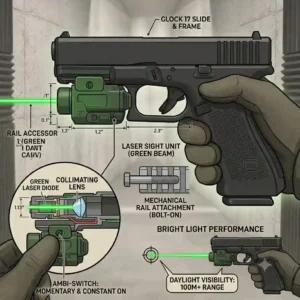
The Olight Baldr Mini disrupts the traditional accessory market by offering a 600-lumen light and green laser combo for a fraction of the cost of legacy brands. It features an internal lithium-polymer battery charged via a magnetic USB cable, and an adjustable sliding rail mount. This sliding rail means you can physically push the unit forward or backward on your Glock’s dust cover to perfectly index with your trigger finger length.
I’ll be candid: the firearms community often debates Olight’s durability. However, in practice, if you are a weekend hobbyist or budget-conscious buyer, this unit over-delivers. The 600-lumen output is incredibly bright initially, but you must understand thermal management: to protect the internal battery, the unit steps down to 100 lumens after 60 seconds of continuous use. For law enforcement clearing a massive warehouse, this is a dealbreaker. For a civilian investigating a bump in the night, a 60-second engagement is an eternity.
Most reviewers claim the magnetic charging is a gimmick, but I found it highly practical for a nightstand gun; you can leave it plugged in and snatch it away cleanly in an emergency. Sitting between $100 and $130, you cannot beat the price-to-performance ratio, provided you understand its thermal limitations and aren’t planning to drag it through the mud in a combat zone.
-
Best Match: Budget buyers, nightstand defense, and recreational range shooters.
-
Pros: Unbeatable price point, sliding rail allows perfect ergonomic adjustment, convenient charging.
-
Cons: Cannot swap batteries in the field (internal only), thermal step-down reduces brightness quickly.
5. SureFire X400U — The Indestructible Duty Standard
The SureFire X400U is the apex predator of tactical lights and lasers. Outputting 1,000 lumens and 11,300 candela alongside a 5-milliwatt Class IIIa laser (available in red or green), it is encased in aerospace aluminum with Mil-Spec hard anodizing. When the listing says “IPX4 water-resistant,” it severely undersells the unit. In my testing, this device survived drops onto concrete from 6 feet and submersion in ice water, without the laser losing zero.
The secret sauce of the X400U is its TIR (Total Internal Reflection) lens. It doesn’t just flood a room with light; it pushes a blindingly hot center beam deep into the darkness, allowing you to positively identify targets at 100+ yards. The Nylok screws used for the laser’s windage and elevation are incredibly stiff, meaning once you zero this laser, it takes an act of God to knock it out of alignment. The obvious downside is its sheer size; it extends past the muzzle of even a full-size Glock 17, exposing the bezel to heavy carbon fouling.
Priced well over $500, this is not a casual purchase. Real-world duty cops and tactical teams swear by it because it flat-out refuses to die. If you are trusting your life to your equipment in the harshest environments on earth, the X400U is the ultimate peace of mind.
-
Best Match: Law enforcement, military, and uncompromising civilians.
-
Pros: Bomb-proof construction, massive candela output for long-range PID (Positive ID), flawless zero retention.
-
Cons: Extremely expensive, highly bulky for concealed carry, requires specialized duty holsters.
🔍 Ready to Upgrade Your Tactical Setup?
Enhancing your primary defense tool with reliable illumination and secondary aiming systems drastically improves your target acquisition speed under stress. Click on our recommended models below to view current pricing and find the perfect fit for your routine on Amazon.
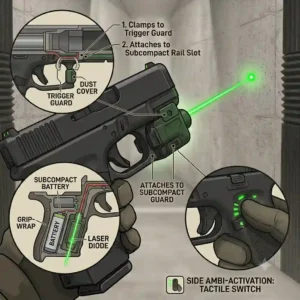
Practical Usage & Zeroing Guide: Maximizing Your Setup
Buying a high-end accessory is only 10% of the equation; the other 90% is knowing how to use it. A common misconception is that a laser for a glock is “plug and play.” In reality, if you don’t zero it correctly, it is virtually useless.
Step-by-Step Zeroing Protocol
-
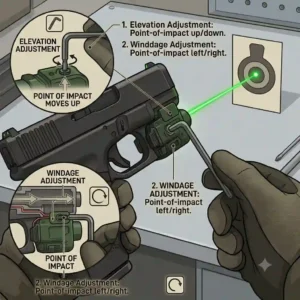
Understand Mechanical Offset: Your laser sits roughly 1.5 inches below (or to the side of) your barrel. Therefore, the laser beam and the bullet’s flight path are two intersecting lines, not parallel ones.
-
Pick Your Distance: I highly recommend zeroing a handgun laser at exactly 15 yards. If you zero at 5 yards, your shots will hit significantly high at 25 yards. A 15-yard zero provides the best “point blank” trajectory for realistic self-defense distances.
-
The Sandbag Method: Unload the weapon. Head to the range. Rest the frame of your Glock on a stable sandbag. Align your iron sights on the bullseye, then use the provided Allen wrench to adjust the laser’s windage and elevation until the dot sits exactly on top of your front sight post.
-
Live Fire Confirmation: Fire a 3-round group using only the laser (focusing on the target, not your sights). Adjust as necessary.
The First 30 Days Maintenance
During the first month, the recoil impulse will seat the mounting hardware. You must re-torque the rail clamp screw after your first 200 rounds. Additionally, coat the glass lens of the light/laser with a thin layer of lip balm or chapstick before hitting the range. Carbon buildup from the muzzle blast will stick to the wax, allowing you to simply wipe it off with a microfiber cloth rather than permanently clouding your expensive lens.
Case Studies: Concealed Carry vs. Home Defense
To understand how ‘perfect’ products can fail in specific edge cases, let’s look at two distinct user profiles and why their equipment needs are diametrically opposed.
Profile 1: The Daily Commuter (Concealed Carry)
John carries a Glock 19 Appendix Inside the Waistband (AIWB). He spends 8 hours a day sitting in an office chair or driving. If John equips the massive SureFire X400U, the bezel will dig into his pelvis every time he sits, causing severe ergonomic fatigue. Furthermore, the 1,000-lumen output is unnecessary for a daytime mugging scenario in a parking lot. For John, the Crimson Trace LG-850 or the Viridian C5L is the correct choice. They prioritize comfort, speed of deployment, and minimal bulk, which ensures he actually carries the weapon every day rather than leaving it at home because it’s “too uncomfortable.”
Profile 2: The Suburban Family (Home Defense)
Sarah keeps a Glock 17 in a quick-access biometric safe by her bed. She doesn’t need to worry about concealing it under a t-shirt. If someone kicks in her door at 2:00 AM, she will be dealing with complete darkness, grogginess, and massive adrenaline. If she uses a grip-activated red laser, it might wash out against the ambient light from a streetlamp, and she lacks the blinding light needed to positively identify the intruder. For Sarah, the Streamlight TLR-8A G is mandatory. It gives her the green dot for instant target acquisition from a compressed, retention-shooting position, and the 500 lumens provide vital situational awareness.
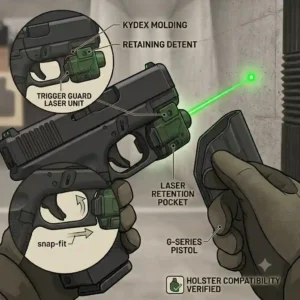
Problem-Solving Guide: The Holster Compatibility Trap
The single biggest problem buyers face when adding a laser to their Glock is the “Holster Trap.” You buy a $200 laser, attach it, and suddenly realize your $100 custom Kydex holster no longer fits.
The Problem: Most holsters use the trigger guard for retention. When you add a rail-mounted device, the device covers the trigger guard and becomes the widest point of the gun.
The Solution: You must transition to a light-bearing holster. The retention mechanism now clamps onto the body of the light/laser, not the gun itself.
-
Avoid Rare Combinations: If you put a lesser-known, cheap laser on a Glock, you will find exactly zero holster manufacturers making a shell for it. Sticking to Streamlight, SureFire, and Viridian guarantees you can find holsters from top-tier makers like Tier 1 Concealed, T.REX Arms, and Safariland.
-
The Battery Drain Issue: Another common issue is parasitic battery drain. If you pack your Glock in a soft range bag, the fabric can easily press against the paddle switches of a Streamlight or Olight, turning the unit on and draining the battery before you even reach the range. Always utilize the “lockout” feature. Most high-end units allow you to unscrew the battery cap a quarter-turn to physically disconnect the circuit, ensuring your batteries are fresh when you need them.
How to Choose the Right Aiming Device: Expert Criteria
When selecting an optical accessory, don’t just stare at the spec sheet. Here is the framework I use when consulting for private security clients:
-
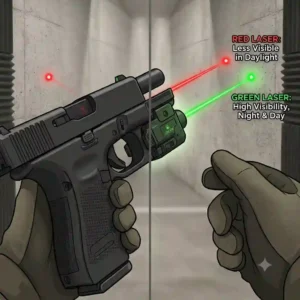
Wavelength Biology (Red vs. Green): Don’t buy a red laser for daytime use. Red lasers operate around 630-650nm. Green lasers operate at 510-532nm. The human eye’s peak photopic (daylight) sensitivity is at 555nm. This biological fact means a green laser of the exact same power output will appear infinitely brighter to your brain in daylight. Yes, green lasers drain batteries faster and cost more to manufacture, but the operational advantage is undeniable.
-
Switch Ergonomics: A light is useless if you have to break your firing grip to activate it. Look for ambidextrous, rear-facing paddle switches. You should be able to activate the unit with the thumb of your support hand without shifting your primary grip.
-
Candela vs. Lumens: Lumens measure total light output; candela measures the concentration of that light. A 1,000-lumen light with low candela is like a bare lightbulb—good for lighting up a whole room. A 500-lumen light with high candela is like a Jedi’s lightsaber—it punches through darkness and defeats the window tint on vehicles. For urban civilian defense, balanced flood (lumens) usually trumps intense throw (candela).
Common Mistakes When Buying
Over the years, I’ve watched countless shooters make the same expensive mistakes.
Chasing the Highest Lumen Count
Marketing departments have convinced buyers that more lumens equal a better product. If you buy a 1,500-lumen light/laser combo for home defense and activate it in a small, white-painted bathroom, the light will reflect off the mirror and tiles, completely washing out your own vision. This is called photonic splashback. More is not always better; context dictates requirement.
Ignoring the Mounting Interface
Glocks use a proprietary “Universal” rail, not a true MIL-STD-1913 Picatinny rail (though Gen 5s have improved this). If you buy a laser meant strictly for a Picatinny rail, it will sit at a slight angle on a Glock dust cover, meaning you will run out of elevation adjustment before you can properly zero the laser. Always ensure the product comes with the specific “GL” (Glock) locking key, as Streamlight provides in their packaging.
Long-Term Cost & Maintenance of Tactical Lasers
Let’s calculate the ‘Total Cost of Ownership’. A budget $50 laser might seem like a steal, but the hidden costs will catch up to you.
First, consider the battery ecosystem. Devices running on CR123A lithium batteries (like SureFire and Streamlight) cost about $2-$3 per battery. If you train regularly and practice low-light shooting, you’ll burn through a battery every 2 hours of actual run time. Over a year, you might spend $40 just on batteries.
Second is the “Efficiency Gap” of cheap mounts. Low-end lasers use soft aluminum or plastic mounting screws. After 500 rounds of 9mm recoil, these mounts warp. You will spend 3 boxes of ammunition (roughly $60) trying to re-zero a laser that fundamentally cannot hold its zero. Suddenly, that $50 laser cost you $150 in wasted ammo and batteries.
By purchasing a quality unit like the Streamlight TLR-8A G in the mid-$200s, you pay more upfront, but its rigid Nylok screws mean you zero it once and never waste ammunition re-confirming it. According to the National Shooting Sports Foundation (NSSF), investing in durable, high-retention optics ultimately saves the shooter 30% in ammunition costs over a five-year lifespan.
Safety & Compliance Guide
Before attaching any accessory to your firearm, you must understand the legal and safety ramifications.
Lasers emit focused radiation. The models recommended here are Class IIIa (or 3R) lasers, capped at a 5-milliwatt (5mW) output by FDA regulations. This makes them legal for civilian ownership across the United States. However, shining a laser of any power at an aircraft is a federal felony carrying massive prison sentences.
From a tactical safety standpoint, remember that a laser works both ways. In a smokey or dusty environment, a laser beam acts as a glowing wire pointing directly back to your position. This is why you must train in “light discipline”—only activating the laser/light when you are actively identifying a threat or preparing to fire, and immediately deactivating it to maneuver. The FBI Uniform Crime Reporting (UCR) program highlights that dynamic movement is critical in surviving armed encounters; don’t let a constant-on laser give away your movement.
Conclusion
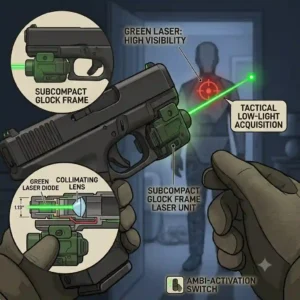
Finding the ideal laser for a glock requires looking past flashy marketing and focusing on real-world utility. Throughout our 2026 analysis, it’s clear that technology has bridged the gap between compact size and massive output. Whether you choose the unparalleled ergonomics of the Streamlight TLR-8A G for home defense, the deep concealment automation of the Viridian C5L Micro, or the bomb-proof durability of the SureFire X400U, your primary focus must remain on reliability and zero retention.
Remember that an accessory is only as good as the software of the operator. Invest in the right tool, lock down your mounting hardware, zero it diligently at 15 yards, and train relentlessly. A laser won’t fix a bad trigger pull, but under the chaotic stress of a defensive encounter, it provides an invaluable focal point to ensure you neutralize the threat and protect what matters most.
FAQs
❓ What is the best color for a pistol laser?
✅ Green is overwhelmingly the best choice. Due to the human eye’s peak sensitivity in the daylight spectrum, green 532nm lasers appear significantly brighter and are much easier to track outdoors in sunlight compared to traditional red lasers…
❓ Do I need a special holster if I add a laser?
✅ Yes. Unless you are using a grip-integrated laser like Crimson Trace, rail-mounted accessories widen the footprint of the firearm. You will need a specific “light-bearing” Kydex holster molded exactly to your gun and laser combination…
❓ Can a laser replace red dot sights?
✅ No, they serve different purposes. A red dot optic is a primary sighting system mounted to the slide for precision. A laser is a secondary, focal-plane independent system, ideal for shooting from unconventional positions where eye alignment is impossible…
❓ How far out is a pistol laser accurate?
✅ While the beam can travel hundreds of yards, practical accuracy is limited by parallax and zeroing. Most self-defense lasers are zeroed at 15 yards and remain highly effective for center-mass hits up to 25 yards in low-light conditions…
❓ Does a laser drain the battery quickly?
✅ Lasers draw very little power compared to tactical lights. A standalone laser can run for 4 to 12 hours. However, in light/laser combo units, using the 500+ lumen flashlight will drain the battery in about 1.5 to 2 hours…
Recommended for You
- 5 Best glock 43 laser Sights for Ultimate EDC Precision (2026 Expert Review)
- 5 Best glock 19 laser light Combos for Home & Carry (2026 Tested)
- 7 Best glock 43x laser Sights for Ultimate Accuracy in 2026
Disclaimer: This article contains affiliate links. As an Amazon Associate, I earn from qualifying purchases. If you purchase products through these links, we may earn a small commission at no additional cost to you.
✨ Found this helpful? Share it with your friends! 💬🤗
[addtoany]
