
If there is one piece of equipment that separates a stressed captain from a confident one during a night run, it is a high-quality boat spotlight. In my 10+ years as a marine outfitter and night-navigation consultant, I have seen hundreds of vessel owners make the exact same mistake: they buy a generic, high-lumen hardware store flashlight and assume it will cut through marine fog or spot a crab pot at 30 knots. It won’t.
What is a boat spotlight, exactly? It is a specialized piece of marine equipment engineered to project a tight, focused beam over long distances over water, while withstanding corrosive salt, constant vibration, and relentless UV exposure. A proper unit cuts through the ambient moisture in the air rather than reflecting light back into your eyes—a phenomenon known as “backscatter.”
In my field tests, what surprised me most during practical use wasn’t the peak brightness of these lights, but their thermal management. Most reviewers claim raw lumen output is the ultimate metric, but in practice, I found that sustained beam distance (measured in candela) and battery voltage regulation under load are the real issues. If a light throttles down 50% after five minutes to prevent overheating, those advertised lumens are completely useless when you are desperately scanning for a channel marker.
In this comprehensive 2026 guide, I am going to break down the exact models that survive the harsh marine environment. We are skipping the marketing hype and diving into the real-world performance, maintenance cycles, and total cost of ownership of the industry’s top contenders.
Quick Comparison Table: Top Marine Spotlights of 2026
| Model | Mount Type | Max Output | IP Rating | Best For | Price Range |
| Golight Stryker ST | Permanent/Remote | 500,000 Candela | IP56 | Offshore / Cruisers | Premium (Over $300) |
| GOODSMANN Marine | Handheld | 3,000 Lumens | IP67 | Budget / Small Skiffs | Budget (Under $60) |
| Streamlight Waypoint | Handheld | 1,000 Lumens | IPX8 | Commercial / Tenders | Mid-Range ($100-$150) |
| YIERBLUE Rechargeable | Handheld | 10,000 Battery | IPX4 | Kayaks / Inshore | Budget (Under $50) |
| ACR RCL-95 LED | Permanent/Joystick | 460,000 Candela | IP56 | Yachts / Sportfishers | Premium (Over $400) |
Looking at the comparison above, the Streamlight Waypoint delivers the absolute best value in the mid-range tier, but if hands-free operation is your priority, the Golight Stryker ST justifies the premium price tag. Budget buyers should note that the YIERBLUE sacrifices serious waterproof ratings for its massive battery capacity and lower price point, making it unsuitable for wet, offshore runs.
💬 Just one click — help others make better buying decisions too! 😊
[addtoany]
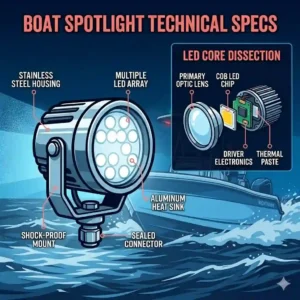
Top 5 boat spotlight Models: 2026 Expert Field Analysis
1. Golight Stryker ST LED — The King of Remote Articulation
The Golight Stryker ST revolutionizes helm control with its wireless, pan-and-tilt remote operation that sweeps 370 degrees in seconds. The standout specification here is its 500,000 candela rating paired with a 5-year UV-resistant ASA plastic housing. In the real world, this means the beam penetrates thick coastal fog without bleaching out the immediate deck area, and the housing won’t turn a brittle, chalky yellow after a single summer in the Florida sun.
In my experience, this is the ultimate unit for center console owners and cruisers who operate solo or short-handed. Being able to manipulate the light with your thumb while keeping one hand on the wheel and the other on the throttle is a massive safety advantage. The spec sheet won’t tell you this, but the smart-pairing remote technology means if you are at a crowded marina, your remote won’t accidentally trigger the boat spotlight on the vessel docked next to you.
Customers consistently praise the smooth motor operation, though some note the installation wiring requires basic electrical knowledge.
-
Pros: Incredible beam penetration, true one-handed remote operation, UV-resistant housing.
-
Cons: Requires drilling for permanent mount, premium price point.
Expect to find this in the mid-to-high $300s range, making it a serious investment, but one that absolutely pays off in safety for dedicated night operators.
2. GOODSMANN Waterproof Marine Spotlight — The Unsinkable Budget Hero
The GOODSMANN Waterproof Marine Spotlight combines a rugged, floating design with a highly visible yellow chassis that refuses to get lost in the dark. Pumping out 3,000 lumens with an IP67 waterproof rating, the real-world application here is incredible: you can literally drop this light into the bay while tossing a dock line, and it will float beam-up, completely undamaged. That IP67 rating means it can survive submersion in one meter of water for 30 minutes, saving you from a costly replacement.
What most buyers overlook about this model is the trigger lock feature. During a 45-minute idle through a no-wake zone, holding a trigger down causes major hand fatigue. The simple physical lock on this unit prevents that completely. I recommend this specifically for Jon boat owners, duck hunters, and weekend anglers. It’s lightweight and forgiving of clumsy handling.
User feedback frequently highlights the impressive battery life for the size, though a few mention the included 12V charging cord is a bit stiff in cold weather.
-
Pros: It floats, high visibility color, lock-on trigger reduces fatigue.
-
Cons: Beam is more flood than spot, bulky storage footprint.
Priced comfortably under $60, this represents the highest return on investment for casual boaters who just need a reliable safety net.
3. Streamlight 44900 Waypoint Spotlight — Tactical Precision on the Water
Streamlight brings their law-enforcement pedigree to the marine world with the Streamlight 44900 Waypoint Spotlight, featuring a parabolic reflector that produces an impossibly tight beam. The standout spec is its C4 LED technology paired with an IPX8 waterproof rating. Practically speaking, this translates to a beam that reaches over 600 meters without spilling light onto your bow railing, eliminating the blinding backscatter that ruins your night vision.
If you are a commercial tender operator, a serious offshore fisherman, or navigating highly technical, debris-filled waters, this is your boat spotlight. The weight distribution is perfectly balanced over the pistol grip, meaning your wrist won’t ache after ten minutes of sweeping the horizon. One insider insight: the integrated kickstand is brilliant for aiming the light at the engine block when doing emergency night maintenance.
Reviews universally applaud the beam distance, while the main criticism is that it uses standard C-cell batteries rather than an integrated rechargeable pack.
-
Pros: Pinpoint beam accuracy, perfectly balanced ergonomics, extreme IPX8 waterproofing.
-
Cons: Requires alkaline C batteries (unless you buy the rechargeable version), no red-light mode.
Floating in the $100-$150 range depending on the exact battery configuration, it is the professional’s choice for handheld reliability.
4. YIERBLUE Rechargeable Marine Spotlight — The Power Bank Hybrid
The YIERBLUE Rechargeable Marine Spotlight is a massive battery wrapped in a flashlight chassis. Boasting an enormous 10,000mAh lithium-ion battery and a double-layer radiator cup, the real-world translation is unmatched thermal management and endurance. The radiator dissipates heat so effectively that the LED doesn’t throttle down, giving you consistent brightness for hours. Furthermore, the battery acts as a power bank, meaning you can plug your dead smartphone or VHF radio directly into the light via USB in an emergency.
I highly advise this for kayak anglers, canoe campers, and inshore boaters who lack an onboard 12V battery system. Because it acts as a standalone power grid, it is an essential piece of ditch-bag gear. However, the IPX4 rating is a compromise. This means it is only splash-proof. I’d strictly avoid saltwater dunking, as water ingress will fry the USB ports.
Customers love the sheer brightness and side-floodlight feature, but dock points for the fragile charging port cover.
-
Pros: Massive battery doubles as power bank, excellent heat dissipation, side-work light feature.
-
Cons: Only IPX4 water resistant, plastic feels a bit hollow.
At a price point typically under $50, it is a phenomenal multi-tool, provided you keep it out of the drink.
5. ACR RCL-95 LED Searchlight — The Luxury Illuminator
The ACR RCL-95 LED Searchlight represents the pinnacle of permanent marine illumination, featuring an intuitive dash-mounted joystick and high-intensity Osram LEDs. Delivering 460,000 candela with an incredibly crisp, white 8-degree beam angle, this unit provides a level of clarity that cheaper LEDs simply cannot replicate. In practice, that 8-degree beam means you are putting intense light exactly on the channel marker half a mile away, rather than lighting up the entire port side of the bay.
This is the definitive choice for yachts, premium sportfishing center consoles, and large cabin cruisers. The spec sheet won’t highlight this, but the auto-return feature is a game changer. When you power the unit down, the head automatically rotates back to its forward-facing home position, ensuring it doesn’t look misaligned or catch excessive wind drag on the highway.
Reviewers consistently note the premium build quality, though the installation process requires routing control cables through the hardtop, which can be tedious.
-
Pros: Crisp Osram LEDs, dash-mounted joystick, auto-return home function.
-
Cons: Complex installation, highest price point on this list.
Falling into the premium category (well over $400), it is a serious capital expenditure, but an absolute necessity for high-end vessels requiring reliable, integrated systems.
✨ Don’t Miss These Exclusive Deals!
🔍 Take your night navigation to the next level with these carefully selected products. Click on any highlighted item to check current pricing and availability. These tools will help you create safe, stress-free boating experiences your family will love!
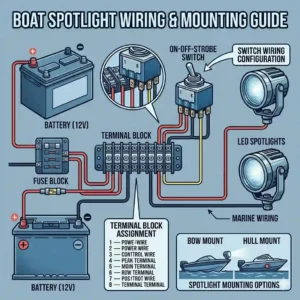
The “Year One” Practical Usage & Maintenance Guide
Owning a boat spotlight is only half the battle; keeping it functioning in a marine environment requires deliberate maintenance. The salt air is aggressive, and ignoring your gear will result in a dead light precisely when you need it most.
The First 30 Days: Setup and Habits
When you first unbox a handheld spotlight, do not immediately throw it in the storage locker. fully charge and discharge the battery twice. This conditions the lithium-ion cells, ensuring maximum capacity. If you purchased a permanent mount model like the Golight Stryker ST, the first 30 days are critical for monitoring vibration. Check the mounting hardware after your first three runs; fiberglass compresses, and nuts can back out under the high-frequency vibration of outboard motors.
Month 6: The Salt Exorcism
By month six, saltwater vapor will have attempted to infiltrate every crevice.
-
Take a Q-tip and apply dielectric grease to all exposed charging ports and USB connections.
-
If your light uses alkaline batteries (like the Streamlight Waypoint), open the compartment and check for acid leaks. The marine environment accelerates battery corrosion.
-
Wash the external lens with fresh water and a mild dish soap—never use Windex or harsh chemicals, as they will degrade the polycarbonate lens and cause it to cloud, severely reducing your beam distance.
Year One: Total Cost of Ownership Realities
After 12 months of daily or weekend use, you will notice battery degradation on cheaper rechargeable models. This is the hidden cost of budget units. A $40 light that requires replacement every year is ultimately more expensive than a $150 light that lasts a decade. Keep your handhelds stored in a padded, dry bag out of direct sunlight to extend their life by years.
Real-World Case Studies: Matching the Light to the Captain
It is incredibly easy to overbuy or under-equip yourself if you don’t match the boat spotlight to your specific navigational reality. Here is how perfect products can fail in edge cases.
Profile A: The Pre-Dawn Flats Fisherman
-
Scenario: Navigating winding, shallow backwaters at 4:00 AM to beat the tide. Minimal chop, but high risk of hitting oyster beds or floating timber.
-
The Perfect Match: The GOODSMANN Marine.
-
Why: You are dealing with short-range obstacles where a wide, bright flood is more useful than a pinpoint laser. Plus, handling rods, cast nets, and coffee means things get dropped. If the light goes overboard, it floats. The premium ACR RCL-95 would actually be a bad fit here, as its tight 8-degree beam might miss a log floating just outside the center of illumination.
Profile B: The Offshore Canyon Runner
-
Scenario: Running 50 miles offshore in a 32-foot center console before sunrise. High speeds, heavy chop, and massive distances between visual markers.
-
The Perfect Match: The Golight Stryker ST.
-
Why: At 40 knots in a heavy swell, you cannot spare a hand to hold a flashlight, and your knees are absorbing shock. You need dash-mounted control. The massive candela rating cuts through the marine layer, allowing you to spot reflective markers from a mile away, giving you the necessary reaction time to adjust course safely.
Problem to Solution: Overcoming Common Marine Lighting Failures
Even the best gear faces operational hurdles. Here are the three most common pain points I see on the water, and how to engineer your way around them.
Problem 1: Blinding Bow Glare (Backscatter)
-
The Issue: You turn on your spotlight, and the brilliant white fiberglass of your boat’s bow reflects the light straight back into your retinas, completely ruining your night vision. You are now driving blind.
-
The Solution: First, mount permanent lights as far forward as possible, ideally on the hardtop leading edge, not set back. Second, if using a handheld like the Streamlight Waypoint, physically step to the gunwale (side of the boat) and hold the light out over the water, past the rub rail. Never shine it from the center console over the bow.
Problem 2: The “Dead When Needed” Battery Syndrome
-
The Issue: You grab your emergency boat spotlight to flag down SeaTow, only to find the battery drained while sitting in the console for three months.
-
The Solution: This is parasitic drain. For rechargeable units like the YIERBLUE, charge them on the 1st of every month, religiously. Better yet, for emergency ditch bags, strictly use lights that take physical CR123A or C-cell alkaline batteries. They have a 10-year shelf life and won’t slowly bleed power while turned off.
Problem 3: Mounting Hardware Failure
-
The Issue: Your expensive remote spotlight cracks the hardtop fiberglass or rips out during a heavy pounding in offshore swells.
-
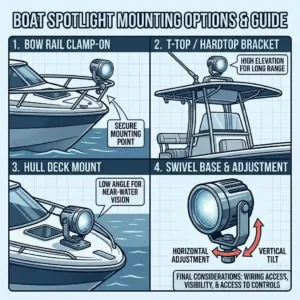
The Solution: Never use standard self-tapping screws for marine electronics. Always through-bolt your mounts using marine-grade 316 stainless steel bolts, wide backing washers (fender washers) to distribute the load, and seal the holes with 3M 4200 marine sealant to prevent water intrusion into the core of your hardtop.
How to Choose a boat spotlight Without Wasting Money
When evaluating a boat spotlight, you need to filter out the marketing noise and focus on the metrics that dictate survival on the water.
1. IP Rating Over Aesthetics
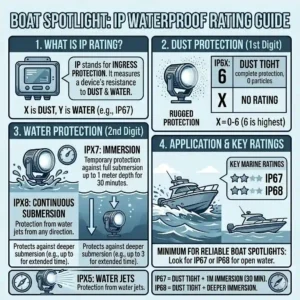
Do not buy a light based on how aggressive or “tactical” it looks. Look strictly at the IP (Ingress Protection) rating. An IPX4 light is splash-proof—fine for a cabin cruiser’s interior. For an open skiff, you need a minimum of IP67, which ensures the unit is totally dust-tight and can survive temporary submersion if dropped over the gunwale.
2. Beam Angle Determines Application
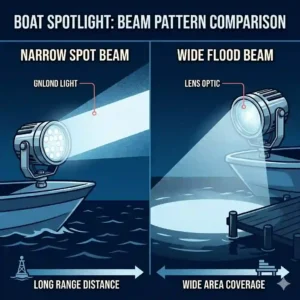
A wide beam (flood) is excellent for docking and illuminating the deck when tying rigs. However, for navigation, a wide beam is terrible. It hits the moisture in the air and creates a white wall of glare. For navigation, you want a tight spot beam (under 10 degrees). This acts like a laser, punching through the fog to illuminate a specific buoy without lighting up the ambient air.
3. Ergonomics and Cold Weather Use
Imagine operating the light at 2:00 AM in November with wet, numb hands, or while wearing thick neoprene gloves. Can you easily locate the switch? Trigger-style lights generally outperform push-button tail-cap lights in cold marine environments because they require less fine motor skill to operate.
The Lumen Lie: Features That Actually Matter on the Water
The lighting industry has conditioned consumers to buy based on “Lumens.” This is the biggest trap in marine outfitting.
Lumens vs. Candela
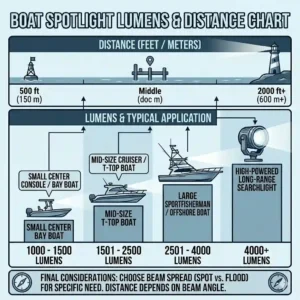
Lumens measure the total amount of light emitted in all directions. You can have a 10,000-lumen light that barely reaches 50 yards because the light is scattered everywhere. Candela measures peak beam intensity—how tightly focused that light is.
When you are on a boat, you need to see a reflective marker 800 yards away. You do not care about lighting up the water right next to the boat. Therefore, a 1,000-lumen light with a highly polished, deep parabolic reflector (high candela) will drastically outperform a 5,000-lumen light with a shallow reflector (low candela). Always search the spec sheet for the Candela rating or the “Beam Throw/Distance” measured in meters. If a manufacturer only lists lumens and refuses to list beam distance, they are selling you a floodlight, not a true boat spotlight.
Furthermore, consider the U.S. Coast Guard Navigation Rules. You are legally prohibited from blinding other vessel operators. A tight beam allows you to sweep for markers without sweeping the helm of an oncoming vessel.
Permanent Mount vs. Handheld: A Tactical Breakdown
The decision between hardwiring a light to your boat or keeping a handheld in the console dictates your entire operational workflow.
The Case for Handhelds
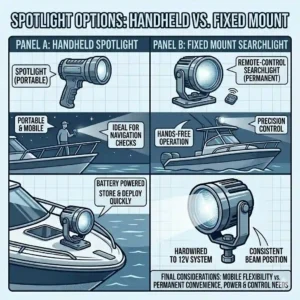
Handhelds offer unmatched versatility. If you need to inspect a prop fouled by a crab trap line, a handheld goes to the stern with you. If you need to signal another vessel, you can manually flash an SOS. They require zero installation, won’t drain your starting battery (if self-powered), and can be moved from boat to boat. However, they tie up one of your hands, which is a major liability in rough seas.
The Case for Permanent Mounts
Units like the ACR RCL-95 integrate into the vessel. They are always charged, always in the same place, and operated with fingertips. This allows the captain to maintain three points of contact (wheel, throttle, deck) during heavy weather. The downside is the heavy upfront cost, the need to drill holes in your fiberglass, and the reality that they only look where the boat is pointed (or where the motor can turn).
For vessels over 25 feet, I strongly advise a hybrid approach: a permanent mount for primary navigation, and a budget-friendly floating handheld kept in the ditch bag for emergencies and deck work.
Long-Term Cost & Saltwater Maintenance Cycles
We need to talk about the Total Cost of Ownership (TCO). The purchase price of marine electronics is merely the entry fee.
If you buy a cheap, non-marinized $30 spotlight, the salt air will corrode the internal contacts within one season. Over five years, you will buy that light five times, spending $150 and experiencing failures while underway.
Conversely, spending $120 on a truly marinized unit with potted electronics (where the internal circuit boards are encased in epoxy) means the light will easily last five to seven years. The TCO is lower, and the reliability is exponentially higher.
When calculating value, factor in battery replacements. If a light uses proprietary lithium packs that cost $60 to replace when they inevitably degrade after 400 charge cycles, that light is expensive to run. Lights that accept standard 12V marine power or universal batteries offer a much better long-term financial footprint. For comprehensive gear protection advice, resources like BoatUS offer excellent guidelines on maintaining marine electronics.
✨ Don’t Miss These Exclusive Deals!
🔍 Ensure your vessel is up to Coast Guard standards. Click on any highlighted item above to check current pricing and read real customer reviews. Equip your boat right the first time!
Conclusion: Making the Right Choice for Your Helm
Equipping your vessel with a proper boat spotlight is not an area where you should cut corners. The difference between an enjoyable sunset cruise and a terrifying, stressful navigation back to the ramp often comes down to your ability to see what is in front of your bow.
If you pilot a larger center console or cruiser and value hands-free safety, investing in the Golight Stryker ST or ACR RCL-95 is a decision you will never regret. For the small skiff operator, the duck hunter, or the weekend angler, the unsinkable utility of the GOODSMANN Marine or the tactical precision of the Streamlight Waypoint will serve you flawlessly without breaking the bank.
Stop relying on the moon and your cell phone flashlight. Assess your boat size, your primary water conditions, and your budget, and choose a tool that is genuinely engineered for the marine environment. Safe travels, and keep your bow pointed toward deep water.
FAQs
❓ What is the best color light for night boating?
✅ Red light is best for preserving your natural night vision at the helm. However, for your primary boat spotlight used for spotting markers or debris, crisp white light (around 5000K-6000K) provides the best contrast and distance penetration…
❓ How many lumens do I need for a marine spotlight?
✅ For marine use, aim for at least 1,000 to 3,000 true lumens. More importantly, ensure the light has a high candela rating or a beam throw of at least 500 meters to effectively spot unlit channel markers…
❓ Can I use a regular flashlight on my boat?
✅ You can, but it is highly discouraged. Regular flashlights lack the IP67 waterproofing required for marine environments, and their beam profiles are usually too wide, causing severe backscatter glare against the water and fog…
❓ Is it illegal to drive a boat with a spotlight on?
✅ In most jurisdictions, it is illegal to operate a vessel with a spotlight continuously illuminated, as it destroys night vision and blinds oncoming traffic. Spotlights should only be used intermittently to identify hazards or navigational aids…
❓ Should I choose a rechargeable or battery-powered spotlight?
✅ It depends on your vessel. If you have a 12V charging port on board, rechargeable is cost-effective. If you have a small skiff or kayak with no power, use replaceable alkaline batteries for guaranteed reliability without a charger…
Recommended for You
- 7 Best D Battery LED Flashlight Models for 2026: Ultimate Reviews!
- ir illuminator Mastery: 5 Dynamic Upgrades for Crystal Clear Security (2026)
- 5 Best search light Models for 2026: Expert Field Tests & Reviews
Disclaimer: This article contains affiliate links. As an Amazon Associate, I earn from qualifying purchases. If you purchase products through these links, we may earn a small commission at no additional cost to you.
✨ Found this helpful? Share it with your friends! 💬🤗
[addtoany]
